
Not all Democrats are ready to jettison big business
Moderate Democrats looking for their party to take back control of the U.S. House in November are offering an alternative to the economic populism message peddled by their more liberal counterparts.
A new blueprint from the center-left New Democrat Coalition, shared exclusively with CNBC, lays out a road map for addressing affordability — top on voters’ minds — without splashy populist promises.
“Buzzy sounds good in a sound bite, but you often end up with unintended consequences or unworkable solutions,” New Democrat Coalition Chair Rep. Brad Schneider, D-Ill., said in an interview. “We’re hearing people saying they are frustrated with the bombast, but also the hollow promises, and they want to see their government coming up with thoughtful solutions.”
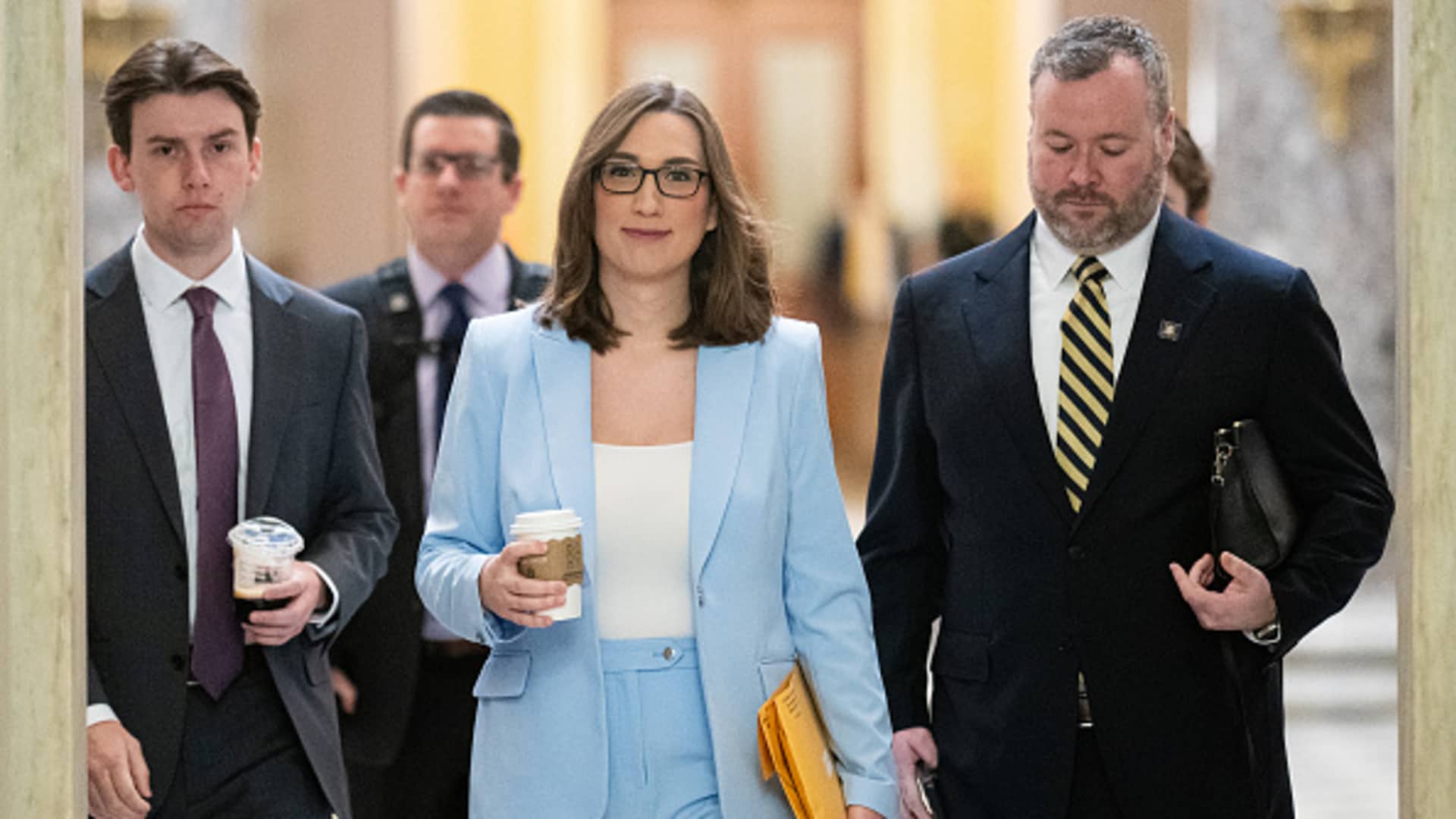
Rep.-elect Sarah McBride, D-Del., and chief of staff Roddy Flynn, right, walk to the U.S. Capitol Rotunda where McBride put on her member pin on Friday morning, January 3, 2025, before being sworn in for the 119th Congress later in the day.
Bill Clark | Cq-roll Call, Inc. | Getty Images
The new plan underscores a tug-of-war within the Democratic Party over its economic message ahead of the pivotal November elections, which could return the party to power after President Donald Trump and his Republicans swept the 2024 elections. And with Trump’s polling on the economy plummeting, picking a winning strategy could be the difference between making the president a lame duck and spending two more years in the political wilderness.
The New Democrats argue Americans want a more moderate approach that bridges the gap between big business and the average voter.
“I reject the idea that business is bad,” said Rep. Chrissy Houlahan, D-Pa., one of the plan’s authors. “This is a set of solutions, tangible, practical, doable solutions, and an answer to ‘what are you going to do when you’re in charge?'”
Among the road map’s proposals are lightening the federal permitting process for energy projects with the aim of lowering utility costs, reducing homebuilding regulations with the goal of getting affordable housing built more quickly, and developing a national strategy for data centers to spread out the “benefits and costs” of the facilities and make sure they don’t “overburden” certain areas.
Absent from the proposal are sweeping new taxes on the wealthy, a cap on credit card interest rates and the creation of a single-payer health-care system, which are popular with prominent progressives like Sen. Elizabeth Warren, D-Mass., and Sen. Bernie Sanders, I-Vt.
They, along with state and local officials like new New York City Mayor Zohran Mamdani, are calling for an ambitious, populist agenda that forsakes the wealthy — a movement that’s gained traction as wealth has consolidated at the top and eats into Trump’s own populist base.
“If there are good ideas that will reduce costs for families, sign me up,” Warren said Tuesday in a brief interview at the Capitol when asked about the New Democrats’ dialed-back approach. “But make no mistake, we need big changes, and that’s bringing down the cost of housing and getting universal child care. That’s what makes a big difference in people’s lives.”
Mamdani notably called for universal child care in New York City during his campaign. The New Democrats instead call for “federal pilot programs that explore cost-sharing partnerships among families, employers, and government to lower monthly child care expenses.”
Ranking member Sen. Elizabeth Warren, D-Mass., talks with the media before Treasury Secretary Scott Bessent testified during the Senate Banking, Housing and Urban Affairs Committee hearing titled “The Financial Stability Oversight Council’s Annual Report to Congress,” in Dirksen building on Thursday, Feb. 5, 2026.
Tom Williams | CQ-Roll Call, Inc. | Getty Images
But the New Democrats, who count 115 U.S. representatives as members, insist their road map is not in conflict with their progressive counterparts.
“I think this is an agenda that can and should unite our caucuses across both chambers and across the ideological spectrum,” said Rep. Sarah McBride, D-Del., a member of both the New Democrat Coalition and the House progressive caucus. “The American people don’t discriminate between progressive versus moderate; they’re looking for solutions that are relevant to them.”
There are some areas where the New Democrats’ road map intersects with progressive goals. The New Democrats are endorsing the creation of a universal paid family and medical leave program. They’re also calling for universal pre-K, a longtime progressive darling priority. And most Democrats agree overturning Trump’s tariffs is a top priority.
Also in the report is a call for eliminating “unfair tax breaks for private equity and large investors” in the real estate market, which is similar to recent progressive calls to bar big financial firms from gobbling up housing that Trump has echoed.
Voters appear mostly dissatisfied with how Trump and congressional Republicans have handled the economy, giving Democrats a leg up going into this year’s elections. Only 36% of Americans approved of the job Trump is doing on the economy in a Marist University poll released Feb. 5, while a whopping 59% disapproved.
Underlying voter dissatisfaction is that 54% of Americans believe lowering prices should be the top priority for the Trump administration, according to the Marist poll.
“For us to get to 218, we’re going to need a lot of progressives elected in districts, and we’re going to need New Dems elected in the toughest districts,” Rep. Greg Stanton, D-Ariz., who runs the NewDem Action Fund, the caucus’ campaign arm, said, referring to the number of House seats a party needs to have the majority. “This is going to be the agenda we run on.”
“We can only win this election if independents and moderate Republicans want change … and that’s where the New Dems come in, we can best appeal to independents and moderate Republicans,” Stanton said.
Whether the strategy works remains to be seen, and Democrats got mixed messages in off-year elections in 2025. In addition to Mamdani winning in New York, Govs. Abigail Spanberger and Mikie Sherrill — both members of the New Democrat Coalition when they were in the House — romped to victories on a more moderate agenda in Virginia and New Jersey. Progressive Analilia Mejia on Tuesday declared victory over more moderate former Rep. Tom Malinowski in a Democratic primary for Sherrill’s old House seat.
Virginia Democratic gubernatorial candidate Abigail Spanberger joins former President Barack Obama, during a campaign event on Nov. 1, 2025, in Norfolk, Virginia.
Steve Helber | AP Photo
What all four had in common was an election message that was focused on affordability.
Democrats also have the unique challenge of trying to win in disparate districts — Rep. Alexandria Ocasio-Cortez’s New York City district is far different than the red district in northern Maine that Rep. Jared Golden has carried for Democrats since 2018 — meaning voters in congressional races may be influenced more by individual candidates than by a sweeping national plan.
Democrats have taken a commanding 5.2-point lead in the generic ballot, according to the RealClearPolitics polling average, a good sign for them as the election approaches.
Pollsters note the debate between progressives and moderates has been a mainstay of election cycles among Democrats. And they are not sure the individual details of plans will ultimately matter to voters when they go to the polls, so long as Democrats offer an alternative to Trump’s Republicans on affordability.
“The extent to which Democrats release any sort of plan, any sort of messaging on affordability, I think that’s going to be helpful to them,” said Matt Taglia, senior director of the Emerson College Polling Center.
“They don’t necessarily have to have one or the other, progressive or moderate, but I do think they need to incorporate elements of both pragmatic policies with a populist message to some degree,” Taglia said.
<