
Businesses scramble to reach China’s growing experiences economy
This report is from this week’s CNBC’s The China Connection newsletter, which brings you insights and analysis on what’s driving the world’s second-largest economy. You can subscribe here.
The big story
There’s nothing quite like the holiday rush in China for the Lunar New Year.
The Beijing city streets start emptying out several days in advance as the majority of residents return to their hometowns or travel elsewhere. A quiet calm replaces the normally tense atmosphere of people rushing to work or school.
So where are the locals going? Immersive experiences rank high.
Bookings for theme park hotels nearly doubled from a year ago, while demand for trips with traditional performances and artisanal crafts rose about 40%, according to preliminary figures from Fliggy, a travel platform owned by Alibaba.
“We’ve seen a lot of younger generation doing much more deep dive into the cultural experience, testing local activities in terms of arts in China,” said Kenneth Chow, a principal at consulting firm Oliver Wyman.
Pictured here is the mascot for Chinese video, animation and gaming platform Bilibili as part of a festival ahead of the Lunar New Year in Shanghai, China, on Feb. 7, 2026.
Vcg | Visual China Group | Getty Images
Those are all trends that businesses are trying to capture in an otherwise challenging economic environment.
So far, one thing’s clear from the numbers: people are moving around more in search of new experiences, thanks in part to affordable trains and hotels.
The official holiday runs from Feb. 15 to 23 this year, but China’s broader travel season stretches roughly 40 days, from early February to mid-March. China counts travel in terms of “trips” rather than people, and is predicting records this year: 110 million trips in and out of Beijing alone and a whopping 9.5 billion trips nationwide. That indicates that most of China’s 1.4 billion people will be traveling to more than one city.
H World Group, which operates more than 20 hotel chains in China, said demand is up for both “major transport hubs and leisure-focused cities such as Xishuangbanna,” a remote region on the border with Myanmar and Laos. In addition to lush nature, the region is known for its ancient Dai Buddhist temples, built hundreds of years ago.
Booking site Trip.com shows that more than 800 hotels opened in the region in the last two years, including a Hilton Garden Inn and one of IHG’s new premium “voco” branded spots.
Last year, Xishuangbanna already reported more than 4 million visits and tourism revenue of 5.04 billion ($730 million) yuan during the holiday.
Theme parks push
Entertainment companies are also finding ways to interact with viewers in person.
Ahead of the holiday, video streaming company iQiyi opened its first theme park in Yangzhou, a city just over two hours away from Shanghai by high-speed train. The indoor venue features live theater and interactive virtual reality experiences based on popular shows streamed on iQiyi, sometimes called “China’s Netflix.”
Founder and CEO Yu Gong didn’t shy away from emphasizing the theme park’s importance to his company. “As demand for offline entertainment surges, we see iQiyi Land as a new driver for our long-term growth,” he said in a press release.
It’s a needed boost for iQiyi, which has struggled to retain paying subscribers against competition from short-form videos and shows on other platforms. The Yangzhou theme park opening was also delayed by a few months.
It’s the first theme park by a video streaming company in China. Rivals Tencent, Bilibili and Alibaba-owned Youku have yet to open year-round experiences, but there’s a growing push for events.
Shanghai-based Bilibili’s annual multi-day expo, where characters from its animated shows and games come to life, sold out in seconds.
In an effort to tap into a similar opportunity, Universal Studios Beijing announced plans ahead of the Lunar New Year to incorporate themes from a major Chinese animated film, a video game and other locally popular characters into upcoming visitor activities — not just for the holiday but the coming weeks.
Even Pop Mart, the toy maker behind the Labubu dolls, also operates a theme park in Beijing.
Tepid market
All these come against a pullback in overall consumer spending. Retail sales in China grew by just 0.9% in December from a year ago.
That hasn’t stopped Louis Vuitton from opening two new stores in the last 12 months — with a clear emphasis on cultivating a shareable experience. The European luxury giant has used celebrities to generate buzz about the brand, while opening a cafe and using iconic store architecture to generate buzz on social media.
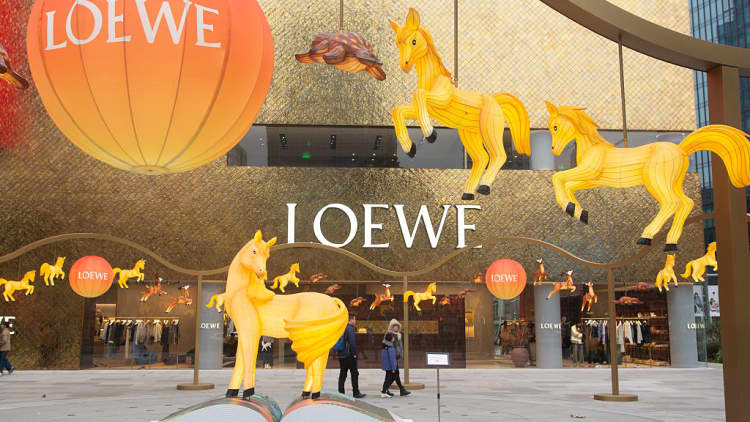
Shopping malls are also full of luxury brands showing off clothes and jewelry designed with the theme of the upcoming year’s Chinese zodiac symbol — a horse.
But what more and more consumers in China clearly will pay for is an emotionally rich journey to a new destination. That’s something businesses will need to adjust to.
Top TV picks on CNBC

The Lunar New Year is a big spending holiday in China, and luxury brands are using the festival to connect with customers.

Stephen Chang, portfolio manager at PIMCO, explained why investors should remain focused on higher-quality credit issuers in China. He also discussed his expectations for the Chinese yuan.
Need to know
In the markets
Mainland China and Hong Kong exchanges were closed for the Lunar New Year holiday.
Trading in Hong Kong will resume Feb. 20, while mainland exchanges reopen Feb. 24.
The CSI 300 is down 1.2% year to date, while the Hang Seng Index rose 1.4% across the same period.

The performance of the Shanghai Composite over the past year.
Coming up
Feb. 24: Mainland China stock markets reopen after Lunar New Year holiday
<