
How to trade this Latin American rival to Amazon that reports earnings Tuesday
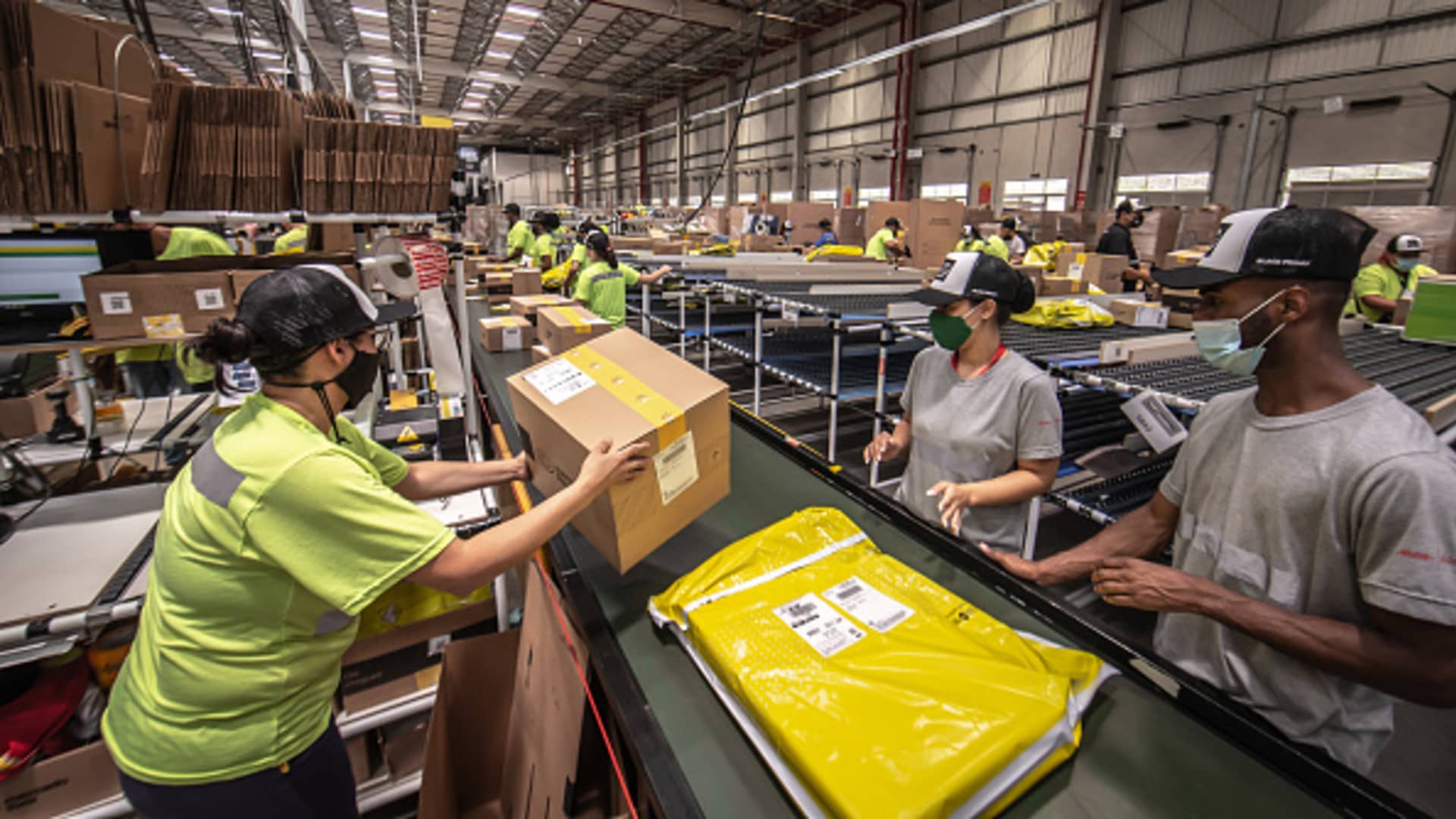
MercadoLibre stands as the preeminent e-commerce and fintech ecosystem in Latin America. Headquartered in Uruguay and operating across 18 countries, the company functions as the region’s leading online marketplace, integrated payments platform (Mercado Pago), logistics network and advertising solutions provider. Serving more than 94 million users, MercadoLibre drives the shift from offline to digital commerce and finance, with its fintech segment now accounting for a growing share of revenue through payments processing, credit offerings and digital wallets. Recent performance underscores this optimism: third-quarter 2025 revenue reached roughly $7.41 billion, a 39% year-over-year increase, supported by record buyer activity and fintech total payment volume growth of over 40%. Street consensus (the average of the full-year estimates from sell-side analysts) is that MercadoLibre will do about $28.6 billion in revenue in 2025. We’ll learn on Tuesday (when the company reports its Q4 2025 results) whether they achieve this. The fly in the ointment is that operating expenses have grown faster than revenues, resulting in ~200 basis points of margin compression. This followed a 250-basis-point compression in margins between fiscal years 2023 and 2024. Growth runway Top-line growth shouldn’t be hard for MercadoLibre to achieve, as E-commerce penetration in Latin America remains well below developed-market levels, offering a significant growth runway. MercadoLibre’s vertically integrated model generates powerful network effects, high switching costs and data-driven efficiencies across commerce, payments, and logistics. Strategic investments in last-mile delivery, free-shipping programs and credit products are deepening user engagement while defending market share against regional and global competitors. If the company hits Street expectations and consensus estimates for FY 2026 adjusted EPS of just under $60 per share remain intact, MercadoLibre is trading at a very reasonable 33x forward earnings, given its 30%+ annual growth rate. Consider that one might view the company as a South American upstart competitor to Amazon.com . However, the company has not been trading particularly well from a technical perspective. It remains well below the 50-, 100- and 200-day moving averages. The relative strength index (RSI) is just 42. The stock is actually trading at the same level it was in January 2021, despite growing revenues fourfold over the past five years. Interestingly, the stock hasn’t moved that sharply over the past four quarterly earnings releases. Last February, the stock rallied about 7% following an impressive earnings beat, and a similar amount when it reported in May 2025, on a more modest earnings beat, whereas the last two quarterly earnings releases in August of 2025 and October saw moves of less than 3%, likely because reported earnings missed estimates by about 15% each time. Conflicted investors It seems investors are conflicted — impressed by the topline growth, but subdued by the rising operating expenses. MercadoLibre is an expensive stock, nearly $2,000 per share, and because options contracts represent 100 shares each, the contracts are similarly expensive. Consider that a single April 2050 call contract is in the neighborhood of $125/contract, or $12,500 including the multiplier! An April 1800/2050/2220 call spread risk reversal creates asymmetric upside/downside participation in the event that MELI moves 10% or so in either direction in the month following earnings. Looking back over the past 44 reported quarters, trade would have won half the time and lost half the time, but the average win was ~7.2%, whereas the average loss was ~6%, meaning the average 30-day return for a trade like this one is ~2.4%. The upside participation is capped, of course, because one is long a call spread, but the downside risk is potentially larger if the stock is particularly hard hit following earnings. For example, back in Q3 2021, the stock fell more than 32% in the month following earnings, a call spread risk reversal of similar moneyness would have lost 22.5% of the stock price — translated to today’s prices, that would work out to a loss of nearly $45,000 per spread. One may gain a better understanding of how call spread risk reversals work by examining the histogram of returns for the past 11 years below. Notice that gains are capped at +8.5%, but the downside is roughly 90% of the current stock price (the short strike of 1800 vs the current stock price of nearly 2,000). However, the risk of the stock going to zero within the next 45 days or so is very low indeed. In any case, that is still somewhat less risk than buying the shares outright. Trading MercadoLibre options isn’t for everybody due to the high share price. However, for those with sufficient capital, zero-cost call spread risk reversals have historically offered attractive returns through earnings in the name. DISCLOSURES: All opinions expressed by the CNBC Pro contributors are solely their opinions and do not reflect the opinions of CNBC, or its parent company or affiliates, and may have been previously disseminated by them on television, radio, internet or another medium. THE ABOVE CONTENT IS SUBJECT TO OUR TERMS AND CONDITIONS AND PRIVACY POLICY . THIS CONTENT IS PROVIDED FOR INFORMATIONAL PURPOSES ONLY AND DOES NOT CONSTITUTE FINANCIAL, INVESTMENT, TAX OR LEGAL ADVICE OR A RECOMMENDATION TO BUY ANY SECURITY OR OTHER FINANCIAL ASSET. THE CONTENT IS GENERAL IN NATURE AND DOES NOT REFLECT ANY INDIVIDUAL’S UNIQUE PERSONAL CIRCUMSTANCES. THE ABOVE CONTENT MIGHT NOT BE SUITABLE FOR YOUR PARTICULAR CIRCUMSTANCES. BEFORE MAKING ANY FINANCIAL DECISIONS, YOU SHOULD STRONGLY CONSIDER SEEKING ADVICE FROM YOUR OWN FINANCIAL OR INVESTMENT ADVISOR. Click here for the full disclaimer.
<