
As AI shockwaves hit global software firms, what’s in store for India’s IT titans?
Ai trading concepts. 3D render
Blackjack3d | E+ | Getty Images
This report is from this week’s CNBC’s “Inside India” newsletter which brings you timely, insightful news and market commentary on the emerging powerhouse. Subscribe here.
The big story
Indian IT stocks are facing their steepest monthly declines since the 2008 global financial crisis, with the Nifty IT Index on track to drop 20% this month, as concerns over AI-led disruption pressure software stocks globally.
At the mega India AI summit last week, major tech companies announced tie-ups with leading Indian IT services firms to drive AI adoption across enterprises. India’s largest and the world’s second largest IT services company, Tata Consultancy Services, tied up with OpenAI, while Infosys partnered with the ChatGPT maker’s rival Anthropic.
These tie-ups did little to cheer the markets with the Nifty IT index down 19.6% so far this month as investor concerns over the impact of rapid artificial intelligence advancements on the sector has dampened sentiment.
Indian IT industry leaders, however, have called AI implementation a “big opportunity.”
“We are confident AI will strengthen growth across our business and unlock the next phase of opportunity for the broader IT ecosystem,” Sham Arora, chief technology officer at Tech Mahindra told CNBC.
But unlike the U.S., where the debate is still on between AI fears being “illogical” and a possible collapse of companies offering software as a service, or SaaS, experts told me that AI won’t make Indian firms offering IT services irrelevant. It will, however, shrink their margins.
Biswajit Maity, senior principal analyst at Gartner, told me that traditional IT services companies such as TCS, Infosys, Wipro and Accenture will play a “pivotal role in enterprise AI adoption” by leveraging their client relationships and domain expertise in integrating AI solutions.
Nvidia CEO Jensen Huang on Thursday also attempted to play down AI concerns, suggesting that markets have miscalculated the threat to software companies.
But to remain relevant, Indian IT services companies need to invest in talent and proprietary platforms, develop industry-specific AI solutions and co-innovate with clients, among other things, Maity said. And while some of that work is underway, the efforts are unlikely to protect margins of Indian IT companies, Maity and other experts forecast.
The pricing pressure
Indian IT companies collectively control over one‑third of global IT services brand value, export technology services estimated at more than $220 billion annually, and dominate the global outsourcing landscape, making them critical for the world’s digital infrastructure.
But the business models of Indian IT companies are dependent on labor arbitrage, and with the advancement of AI this will soon be replaced by technology arbitrage, said Maity.
Indian IT companies get a majority of their revenue from helping enterprises with integration of IT services and digital transformation, and not SaaS. This makes AI an immediate business opportunity, but a long-term challenge.
Enterprises cannot “suddenly move away” from the services that are being provided by Infosys or TCS and “move into Anthropic” straightaway, Manishi Raychaudhuri, CEO of Asia-Pacific focused financial advisory firm Emmer Capital Partners, told CNBC’s “Inside India” on Monday.
But he added that clients are asking IT companies to incorporate AI agents in their services, which means that pricing would take a hit and so would the valuations of these companies.
AI will also transform the business mix of IT service companies.
A report by global brokerage firm Jefferies on Sunday said that AI could shrink the managed services business, which accounts for 22%-45% of revenues of leading Indian IT companies. This will increase cyclicality and require a change in talent and operating model — adding more risks, it said.
Managed IT services refers to IT companies handling the day-to-day management of IT needs of enterprises to provide support services, while consulting is a more cyclical business.
Jefferies said that stock performance of IT companies will “more likely” be tied to the longer-term business outlook rather than earnings delivery in the near term.
Indian IT firms play a pivotal role in enabling AI adoption by enterprises, an area where spending is projected to rise sharply, according to Gartner. It has estimated agentic AI software spending will reach $985 billion by 2030, growing at a compound annual growth rate of 62.7% from 2025 to 2030 as enterprises scale adoption.
Jefferies, however, has cut price targets on Indian IT companies by up to 33% and downgraded most large firms to either hold or underperform.
Investors seem to side with Jefferies’ assessment and appear unconvinced that AI will benefit IT services companies. With two more trading sessions to go, this month could go down as the worst for Indian IT stocks nearly two decades.
Top TV picks on CNBC

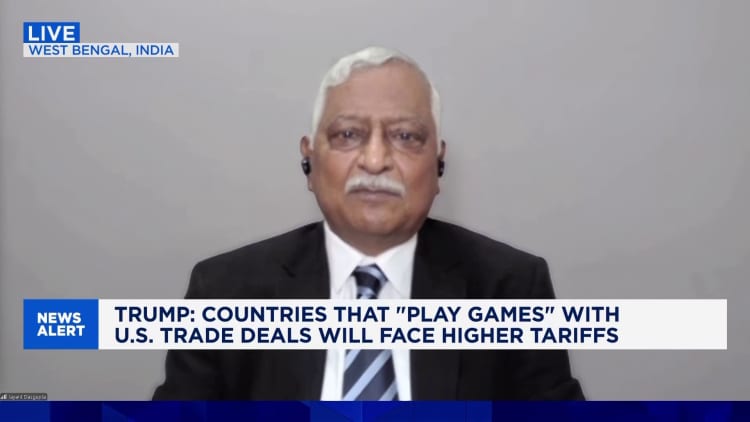
Jayant Dasgupta, former Indian ambassador to the World Trade Organization, said India would be within its rights to withdraw the tariff concessions it had extended to the U.S., as one side has altered tariff rates, effectively reopening the agreement for negotiation.

Santhosh Viswanathan, managing director of Intel India, said in the company was in the country for the “long haul,” and was supporting New Delhi’s semiconductor manufacturing and AI ambitions.

Payal Kanwar, director general of the Indo French Chamber of Commerce and Industry, said that India’s deepening ties with France will help improve its defense ecosystem.
Need to know
India likely to continue buying Russian oil. India will likely continue buying Russian oil as the U.S. Supreme Court’s verdict outlawing President Donald Trump’s import tariffs has constrained his trade policy options, analysts said.
Indian trade negotiators delay U.S. visit. India’s trade negotiators will reschedule their planned visit to Washington, D.C., aimed at firming up an interim trade deal with the U.S., a person familiar with the development told CNBC.
India launches federal government-backed taxi service: Challenging the dominance of American giant Uber, the Indian government has launched taxi-hailing service, Bharat Taxi, which will give drivers a share of profits from the business and charge no commissions.
Quote of the week
In many ways, India’s relationship with Russia is beyond just oil. It is a strategic partnership, and India would not like to pull back on it beyond a point.
— Sarang Shidore, director of Global South Program at Quincy Institute
In the markets
Indian stocks were flat amid regional gains, buoyed by a tech stock rally after Nvidia CEO Jensen Huang said that markets had miscalculated the AI threat to software companies.
In what he described as “counterintuitive,” Huang said that AI agents won’t replace these software tools, but will use them instead.
The Nifty 50 is down nearly 3% so far this year.
Yield on 10-year Indian government bonds was up 1 basis point to 6.685%, while the rupee was trading flat at 90.87 against the U.S. dollar.

Coming up
Feb. 27 – March 2: Canada Prime Minister Mark Carney visits India
Feb. 27: GDP data for quarter ending December 2025
Feb. 28: Industrial output data for January
Each weekday, CNBC’s “Inside India” news show gives you news and market commentary on the emerging powerhouse businesses, and the people behind its rise. Livestream the show on YouTube and catch highlights here.
SHOWTIMES:
U.S.: Sunday-Thursday, 23:00-0000 ET
Asia: Monday-Friday, 11:00-12:00 SIN/HK, 08:30-09:30 India
Europe: Monday-Friday, 0500-06:00 CET
<