
Get to Know a College Basketball Mid-Major: Conference USA
You know all about the Power 5 conferences in college basketball. You hear about those more than any other, and those groups often dominate the March Madness conversation. There are 26 other conferences out there, however, and our goal is to get you up to speed on the teams, players and fights in the standings to know before the conference tournaments, Selection Sunday and the official start of March Madness.
It’s time for you to get to know a mid-major: this time, it’s Conference USA.
As far as conferences go, Conference USA is relatively new, in that this season marks its entry into its fourth decade. It’s in a state of flux at present, as it had 10 members in 2024-2025, shot up to 12 members for this academic season, and will drop to 11 and then 10 teams in the next two as it loses schools to Mountain West and then the Sun Belt. Those are tomorrow’s problems, though! In 2026, Conference USA is a dozen strong, and any analysis of it should center around that.
Like how, for instance, the conference tournament hasn’t actually changed its format from last year to this one despite the addition of two teams. Rather than including all 12 teams like how all 10 were invited to the Conference USA tournament a year ago, this time, it’s just the top 10 making it, with the bottom two staying home. The top six seeds start out in the quarterfinals, while the other four have to make it through a play-in first round for a chance at the Conference USA championship and the automatic bid that comes with it.
That automatic bid is the only way to get to March Madness, too: none of these teams have pushed the at-large issue, on either the men’s or women’s side, and historically the auto bid was the only one to go around, anyway.
Leaders:
- Points Per Game: Mostapha El Moutaouakkil, Jacksonville State, 19.1
- Rebounds Per Game: Julius Mims, New Mexico State, 8.9
- Assists Per Game: Zach Cleveland, Liberty, 6.9 (T10th in D-I)
- Steals Per Game: Kashie Natt, Sam Houston, 2.1
- Blocks Per Game: Melian Martinez, Louisiana Tech, 1.9
While Liberty has what should be an insurmountable lead in the Conference USA standings at 15-2, there are three games left in the season, so technically the Flames haven’t clinched the top seed yet. They are followed by 12-5 Sam Houston, 10-7 Western Kentucky, 9-8 Kennesaw State, Jacksonville State (JSU) and Louisiana Tech. Middle Tennessee is 8-9 and Missouri State 7-10. After that, you get into failure to qualify for the tourney territory: all three of FIU, New Mexico State and UTEP are 6-11, with Delaware 5-12: two of those teams will play in the Conference USA tourney, and the other two will not.
Liberty and Sam Houston might have a few games between them in the standings, but are 94th and 95th in the NCAA Evaluation Tool. They also have quite the lead on the rest of the bunch: Western Kentucky is the only other Conference USA team in the top 150, with three others in the top 200. Just one, Delaware, is in the bottom-100 in Division I, however — Conference USA might lack any bubble teams, but it also doesn’t have any members on the other extreme.
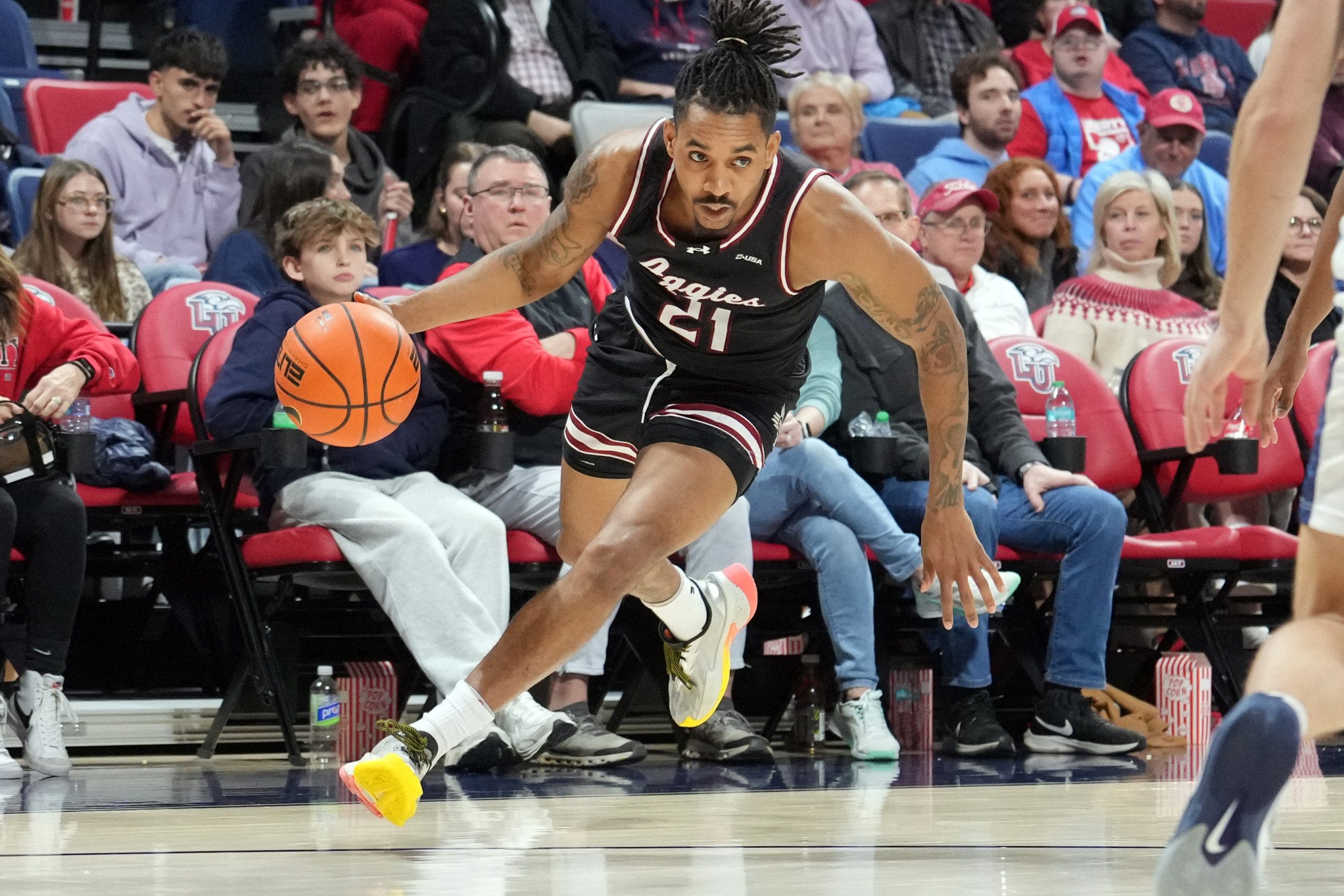
Liberty has been the best in Conference USA, but still needs the automatic bid to March Madness. (Photo by Mitchell Layton/Getty Images)
As said, it’s automatic bid or bust here: Liberty is the top team in Wins Above Bubble, but ranked 62nd there with a score of -1.48 — there just aren’t enough top teams in the conference or even games left for the Flames to push toward a positive score. Sam Houston is even further out of the question, at -4.24, and that’s it for top-100 teams in WAB. So, while one of these two as the conference winner and March Madness representative isn’t a guarantee with some of the clustering of talent going on here, Liberty and Sam Houston are clearly the top options to win it all.
What makes it an open question, even if it’s one where you can lean in the direction of a likely correct answer, is that Liberty just hasn’t dominated despite its record. In conference play, the Flames are scoring 77.6 points per game, but allowing 72.5. And yet, those are good enough rates for the second- and fourth-best in Conference USA, so the competition hasn’t been consistently challenging Liberty here even if there is a clear vulnerability to exploit. Sam Houston has a similar issue, but a little more extreme: it’s first in points per game (79.7), but just eighth in the conference in points allowed (73.8). Both of these teams can score, but never can defend overly much, and it could be their undoing.
Leaders:
- Points Per Game: Kaemyn Bekemeier, Missouri State, 17.4
- Rebounds Per Game: Ify Nwaobi, Liberty, 9.8
- Assists Per Game: Fanta Kone, Sam Houston, 4.7
- Steals Per Game: Fanta Kone, Sam Houston, 3.6 (8th in D-I)
- Blocks Per Game: Rhema Collins, Florida International, 1.6
Louisiana Tech lost its first game in conference play. It has won 14 games in a row since. No one else is even close to it in the standings: Missouri State and FIU are both 10-6, Middle Tennessee and Sam Houston 9-6, then Liberty 9-7. JSU is 7-9, Delaware 6-10 and both UTEP and New Mexico State are 5-10. As of now, Kennesaw State and Western Kentucky are both out of the Conference USA tournament, at 5-11 and 4-11, but the standings at the bottom are bunched up enough that this could change between now and the end of the regular season.
The Bulldogs are fascinating in this conference, as they are just well ahead of the rest. Louisiana Tech is first in points scored per game (70.4) and points allowed (56.3) during conference play, and its season-long figures against all competition are both nearly top-50. It’s first in field goals in Conference USA play despite being fifth in attempts, thanks to shooting 50.9% on 2-pointers and 37.5% from 3 — both tops in the conference. The rebounding is not there, but the Bulldogs average just under 17 assists per game and put themselves in position to make good shots, which has helped — a problem against a better defense and on a night when the shooting goes cold, but this has not been an issue in conference play, at least.
Junior guard Kaemyn Bekemeier has helped Missouri State to second place in the conference and 123rd in NET by leading Conference USA in scoring, at 17.4 points per game. Per Player Efficiency Rating (PER), however, the Bears have a better player on the roster, in sophomore forward Lainie Douglas (2nd in PER, 27.2). The issue is a lack of depth behind this pair: the rest of the bunch does one thing well but nothing spectacularly, while Bekemeier and Douglas combine for 31 points and 14.1 rebounds per game, as well as both being top-10 in PER.
Florida International’s Rhema Collins is tops in the conference in PER, at 28.5. She’s third in Plus/Minus, fourth in Offensive Rating and sixth in Defensive Rating — just a well-rounded player. The problem for the Ole Miss transfer is that, similar to Missouri State, there isn’t anyone who consistently takes over besides her and senior guard Parris Atkins, who is leading the team in scoring at 16.8 points. FIU is fourth in Conference USA in points scored — 64.4 — but mediocre in points allowed, at 62.0.
The team rates much higher in the actual standings than in NET, where the Panthers are 180th overall and sixth in the conference; given the 10-6 record in conference play, though, it’s also clear that FIU can win against CUSA teams, and that’s the only goal for the next couple of weeks.
<