
Why DuPont is proposing a reverse stock split, another Nvidia team up
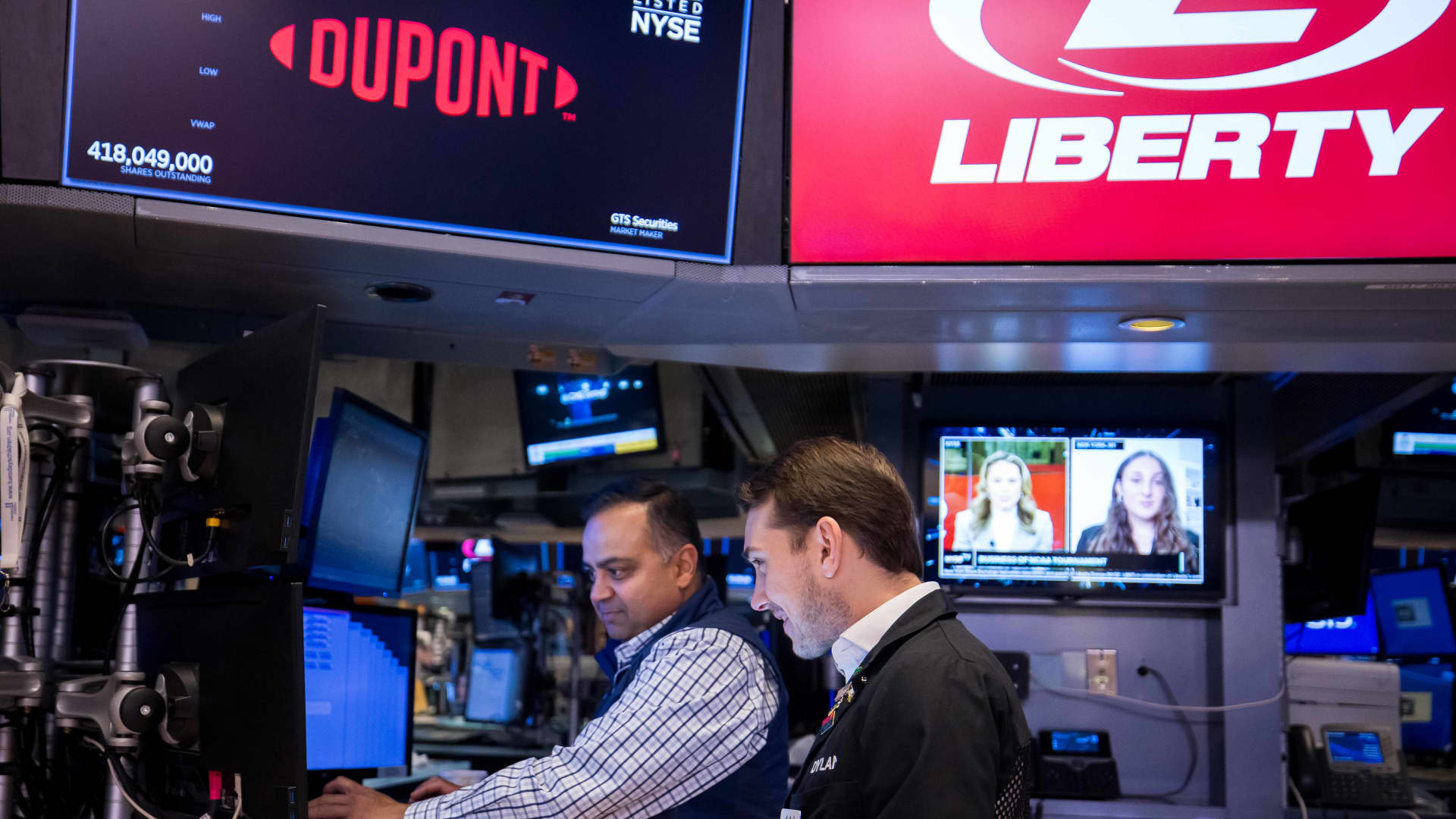
Every weekday, the CNBC Investing Club with Jim Cramer releases the Homestretch — an actionable afternoon update, just in time for the last hour of trading on Wall Street. Stocks are falling for the second session in a row, as the S & P 500 makes a new low for 2026. The drawdown from the record high close on Jan. 27 has now reached roughly 5.75%. Historically, the S & P 500 experiences a 5% pullback a few times per year, but they never feel good while it’s happening. Keeping emotions in check is exactly why we lean on the S & P Oscillator in stretches like this. This technical indicator helps us identify when the market has become oversold and sentiment has turned too negative. The deeply oversold condition is why we’ve been picking at one or two stocks to buy small each day while keeping plenty of dry powder in case geopolitical tensions escalate and push oil prices higher. DuPont is seeking stockholder approval for a reverse stock split in the 1-for-2 to 1-for-4 range, with the exact ratio to be determined by its board, the company announced late Wednesday. You don’t often see reverse stock splits among established companies; typically, they are undertaken by smaller companies whose stock prices have fallen sharply and need to be above a certain threshold to maintain their exchange listing. However, there is some precedent from a fellow industrial that also underwent a significant number of changes. GE did a 1 for 8 reverse split in July 2021. This predated the spinoffs of GE Healthcare and GE Vernova . The company made this move to shrink its roughly 8.8 billion outstanding shares at the time “to levels that are better aligned with companies of GE’s size and scope.” DuPont ended 2025 with roughly 420 million shares outstanding, making this a much different case than GE. We’d like more clarity on why DuPont is pursuing this, but the company has built goodwill with investors over the past six months following the value-creating spinoff of Qnity Electronics . Speaking of Qnity, it’s collaborating with Nvidia to accelerate AI-driven innovation, the company said Wednesday. The two companies are teaming up to advance materials research and development to support next-generation AI, high-performance computing, and advanced packaging technologies. The news isn’t moving the needle for Qnity on Thursday, but it’s incrementally positive to see the company deepen its partnership with Nvidia to support future AI demand. FedEx reports after Thursday’s closing bell , and we’ll be focused on CEO Raj Subramaniam’s commentary on how geopolitical tensions and rising fuel costs are affecting global commerce. There are no major earnings reports or economic data releases on Friday. (See here for a full list of the stocks in Jim Cramer’s Charitable Trust.) As a subscriber to the CNBC Investing Club with Jim Cramer, you will receive a trade alert before Jim makes a trade. Jim waits 45 minutes after sending a trade alert before buying or selling a stock in his charitable trust’s portfolio. If Jim has talked about a stock on CNBC TV, he waits 72 hours after issuing the trade alert before executing the trade. THE ABOVE INVESTING CLUB INFORMATION IS SUBJECT TO OUR TERMS AND CONDITIONS AND PRIVACY POLICY , TOGETHER WITH OUR DISCLAIMER . NO FIDUCIARY OBLIGATION OR DUTY EXISTS, OR IS CREATED, BY VIRTUE OF YOUR RECEIPT OF ANY INFORMATION PROVIDED IN CONNECTION WITH THE INVESTING CLUB. NO SPECIFIC OUTCOME OR PROFIT IS GUARANTEED.
<