India takes a ‘huge hit’ on tax revenue to keep fuel prices from surging during the Iran war
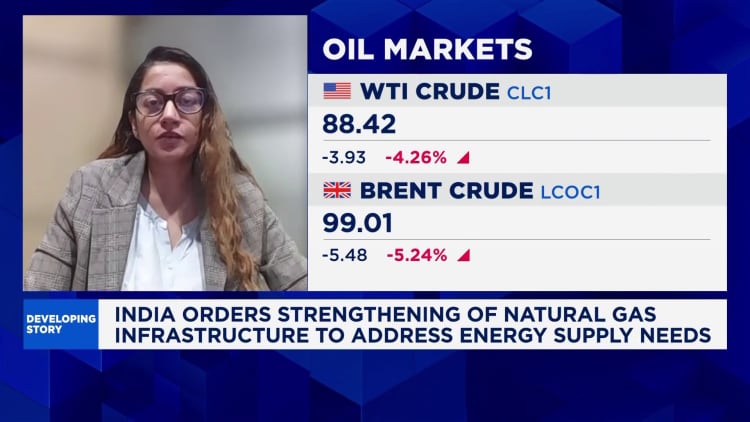
People stand in a queue to refill fuel at a gas station in Guwahati, India, on March 26, 2026.
David Talukdar | Anadolu | Getty Images
The Indian government’s tax revenues have taken a “huge hit” after New Delhi slashed central excise duties on fuel for domestic consumption, Petroleum and Natural Gas Minister Hardeep Singh Puri said Friday.
The Indian government late Thursday cut central excise duties on petrol and diesel for domestic consumption by 10 rupees ($0.11) per liter each, to keep pump prices from rising as the Iran war disrupts global energy supplies.
International crude prices have “gone through the roof” in the last month, from roughly $70 a barrel to around $122, Puri said in a post on X.
The government has decided to bear the cost of rising energy prices and keep retail fuel prices from rising, he said, adding that these tax cuts will reduce the losses faced by oil companies, which stand at around 24 rupees per liter for petrol and 30 rupees per liter of diesel.
According to a government notice, the excise duty for petrol will be reduced to 3 rupees per liter, down from 13 rupees, while diesel will be zero rupees per liter, down from 10 rupees.
As a further safeguard, the government raised duties on diesel exports to 21.5 rupees per liter and on aviation turbine fuel to 29.5 rupees per liter. Finance Minister Nirmala Sitharaman said it was done to “ensure adequate availability of these products for domestic consumption.”
“This will provide protection to consumers from rise in prices,” Sitharaman said in a post on X on Friday.

Oil is a sticky topic
As the world’s third‑largest oil importer and second‑largest liquefied petroleum gas consumer, India is grappling with rising energy costs and panic‑buying amid tightening supplies due to the closure of the Strait of Hormuz.
“The longer the energy supply disruptions persist with oil prices remaining above $100/barrel, the higher the structural risks to the economy, particularly if domestic policy responses are not managed carefully,” said Luchnikava-Schorsch, head of Asia-Pacific Economics, S&P Global Market Intelligence, told CNBC.
If the Indian government raises retail prices of oil and gas, it could lift inflation and temper growth. However, absorbing the higher costs would widen the fiscal deficit.
The impact of the Middle East conflict is already visible in key macroeconomic indicators.
HSBC‘s flash Purchasing Managers’ Index, released Tuesday, showed that India’s private‑sector activity in March slowed to its lowest level since October 2022 due to softer domestic demand.

Subscribe now
Companies surveyed cited the Middle East conflict, unstable market conditions, and intensifying inflationary pressures as factors weighing on growth. Cost inflation is now near a four‑year high.
If oil settles at $85-$95 a barrel after the war, that could lead to incremental outflows of $40 billion to $50 billion — more than 1% of India’s GDP — according to Renaissance Investment Managers CEO and Chief Investment Officer Pankaj Murarka, speaking to CNBC’s “Inside India” on Friday.
This could trim India’s economic growth to 6.5% from from 7.2%, he said.
<