How the trade has fared since ‘liberation day’
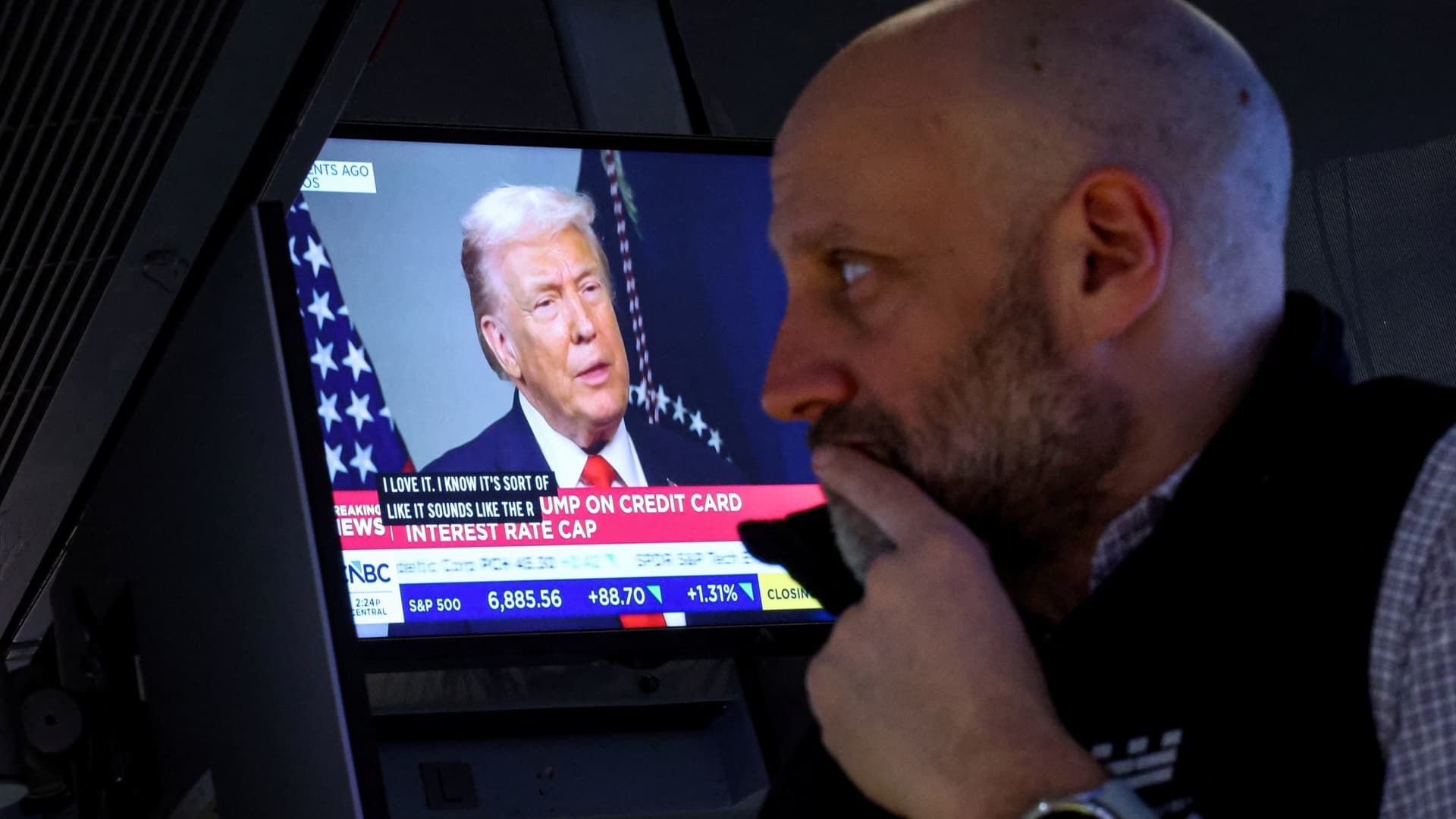
President Donald Trump’s ” liberation day ” didn’t just reshape global trade, it also spawned a new play in the stock market: the “TACO trade.” “Trump Always Chickens Out” was coined as a way to navigate major Trump policy announcements that the markets find hostile. The idea is that Trump often presents an extreme position on policy initially, then after negotiations, ends up in a more palatable place for equities — leading investors to then “buy the dip.” Steve Sosnick, chief strategist at Interactive Brokers, said the trade has had incredible staying power. “That memory of the post-liberation day event. … If you were caught on the wrong side of that 9% rally, you don’t want that to happen again,” he said, referencing the S & P 500’s rebound after its dramatic liberation day sell-off. It’s the reason why he thinks the decline from the U.S.-Iran war has been softer than investors feared. “If there’s a rally, they don’t want to be left behind.” But the returns on the trade haven’t been as strong over time, and data on whether traders are still buying the dips amid the Middle East war is murky. Sosnick said Interactive Brokers’ traders are, but Vanda Research and JPMorgan wrote at the end of March that retail investors — who drove the “TACO” trade — were relatively less active during the month. The original ‘TACO’ Following a more than 12% decline in the S & P 500 on the back of Trump’s “liberation day” tariff announcements, the index surged 9.52% on April 9, 2025 after Trump announced a 90-day pause on his reciprocal levies applied to all countries except China. The surge marked the end of the sell-off that began in late February over uncertainty regarding the president’s trade policy. China ‘TACOs’ The high tariffs on China spooked markets and led the S & P 500 to decline 5.4% over the seven sessions that followed the April 9 bounce. But on April 22 , Treasury Secretary Scott Bessent said the levies on China — then 145% — would not last and that there would be de-escalation with the country on trade. He made similar comments on April 23 , and by April 24 , the S & P 500 jumped 6.3% over three sessions. On May 12 , China and the U.S. officially agreed to suspend tariffs on most goods. The S & P 500 jumped 3.26% on the news. Then, on Oct. 10 , the S & P 500 fell 2.71% after Trump threatened to again hike tariffs on China in reaction to Beijing’s export controls on rare earths. On Oct. 27 , the index jumped 1.23% after Bessent said the two countries had a framework for a truce on trade tensions, which the nations solidified in early November . Greenland ‘TACO’ On Jan. 20 , the S & P 500 dropped 2.06% after Trump threatened to impose tariffs on some countries opposing the sale of Greenland to the U.S. But the following day , Trump reversed course after he said he made a deal on Greenland with NATO Secretary General Mark Rutte and thus would not impose any new tariffs. The S & P 500 rose 1.16% in response, and the “TACO” trade won again as retail investors bought the dip the day before . War ‘TACOs’ After the S & P 500 fell 5.4% from the start of the war in the Middle East, Trump announced on March 23 that the U.S. and Iran held productive talks and he was halting strikes on Iranian power plants and energy infrastructure for five days. The S & P 500 jumped 1.15% in response, though it closed below its session highs. However, on March 26 after the bell — when markets were down 5.8% since the start of the war — he extended that pause to April 6. This time, though, the index fell 1.67% on March 27 . Iran represents a unique moment for the “TACO” trade: Trump alone can’t end the war like he could remove tariffs or back off his Greenland threats. This time, he needs another party, Iran, to agree with him. “These current events stretch the parallels to liberation day,” Sosnick, the strategist, said. “This is a situation that defies an easy conclusion, at least to the same extent as the tariff situation. This is a bell that you can’t easily un-ring.”
<