
Singapore central bank tightens monetary policy as Iran war stokes price risks
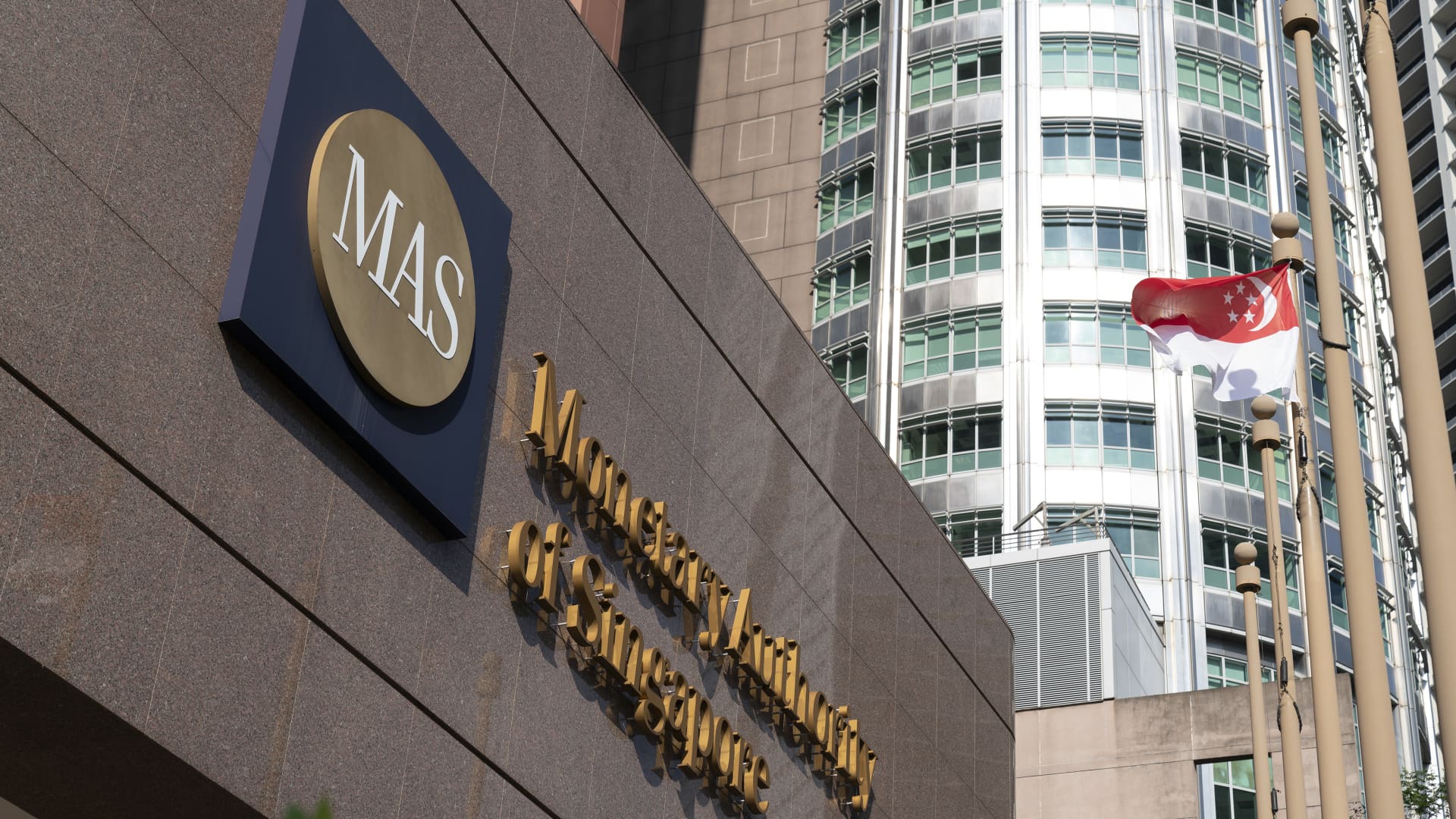
The Monetary Authority of Singapore building in Singapore, on Wednesday, Oct. 27, 2021. The chief of Singapore’s central bank said the city-state is considering new measures that will make it more difficult for retail investors to trade cryptocurrencies at a time when they seem to be “irrationally oblivious” about the risks.
Wei Leng Tay | Bloomberg | Getty Images
Singapore’s central bank tightened its monetary policy settings on Tuesday, flagging the risk that an Iran war-fueled energy shock could push up core inflation even as mounting pressure on growth was underscored by a first-quarter economic contraction.
The Monetary Authority of Singapore (MAS) said it would increase slightly the rate of appreciation of the S$NEER policy band, in line with what most analysts polled by Reuters had expected. MAS said there would be no change to its width and the level at which it is centered.
“GDP growth in the Singapore economy will slow over the course of this year, while the output gap should average around 0%. Singapore’s imported energy costs have already risen. Prices of a wider range of imported goods and services are expected to increase in the quarters ahead,” the MAS said.
Of the 13 analysts polled by Reuters ahead of the review, 11 expected the MAS to tighten policy due to the jump in energy prices after the Middle East war erupted late in February and heightened inflation risks. Two forecast no change.
Sheana Yue, Oxford Economics senior economist, said this was “not yet a severe inflation scenario”.
“The risk is that more persistent cost pressures, particularly via food and wages, could warrant further policy tightening if second-round effects materialize more quickly than expected.”
GDP weaker than expected
The decision came at the same time as preliminary government data released on Tuesday showed the economy grew 4.6% in the first quarter of 2026, weaker than market expectations of a 5.9% pace.
On a quarter-on-quarter seasonally adjusted basis, GDP contracted 0.3% from the fourth quarter of 2025, according to the advance estimates.
Core inflation was 1.4% y/y in February, before the war in the Middle East began. Inflation data for March is due next week.
The trade ministry had previously forecast growth this year at 2% to 4%. MAS said this will be updated in May.
MAS on Tuesday raised core and headline inflation forecasts for 2026 to 1.5%–2.5%, from 1.0%–2.0% previously.
“As higher energy costs pass through supply chains worldwide, a broader range of Singapore’s import costs will increase,” the central bank said.
The government has announced a support package worth almost S$1 billion ($785 million), including cash handouts and fuel vouchers, to counter the economic hit of the war.
The MAS held policy steady at its previous three meetings in January, October and July. It had eased policy last April.
Instead of using interest rates, Singapore manages monetary policy by letting the local dollar rise or fall against the currencies of its main trading partners within an undisclosed trading band, known as the Singapore dollar nominal effective exchange rate, or S$NEER.
It adjusts policy via three levers: the slope, mid-point and width of the policy band.
<