
CB keeps markets guessing on rates, warns of ‘layer cake of shocks’
With less than 2 weeks remaining until the next European Central Bank meeting, the bloc’s policymakers appear undecided on the future of interest rates.
Financial markets are currently pricing in a hold at the April 29-30 meeting, followed by a hike in June, according to LSEG data. The majority of traders expect the ECB’s key interest rate to reach at least 2.5% by the end of the year – a hike of 50 basis points or more from current levels.
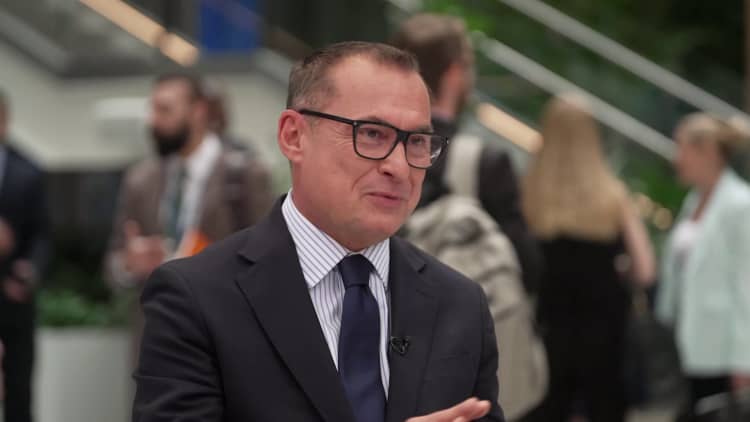
Speaking to CNBC at the IMF’s Spring Meeting in Washington, DC, on Wednesday, Joachim Nagel, president of Germany’s Bundesbank, said oil price volatility had left the ECB “between our baseline and our adverse scenario.”
“The whole situation is very opaque, very cloudy, and in two weeks, we have to decide what is coming next,” he said, adding that “data is coming in on a daily basis in the form of news.”
Questions around the reopening of the Strait of Hormuz are at the center of the uncertainty, Nagel noted, labeling the critical waterway “the heel of the world economic system.”
“If there is more uncertainty coming, that is then also influencing the decision we have to take when we come together in two weeks,” he said. “[A] meeting-to-meeting approach is the right way to do it, and it was the way we did it in the past. It’s becoming even more important in this very complicated day.”

Nagel hinted policymakers were still contemplating the interest rate trajectory.
“It is so important to really wait until we have all the information that is available on the day when we have to take the decision,” he said. “And so this meeting-to-meeting approach is the best way to do or to conduct monetary policy.”
Nagel said inflation was expected to hover around the central bank’s 2% target, but cautioned that lingering uncertainty could force an ECB reaction if prices rise more than expected.
“We have to keep the optionalities in the way we are doing – monetary policy shouldn’t exclude anything,” he said, again pointing to the Strait of Hormuz as the key to decision making.
“We have to be vigilant here … In monetary policy terms, it is still something where we have to look at what is coming in the next two weeks. In two weeks, we can see a lot of new things coming, so I’m really cautious to give a proper indication what is the next step we have to do on the monetary policy side.”
A ‘layer cake’ of shocks
Martins Kazaks, a Latvian central banker who sits on the ECB’s Governing Council, also told CNBC that policymakers were taking a meeting-by-meeting approach. Asked whether April would be too soon to hike rates, he replied: “we’ll see.”
“What do we see in terms of, for instance, intensity of repricing? How does it spill over to other segments of the economy?” he said, noting that core inflation did not inch upward in March for the euro zone.
Kazaks told CNBC that the economic shocks of 2020 and 2022 – when the Covid-19 crisis and Russia’s full-scale invasion of Ukraine shook the global economy – had made central bankers more vigilant, with nobody knowing exactly how the war will end.
“Nobody knows if it will be followed by other shocks, and the issue that we’ve seen in 2020 and 2022 is that when the shocks come … it is like a layer cake,” he said. “Shocks lay on the top of each other, they interplay. They might kick off some non-linearities. And for central bankers, I think it is very important to be watchful and cautious and see what happens with those non-linearities. If they kick in, and I would sometimes call them second round effects, then we need to move.”

Europe is currently in a “comfortable situation,” he added, but Kazaks said officials must monitor data prints as the situation unfolds.
“The markets, for the euro area, expect two hikes, starting with June,” he said. “I don’t have anything against it at the moment. Let’s see how it develops. But of course, at some point we will need to deliver. These non-linearities are certainly the element that we should be very cautiously looking at and, if necessary, acting very quickly.”
At the end of March, ECB President Christine Lagarde said the central bank was ready to hike interest rates, even if an expected rise in inflation proved to be temporary.
If the shock gives rise to a large, though not-too-persistent, overshoot of our [inflation] target, some measured adjustment of policy could be warranted,” Lagarde told an audience at “The ECB and Its Watchers” conference in Frankfurt, Germany.
“To leave such an overshoot entirely unaddressed could pose a communication risk: the public may find it difficult to understand a reaction function that does not react.”
ECB in ‘crisis mode’
Carsten Brzeski, global head of macro research at ING, told CNBC in an email on Thursday that “the ECB’s ‘good place’ is no more.”
“Instead, the ECB is back in crisis mode, shifting its focus away from longer-term projections to actual developments, back to a ‘driving at sight’ approach,” he said.
Key variables to watch, according to Brzeski, include actual inflation data, survey‑based longer‑term inflation expectations, and wage developments, which he said policymakers will weigh the against the risk of slowing economic activity and financial stability concerns.
ING believes the ECB is expecting an initial inflation wave, starting with gasoline prices, followed by knock-on effects for transportation costs, food prices and industrial products.
“As long as this remains a single, time‑limited wave, there is no need for ECB rate hikes,” Brzeski said.
“The longer the blockade of the Strait of Hormuz lasts, the higher the likelihood that some pain points will be hit. This is why we now see the ECB announcing at least one insurance rate hike. Some would go as far as calling it a policy mistake.”
Antonio Alvarenga, a professor of strategy and entrepreneurship at Nova School of Business and Economics, said ECB officials were being more careful and conditional than usual when it came to providing guidance.
“The ECB is heading into the April decision with an unusually wide and contrasted set of plausible scenarios in a context of weak growth in key economies, sticky inflation dynamics, and renewed upside risks to energy prices from Middle East tensions,” he said in an email on Thursday. “In that environment, being very specific can be costly because facts can change quickly before the meeting.”
Alvarenga added that “traditional forward guidance about a likely path has effectively faded,” with the central bank’s policymakers leaning into “reaction function” communication that keeps maximum optionality on the next move.
“[The war] changes what kind of guidance is credible. The best they can do is communicate contingencies: ‘if inflation expectations de-anchor or energy-driven second-round effects build, we respond,’ versus ‘here is the rate path,'” he told CNBC.
“The trade-off for this approach is more market volatility and wider dispersion in expectations. But from the ECB’s perspective, the bigger risk is being boxed into a pre-announced trajectory and then having to reverse it abruptly if the shock evolves.”
<