
Dow CEO says clearing the Strait of Hormuz logjam will take almost a year
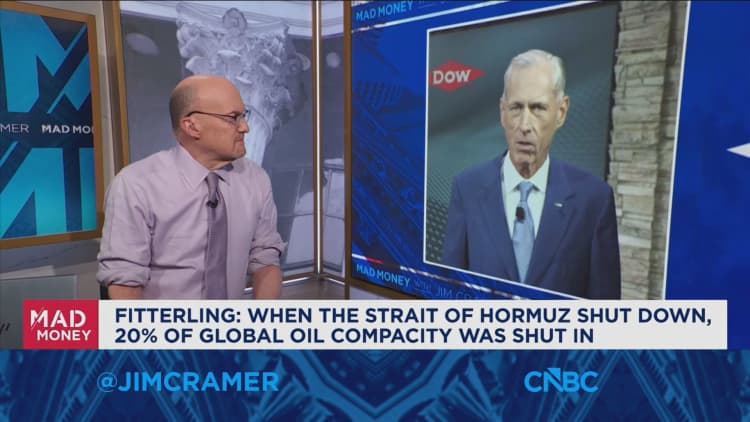

Outgoing Dow CEO Jim Fitterling said clearing the disruption in the Strait of Hormuz could take far longer than investors expect.
“Some scenario planning that we did said that even if the straits were to reopen today, just to clear the logistics logjam… is going to take 275 days, maybe more now,” he told Jim Cramer on CNBC’s “Mad Money” on Thursday.
The Strait of Hormuz effectively shut down in early March at the onset of the Iran war, triggering a major bottleneck in global energy and petrochemical flows. Fitterling said the path back to normal will be slow and operationally complex.
“You’ve got to get empty ships back. We’ve got to clean out the strait and the Arabian Gulf. We’ve got to get empty ships back in,” said Fitterling, who is retiring on July 1 as Dow’s chief executive after an eight-year run. “This is not going to be in a month or two. This is going to be several quarters before you’re going to see things return to normal.”
The initial shock was significant for the petrochemical market, in which Dow is one of the leading players. “When the Strait of Hormuz shut down, 20% of global oil capacity was shut in, but about 50% of global ethylene and polyethylene production was impacted,” Fitterling said, referencing two key inputs used to create plastic products used in everyday life.
He added that the chokepoint is critical to petrochemical supply chains, noting that about 40% of the naphtha used in Asian and European production flows through the strait, tightening supply almost immediately. Derived from crude oil, naphtha is a key ingredient to produce plastics and other chemicals.
That imbalance has driven a sharp pricing surge. “We saw a 10 cent-per-pound increase in March, and we’ve got another 30 cents in April, and another 20 cents out there in May,” he said. “We haven’t seen this kind of an uplift in prices for well more than a decade.”
The pricing tailwind helped support Dow’s latest results, with the company reporting solid revenue and a smaller-than-expected loss in its first-quarter report released April 23. Shares have surged roughly 65% this year.

<