
Euro zone inflation jumps to 3% as economic growth almost stalls
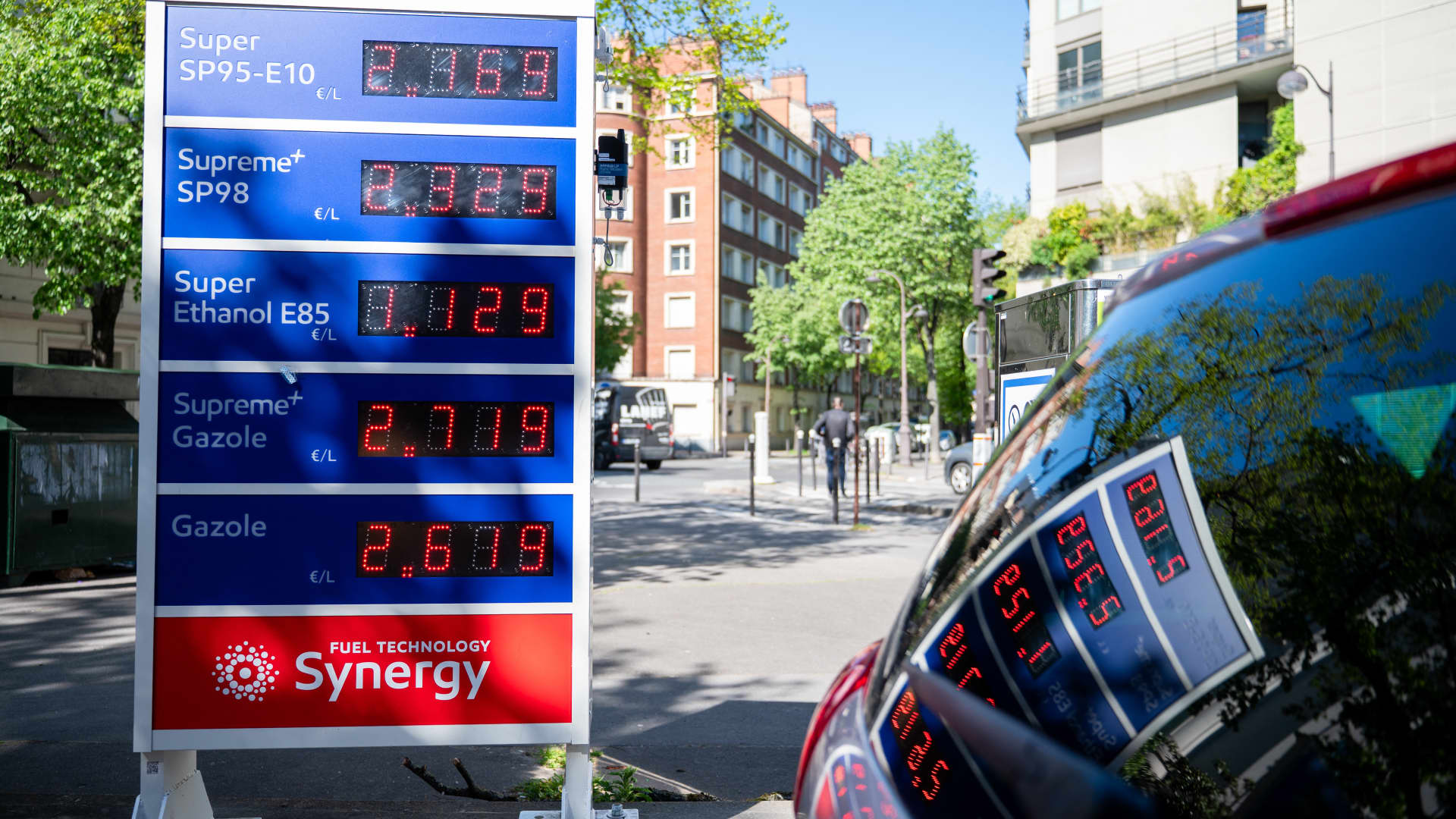
Fuel prices are displayed at a service station in Paris showing high gasoline and diesel costs due to the war in Iran, on April 8, 2026.
Stephane Mouchmouche | Afp | Getty Images
The euro zone economy expanded by a meager 0.1% in the first quarter of the year, preliminary data showed on Thursday, as the Iran war hampers growth in the region and inflation pressures intensify.
The print came as flash data showed consumer prices in the single currency area are creeping higher, with inflation jumping to 3% in April, up from 2.6% in the twelve months to March and from 1.9% the month before that.
The data prints come ahead of the European Central Bank’s next monetary policy decision on Thursday, with the bank’s governing council widely expected to hold its benchmark interest rate at 2% as it gauges how inflationary pressures caused by the Iran war, particularly fuel price rises, play out.
Energy costs drove the latest inflation print higher, statistics agency Eurostat said, up 10.9% compared with 5.1% in March. The region’s inflation rate has now leapt above the central bank’s 2% target, putting pressure on policymakers to consider interest rate hikes.
Economists fear Europe could be facing a period of “stagflation” — low growth, rising inflation and unemployment — as the war prompts a global energy crunch, price rises and dents business and consumer confidence.
Problematically for the ECB, however, efforts to control inflation via interest rate hikes could weigh further on economic activity and consumer confidence. The principal source of current inflationary pressure — higher energy price rises due to the Iran war — is also beyond the bank’s control.
The ongoing blockade of the Strait of Hormuz, the vital oil and gas passage, is a key source of worry for Europe as it scrambles to source oil and gas, and jet fuel, from suppliers outside the Middle East when demand and competition are already heightened.
“The world is a dangerous place. In addition to the Trump tariffs and China’s subsidised export drive, the fallout from the Iran war is now battering European economies,” Berenberg economists warned in emailed analysis last week.
“While the Strait of Hormuz remains largely closed and pervasive uncertainty weighs on confidence, the Eurozone and UK economies will likely suffer a bout of stagflation. Even if the worst of the war is over by the end of April, as we assume for our base-case scenario, growth in Europe this year will fall short of last year’s pace,” they noted, urging the ECB to hold tight on rates for now.
“The outlook thereafter will depend largely on the ECB. In our view, inflation risks are much more subdued than in 2022 … However, if the ECB were to hike rates in response to the temporary spike in inflation, the Eurozone may first fall into an unnecessary mini-recession in late 2026 or early 2027 before the economy can start to recover from that policy mistake. Fingers crossed that the ECB will stay on hold this year,” they concluded.
<