
Meta’s public nuisance case New Mexico has billion-dollar consequences
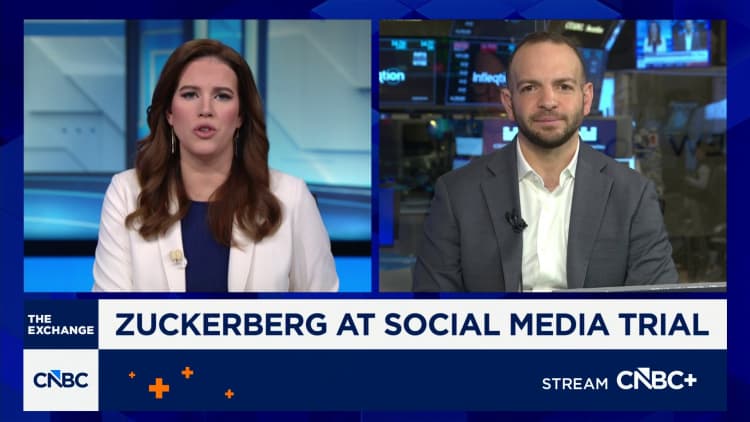
Mark Zuckerberg, CEO of Meta, is seen in the U.S. Capitol after a meeting in the office of Senate Majority Leader John Thune, R-S.D., on Thursday, March 26, 2026.
Tom Williams | CQ-Roll Call, Inc. | Getty Images
Meta is back in a New Mexico courthouse on Monday as part of an ongoing child safety case that could determine whether the company is considered a public nuisance and must spend potentially billions of dollars to fix its products.
The social media company lost the first round of the trial centering on claims brought by New Mexico Attorney General Raúl Torrez that it failed to safeguard children on its apps from sexual predators and misled the public about alleged harms from use of apps like Instagram and Facebook.
A New Mexico jury ruled in March that Meta willfully violated the state’s unfair practices act, and that the company must pay $375 million based on the number of offenses.
The second phase of the proceedings, known as a juryless bench trial, will establish over a three-week period if Meta’s actions created a public nuisance, thus warranting potential product changes.
Meta said in a quarterly filing last week that New Mexico’s AG’s office is seeking “approximately $3.7 billion in abatement costs as well as injunctive relief, which includes requests for extensive changes to the manner in which we provide our services in New Mexico.”
For Meta and its peers, the trial is one of several this year that experts have characterized as social media’s “Big Tobacco” moment. In the 1990s, tobacco companies were forced to pay billions of dollars for misleading the public about the safety and potential harms of their products, and subsequently saw their power and influence dwindle dramatically.
“That was not an instant change, but if one compares the power held by big tobacco companies today, and compares it to the 1980s or even 90s, I mean there’s no comparison,” said Nikolas Guggenberger, an assistant professor at the University of Houston Law Center. “They really just don’t have that position anymore.”
The other major social media trial to have concluded this year took place in Los Angeles in March. Meta and Google’s YouTube service lost a personal injury trial there involving a plaintiff who alleged she became addicted to apps like Instagram and YouTube as a child.

In New Mexico, the AG wants Meta to overhaul its apps by implementing features like effective age-verification technologies, altering recommendation algorithms that don’t compromise child well-being and making other modifications that result in “fundamentally restructuring how Meta is allowed to do business in the state,” Torrez said during a press briefing last week.
Torrez also said the state is asking for an “independent monitor” to ensure that the company adheres with the proposed changes, because “we’ve known now that Meta can’t be trusted to regulate itself, to independently comply and correct its behavior.”
A Meta spokesperson said in a statement that New Mexico’s demands are “technically impractical, impossible for any company to meet and disregard the realities of the internet.”
“While it is not in Meta’s interests to do so, if a workable solution to Attorney General Torrez’s demands is not reached, we may have no choice but to remove access to its platforms for users in New Mexico entirely,” the spokesperson said.
‘First test case’
In the LA trial, jury members found that Meta and YouTube’s negligence was a “substantial factor” in the plaintiff’s severe mental health problems. The companies were ordered to pay a total of $6 million in compensatory and punitive damages, with Meta responsible for 70% of the penalties.
Meta, YouTube, TikTok and Snap are also involved in a major federal trial in the Northern District of California involving similar claims that the companies misled consumers and built defective apps with features that fostered unhealthy and addictive behaviors in teens and children.
That trial, involving hundreds of school districts, is expected to commence on June 15. Plaintiff attorneys will likely be monitoring the New Mexico trial because both cases involve state public nuisance allegations, said Adam Zimmerman, a professor at the University of Southern California Gould School of Law.
“This case will not only determine whether or not there are these big remedies for the state of New Mexico, but it’ll be kind of like the first test case for a theory that all these school districts are relying on in federal court that have been filed around the nation, and they’re all consolidated into one,” Zimmerman said.
New Mexico’s most prominent example of a public nuisance case involved a 2022 opioid crisis-related trial in Santa Fe against Walgreens, James Grayson, the state’s deputy AG, said during last week’s press briefing. The state eventually reached a $500 million settlement with Walgreens.
“That created or laid the groundwork for using public nuisance in this kind of space,” Grayson said. “What we’re really trying to do is show statewide harm and the real impact to New Mexicans with this cause of action.”
Meta called New Mexico’s effort “a misguided strategy that ignores the hundreds of other apps teens use daily.”
“Regardless, we remain committed to providing safe, age-appropriate experiences and have already launched many of the protections the state seeks, including 13 safety measures this past year,” a Meta spokesperson said in an email.
Guggenberger said the challenge for plaintiffs will be to “articulate the harm that’s accruing to third parties” in the state, due to the public nuisance claims. Although public nuisance suits have traditionally stemmed from the physical world, attorneys are now testing this legal approach to the digital realm for the first time, he said.
It’s another attempt by plaintiff lawyers to apply new legal strategies against tech giants like Meta, which many critics say have escaped accountability, largely due to the shield of Section 230 of the Communications Decency Act that protects websites from being sued over third-party content on their respective platforms.
Meta and other social media companies could eventually turn to the Supreme Court if they keep losing trials, Zimmerman said.
The plaintiffs are trying to say “this is not a typical Section 230 case involving content that should or shouldn’t have been taken down,” Zimmerman said. Rather, they’re saying, “this is about the whole system, and the system is like a defective product,” he added.
“And for the social media companies, they’re like, we’re a product that mediates content,” Zimmerman said.
WATCH: Meta shares sink as capex grows: Here’s what investors need to know.

<