Manchester’s Andy Burnham scrutinized as he eyes PM Keir Starmer
Mayor of Greater Manchester Andy Burnham.
Leon Neal | Getty Images News | Getty Images
This report is from this week’s CNBC’s UK Exchange newsletter. Like what you see? You can subscribe here.
The dispatch
My one interview with Andy Burnham should have been during a live outside broadcast at Alliance Manchester Business School.
The Greater Manchester mayor arrived at noon, 90 minutes before the on-air time, which had been agreed well in advance with his PR advisers. They insisted he could not stay for the live broadcast.
After we had recorded a face-saving interview, which went unscreened, Burnham and his gaggle of advisers scurried off and I asked another interviewee if she was surprised by the mayor’s sloppy time-keeping.
“Oh no,” she replied. “Up here, we call him the Late Andy Burnham.”
Those memories returned when, last week, Burnham declared himself a candidate for the forthcoming Makerfield by-election — a contest that, should he win, is likely to be followed by a successful leadership challenge to Prime Minister Keir Starmer.
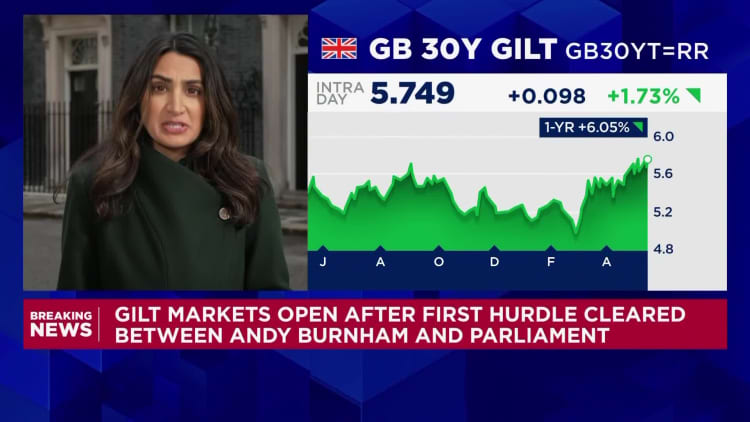
Burnham, who has twice failed to be elected leader of the governing Labour Party, is appreciably to the left of Starmer. Reminders of his injudicious remarks about government borrowing in September last year, when he told the New Statesman, “we’ve got to get beyond this thing of being in hock to the bond market,” last week sparked a sell-off in U.K. government bonds.

His pitch to become Britain’s next prime minister will center on his performance since becoming mayor in 2017.
According to a report published in January by the Greater Manchester Combined Authority, the region’s economy — as measured by Gross Value Added — grew more quickly than that of Britain as a whole in seven of the nine years to 2023, averaging 3.1% growth compared with 1.5% for the country.
Burnham calls his style of economic management “Manchesterism.”
This is not the energetic capitalism that made Manchester wealthy in the 19th century, under the great free traders Richard Cobden and John Bright, but an ambiguous mixture of policies including greater devolution, higher public spending, a more interventionist government and state ownership of services like energy, transport and water.
Where the money would come from to nationalize such assets (United Utilities, the water supplier to Manchester and the wider north west of England, alone has a stock market valuation of £9.5 billion, or around $12.7 billion) remains unexplained.
Building on past success?
Burnham’s template is the Bee Network, a publicly owned travel system with standardized fares, integrating trains, buses, trams and cycle routes.
Yet the most recognisable element, Manchester’s lauded Metrolink tram system, was actually signed off as long ago as 1989 when Margaret Thatcher, the Conservative prime minister Burnham most likes to repudiate, was in office. He can only claim so much credit for its success.
The same, critics say, applies to Manchester’s broader economic achievements, the main architects of which were Richard Leese, Labour leader of Manchester City Council from 1996 to 2021 and the late Howard Bernstein, chief executive of the council from 1998 to 2017. They championed development across the city, including the construction of numerous high-rise towers, landmark buildings like the Manchester Arena and the City of Manchester Stadium (now home to Manchester City FC) and developments such as the Spinningfields business district.
This visionary pair worked tirelessly with talented developers like Tom Bloxham and Carol Ainscow, respectively founders of Urban Splash and Artisan, to regenerate the city centre and bring back residents, particularly after 1996, when an Irish Republican Army (IRA) bomb destroyed the Arndale shopping centre. They were also happy to work with George Osborne, a Conservative chancellor (finance minister) and MP in the north west, who shared their aims.
To Burnham’s credit, he has built on the duo’s success.
However, as British voters learned during former Greater London Mayor Boris Johnson’s premiership from 2019 to 2022, successful regional mayors do not necessarily translate to successful prime ministers.
— Ian King
Need to know
Bank of England does not need to hike interest rates, says IMF — it may even need to cut. The International Monetary Fund upgraded the U.K.’s growth forecast for 2026 and suggested that the central bank should be ready to cut interest rates, if necessary.
Why a small UK lender has major U.S. credit firms on edge. The failure of U.K. specialist lender Market Financial Solutions has left banks and investment firms on both sides of the Atlantic facing potentially hundreds of millions in losses.
Britain’s prospective next PM tries to placate bond markets after sell-off. Bond markets are trying to gauge whether the U.K.’s would-be prime minister, Andy Burnham, could rip up the fiscal rule book.
— Holly Ellyatt
Coming Up
MAY 20: UK inflation rate for April
MAY 21: UK PMI data for May
MAY 22: UK retail sales for April
<