When are prediction markets most helpful? Evercore ISI has a formula
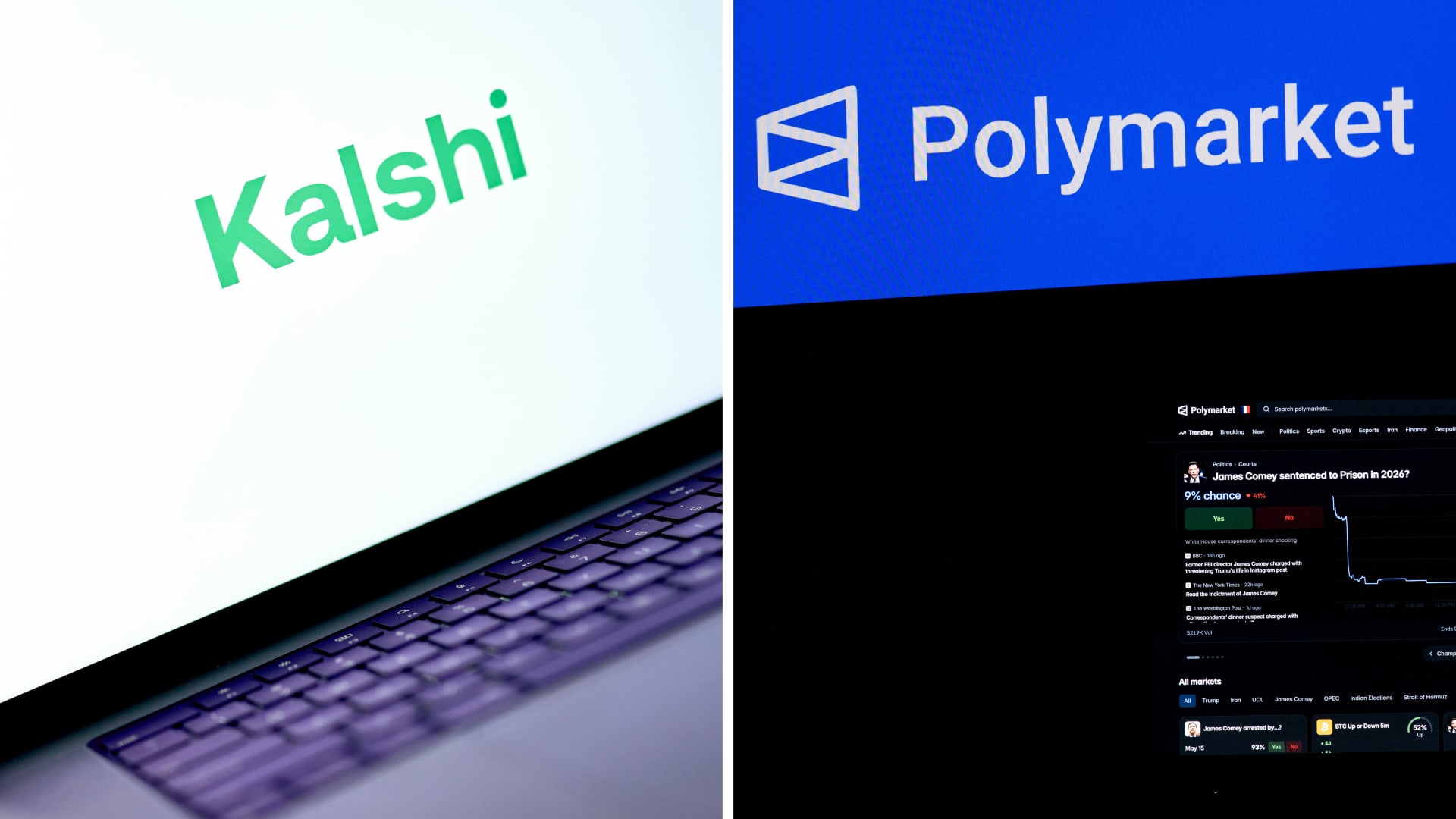
Kalshi and Polymarket.
Gabby Jones | Bloomberg | Martin Lelievre | Getty Images
High volume and short-term markets that ask simple questions with clear resolution rules — that’s the formula Evercore ISI strategists say make prediction markets helpful for forecasting.
Led by Julian Emanuel, they found contracts with higher volume produce more reliable probabilities than shallow markets. Similarly, contracts closer to their termination date showed stronger probability versus a long-term contract.
Despite the growth, they avoided calling prediction markets a north star.
“Their limitation is that they do not discover the future so much as reveal what the crowd believes,” the strategists wrote in a May 17 report.
There’s also another issue: Most contracts have low volume. Evercore found that only about 8% of events on Kalshi and Polymarket clear $1 million in volume.
A similar pattern was found with only live markets as well. As of Friday afternoon, nearly 60% of live markets on Kalshi and Polymarket have less than a $1,000 in trading volume. Only a sliver, roughly 5.3%, have markets with at least $100,000 in trading volume.
Evercore did note, however, that prediction markets thrive in chaotic macro events since it responds to headlines or real life moments compared to traditional forecasting tools that can face “polling errors, expert bias or subjective judgement.” It also helps that a market can penalize participants and can have a mix of macro traders, industry experts and regional participants.
“The resulting price is not a perfect forecast, but it is often a useful expression of the live consensus probability,” the analysts wrote.
But this diversity of traders can also be a hinderance. Everyone’s reasoning to trade stretches from entertainment to hedging, which can “contaminate” the market price, the analysts cautioned. For example, a geopolitical market may be less about forecasting and more so representing a political view or fear.
The strategists also warned a thin market, suddenly being moved by a large trader, can deceive the market’s outcome.
Having markets with an objective outcome rather than an ambiguous one can impact how good prediction markets are at detecting the probability of the event. The strategists said this is especially true for geopolitical reasons.
For example, “will a ceasefire hold?” may be up to interpretation, the analysts shared. When ambiguous contracts resolve, it can focus less on the actual event happening but more on that it fulfills the language.
Markets with simple questions also have their downsides, they said. Since simplified contracts can fail to get the full picture of an actual real life event.
“A binary contract can capture one slice of that uncertainty while leaving out the parts investors actually need,” Evercore wrote.
The strategists said prediction markets skyrocketed because of institutional attention, its infrastructure, contract breadth and the 2024 CFTC decision to approve election-related contracts on Kalshi. Leading prediction market platforms Kalshi and Polymarket saw trading volume growth during the 2024 presidential elections but trading volume skyrocketed in fall 2025.
Disclosure: CNBC and Kalshi have a commercial relationship that includes customer acquisition and a minority investment.
<