
‘No poaching’ our people, China’s DeepSeek reportedly tells investors
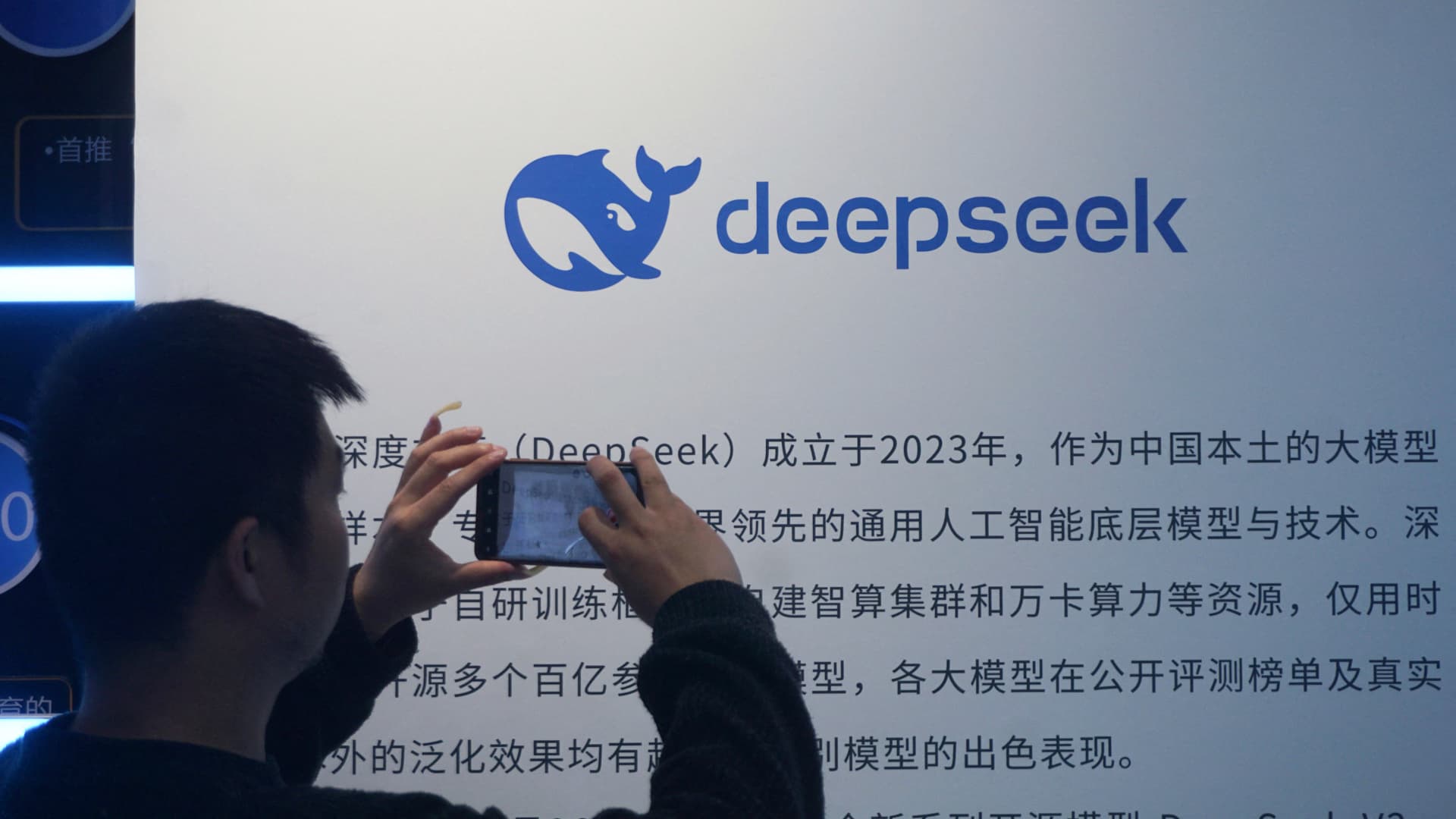
A man takes photos of a DeepSeek display at a shopping mall in Hangzhou, in China’s eastern Zhejiang province on April 23, 2026. Chinese startup DeepSeek released a new artificial intelligence model with “drastically reduced” costs on April 24, more than a year after it stunned the world with a low-cost reasoning model that matched the capabilities of US rivals.
Afp | Getty Images
China’s DeepSeek has a precondition for its $7.4 billion maiden fundraise: no poaching the AI lab’s talents.
During a four-hour virtual meeting with prospective investors in May, founder Liang Wenfeng told participants on the call that a condition of investing in DeepSeek was a promise not to poach the startup’s staff or encourage them to start their own companies, a fundraising-focused news outlet owned by 36Kr reported Wednesday. CNBC couldn’t independently verify the report.
The unusual talent-poaching precondition underscores how the contest among Chinese tech giants to build advanced AI, and eventually AGI, has tipped into open competition for engineers.
DeepSeek reportedly closed its first external funding round this week, which valued the Hangzhou-based company at more than $50 billion and made it China’s most valuable AI-only startup. The startup, which had turned down outside funding since its inception to focus on research instead of commercialization, sought the latest fundraise after losing a number of key researchers to rivals.
Luo Fuli, a core contributor to its V3 model, left late last year to lead Xiaomi’s MiMo team, which has since released AI models that outperformed DeepSeek’s own on several benchmarks.
ByteDance has lost two key AI developers to Tencent, 36kr reported in March, citing sources. The Information reported on Monday, citing sources, that Tencent had invested $20 million in a new AI lab founded by Juyang Lin, former lead researcher for Alibaba’s Qwen models.
Lin said in March he stepped down from Qwen. Alibaba replaced the head of its corporate-focused Dingtalk app after an internal debate about the unit’s role in the company’s overall AI strategy, Bloomberg reported in June, citing sources.
Eyeing talent that trained at frontrunning U.S. labs, Tencent hired Yao Shunyu from OpenAI to become chief AI scientist for the Chinese tech company last year.
Both Yao and DeepSeek’s Liang see China’s path forward in fully committing to developing AGI — AI with human-level or above capabilities.
DeepSeek, Tencent, Alibaba and ByteDance did not immediately respond to requests for comment.
<