
AI layoffs hit U.S. but not China jobs — yet
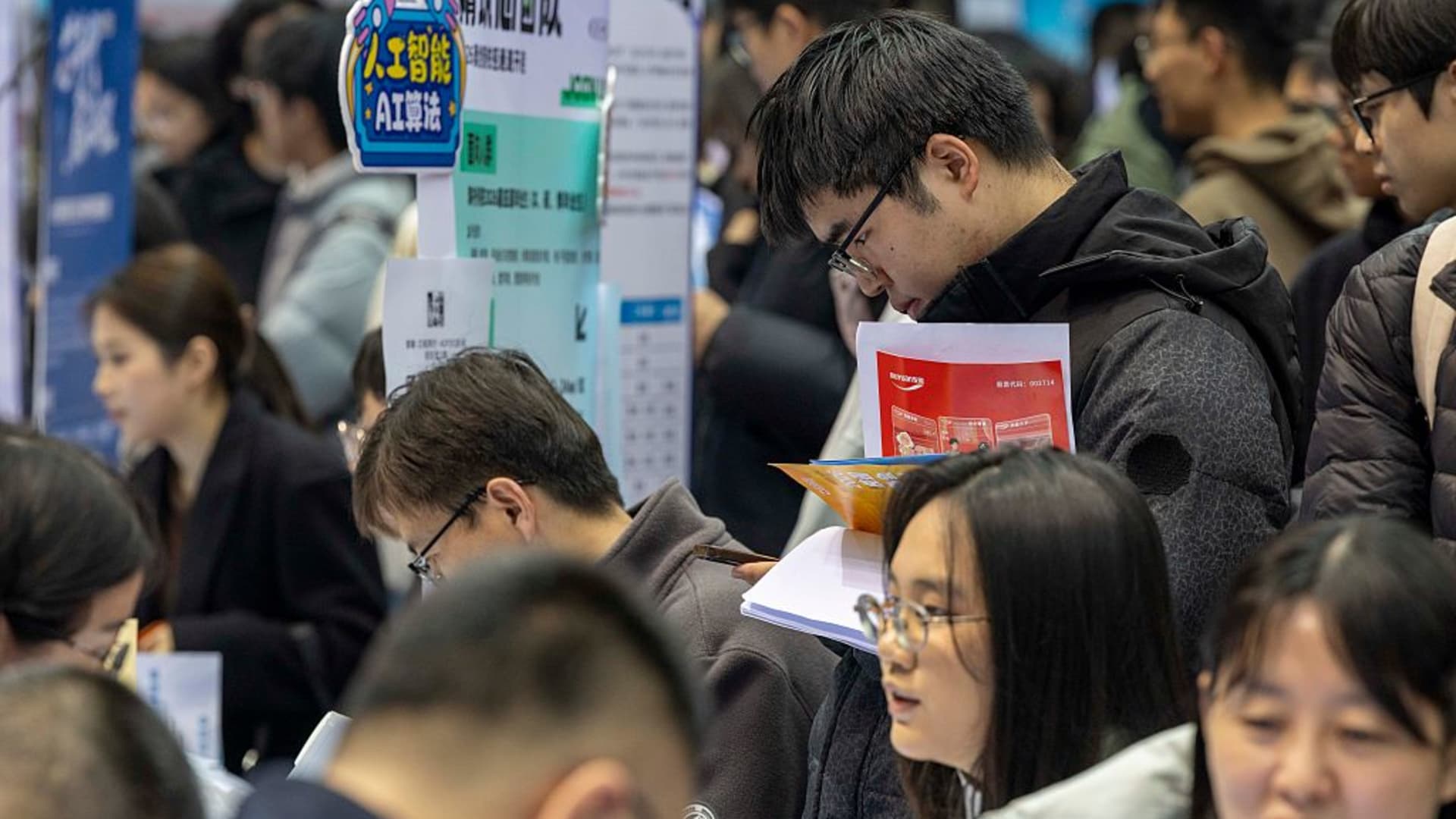
College students look for employment opportunities at the Large-scale Recruitment Fair for Science and Engineering Universities on March 24, 2026 in Harbin, China.
Tyne Chin | Getty Images News | Getty Images
Hi, this is Evelyn, writing to you from Beijing. Welcome to the latest edition of The China Connection — a succinct snapshot of what I’m seeing and hearing from local businesses.
Today, I dive into the AI job market on both sides of the Pacific. While Silicon Valley braces for overnight layoffs, is China faring any better?
The big story
As Oracle becomes the latest U.S. tech giant to undergo massive layoffs, the impact of artificial intelligence on jobs at Chinese companies looks more contained for now.
There are a few underlying reasons, starting with a different government system. Unlike the U.S., Beijing has a national employment goal — a jobless rate of around 5.5% in cities.
On top of that state-directed mandate, lower labor costs in China also mean local companies aren’t laying off as many people as their U.S. peers, according to Alex Lu, founder of LSY Consulting.
The average monthly salary for high-demand algorithm engineers was 20,035 yuan (about $2,900), online jobs platform Zhilian revealed last month.
While considered decent starting pay in China, in U.S. dollar terms, that’s an annual salary of around $35,000 — nearly ten times less than what Silicon Valley offers, albeit with far higher taxes and living costs in the U.S.
A “level 2” software engineer in the U.S. making around $300,000 in base salary would get a 50% pay cut if transferred back to China, according to a human resources manager at a startup in Silicon Valley who previously worked at Baidu and TikTok. She requested anonymity as she was not authorized to speak with media in her current role.
“The two markets are fighting over the same bunch of people,” she said.
But for Chinese nationals in the U.S., sudden layoffs also threaten their immigration status, she said, noting that many engineers are choosing to return to China, as it’s difficult to get another U.S. job in time to maintain residency requirements.
The transition is not always smooth, however. For those who’ve spent more time at U.S. companies, China’s long hours and hyper-competitive environment could come as a shock.
Market differences
While work-from-home policies took off in the U.S. after the pandemic, companies in China tended to require staff to work in the office as much as possible. There’s also a cultural aspect, where many business leaders put more weight on overseeing a large number of in-person teams and assistants.
An engineer at a Chinese company may typically do a wider range of tasks than one at a comparable U.S. tech giant, making the role harder for AI to replace completely, said Tina Zhou, founder of marketing startup Boomfluence.ai. She is based in Beijing and travels to San Francisco around once a quarter.
Zhou added that many Chinese companies also have more employees working on marketing and customer operations — not just engineering.
That’s not to say AI-related layoffs haven’t affected Chinese companies: Alibaba reported a headcount drop of more than 30% that it attributed to business changes meant to prioritize AI efforts.
Tencent, however, disclosed a modest increase in its total employees last year. Huawei said it had 114,000 employees in research and development as of December, up from 113,000 a year earlier.
Current business structures also limit the impact of AI. Companies in China are less digitalized in comparison with the U.S., where enterprise software is more widely used, pointed out LSY’s Lu.
For example, despite OpenClaw’s recent popularity in China, it is a product for individual productivity, rather than being enterprise-grade, he said.
Still, AI remains a hot topic for parents in China who have long been anxious about their children’s education and career success.
Zhang Xuefeng, a widely followed education influencer who died last month, said in a video in December that children as young as the sixth grade should start learning about AI and pay attention to related opportunities in engineering, robotics and chips.
Chinese policymakers also face the task of striking a balance between supporting growth and technological innovation. Youth unemployment has remained in the mid-to-high double-digits for the last few years, despite the broader urban jobless rate hovering around 5%.
Central bank advisor Huang Yiping told reporters Tuesday that China must pursue high-tech development in order to achieve economic growth — and emphasized that any AI innovation should put human needs first.
— CNBC’s Matthew Chin contributed to this report.
Need to know
Oil’s surge prompts Chinese suppliers to raise prices for U.S. customers
Several Chinese exporters told CNBC they will need to raise prices for goods sold in the U.S. due to oil price surges in the wake of the Iran war.
Zhipu AI says revenue doubled last year
Also known as Knowledge Atlas Technology, the Hong Kong-listed company said its revenue last year surged by 132% to 724 million yuan. However, that slightly missed analyst estimates, while Zhipu recorded a net adjusted loss for the year as it spent more on research and development.
Factory activity climbs to one-year high
China’s official gauge for manufacturing activity rose in March to 50.4, the highest level in 12 months and better than analysts’ expectations.
Coming up
April 7 – 12: Taiwan’s opposition party chair to lead delegation to Beijing, Shanghai and Jiangsu
April 10: China CPI, PPI for March
April 13 – 18: Hainan hosts the China International Consumer Products Expo (CICPE)
<