
Beijing’s surprise intervention on Meta’s Manus renews debates on ‘China shedding’
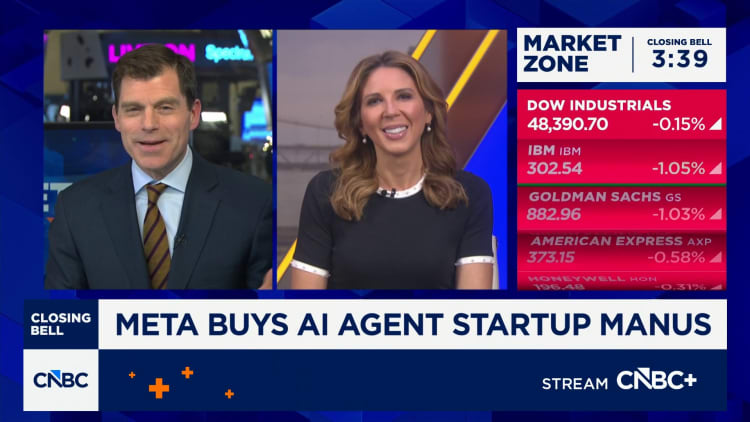
CHONGQING, CHINA – JANUARY 07: In this photo illustration, the Manus logo is displayed on a smartphone screen, with the Chinese national flag visible in the background, on January 7, 2026 in Chongqing, China.
Cheng Xin | Getty Images News | Getty Images
Tech circles from Silicon Valley to Shenzhen buzzed when Meta acquired Manus, a Singaporean AI startup with Chinese roots, for $2 billion late last year.
For Chinese founders striving to build products that could rival American peers, the deal felt like a validation that an intricate offshore structure – known as “Singapore washing” where companies relocate to the city state – was the answer to circumvent scrutiny from both Beijing and Washington.
Within days, China’s surprise intervention on the deal quickly shattered that hope, as Beijing stepped up efforts to discourage Chinese AI founders from moving business offshore.
The Chinese government started reviewing whether Manus’ sale had violated laws governing technology exports and outbound investment, and barred co-founders Xiao Hong and Ji Yichao from leaving China for Singapore, according to a Financial Times report earlier this week.
Founded in China, Manus relocated its headquarters and core teams to Singapore last year, allowing it to access deeper capital pools from foreign investors, including the San Francisco-based venture capital firm Benchmark. The company captivated Silicon Valley with an AI agent capable of building websites and executing basic coding tasks independently.
But that investment drew fire in mid-2025 from lawmakers in the U.S. who have prohibited American investors from backing Chinese AI companies directly.
The broadening review by the Chinese government fueled concerns and confusion among a generation of Chinese tech founders and venture capitalists that had quietly embraced the so-called “Singapore-washing” model, forcing a reckoning as the U.S.-China tech rivalry deepens.
The model that no longer works
“The path taken by Manus: people will not go down that route anymore,” Wayne Shiong, managing partner of Argo Venture Partners, a Silicon Valley-based seed investor in AI.
More founders are now looking to start outside China from “day one,” before any meaningful research and development is done in China, rather than attempting a structural pivot mid-growth, Shiong told CNBC.
“Founders eyeing global expansion and higher valuations would still see the upside of having backers in the U.S.,” Shiong added. Valuations for Chinese AI startups tend to be a fraction of their U.S. peers.
The Manus deal came as the U.S.-China rivalry in the AI space intensified, and the competition has increasingly been defined not just by access to advanced chips but also by the flow of talent and technology.
Yuan Cao, a Beijing-based lawyer at Yingke law firm, said it was “a red flag for Beijing” for companies to develop technology in China in their early days before “transferring assets to an overseas entity through a restructuring.”

In cases like this, “where you build your product matters more than where the holding company is registered,” Cao said.
Matthias Hendrichs, a Singapore-based adviser to global AI firms, said that “‘Singapore-washing,’ or simply setting up a legal entity locally and hiring a handful of local staff, is nowhere near sufficient.”
“The entire team needs to relocate, the customer base must be transitioned, and early Chinese investors will typically need to exit their positions,” Hendrichs said.
The Manus deal also served as a wake-up call for tech investors betting that offshore structures can protect promising Chinese startups from Beijing’s reach.
Chinese authorities would “look past the Singaporean facade and dig into the root of the company, including the codes, data and talents,” said Alex Ma, managing partner at Singapore-based family office Alpha Omega Holdings.
But Beijing also may not want to “over-punish success” as it would discourage founders and distort incentives,” said Ma, who remained positive that companies would continue to find new compliance pathways in the wake of the Manus episode.
What’s next?
It remains unclear what further action the Chinese government will take in addition to the exit bans on the founders, and whether it will order Meta-Manus to unwind the transaction.
While Beijing pressed ahead with its review, the deal was completed with more than 100 Manus employees having moved into Meta’s Singapore office in early March, according to people familiar with the matter.
In an emailed response to CNBC, a Meta spokesperson said “the transaction complied fully with applicable law. We anticipate an appropriate resolution to the inquiry.” China’s Foreign Ministry, Chinese Embassy in Singapore, and Manus did not respond to requests for comment.
Should Beijing want to unwind the deal, it would be “very tricky” for Meta as the U.S. tech giant rushed to integrate Manus amid cutthroat competition in the space, said Hendrichs.
Even for startups incorporated outside China from inception, Beijing’s action has added another layer of uncertainty to an already opaque regulatory system.

Among the unanswered gray areas was whether outsourcing work to China-based teams constitutes a technology export violation. Outsourcing has been common among overseas Chinese tech founders, for benefits including cost savings and tapping into the country’s deep and affordable technical talent pool.
China’s cyberspace regulator has raced to regulate the rapidly growing field in recent years, but struggled to stay ahead of a technology that is advancing faster than the rules designed to govern it.
Sometimes clarity arrives only when a case becomes prominent enough to prompt the government’s attention, said Allen Wang, co-founder of Cognitio Labs, a Singapore-based AI startup. The Chinese founder started the company earlier this year in Singapore after residing in the city-state for over 10 years.
When asked about whether outsourcing to China would be an option for his company, Wang was direct: “you never know until you get big enough.”
<