
Berkshire Hathaway filing provides glimpse of share buyback resumption
(This is the Warren Buffett Watch newsletter, news and analysis on all things Warren Buffett and Berkshire Hathaway. You can sign up here to receive it every Friday evening in your inbox.)
Berkshire Hathaway filed its definitive proxy statement with the SEC late this afternoon ahead of the company’s annual shareholders meeting on May 2 in Omaha.
It shows Berkshire bought back the equivalent of 309 Class A shares, roughly $226 million worth, on March 4, the day it resumed repurchases for the first time since May 2024. That’s based on the number of outstanding shares as of March 4, the record date of the annual meeting, as shown in the proxy statement.
The company disclosed the resumption in a March 5 SEC filing “in the interest of transparency with our leadership transition” but provided no details. New CEO Greg Abel told CNBC last week there won’t be any future buyback announcements, except for what’s in its regular quarterly financial reports.
Warren Buffett speaks during the Berkshire Hathaway Annual Shareholders Meeting in Omaha, Nebraska on May 3, 2025.
CNBC
According to the proxy document, Warren Buffett’s total annual compensation last year declined to $389,488 from $405,111 in 2024. That’s a drop of close to 4%. It’s entirely due to a reduction in the amount Berkshire paid for Buffett’s personal and home security services. His salary each year was $100,000, as it has been for decades.
New CEO Greg Abel’s salary last year was $22 million, up from $21 million the year before. Last week, Abel told CNBC he used his entire after-tax salary to personally buy $15.3 million of Berkshire Class A shares. He plans to continue to buy Berkshire stock with his salary for each year “as long as I’m CEO.”
Abel’s salary this year is $25 million.
Berkshire’s insurance chief Ajit Jain’s 2025 salary was also $22 million, up from $21 million in 2024.
Shareholders attend the Berkshire Hathaway Inc annual shareholders’ meeting, in Omaha, Nebraska, U.S., May 3, 2025.
Brendan McDermid | Reuters
Shareholders are being asked to approve, on an advisory basis, the compensation paid to Berkshire’s top executives. The board is also asking shareholders to endorse plans for another advisory vote on compensation three years from now.
The board is recommending a “no” vote on a shareholder proposal backed by Whistle Stop Capital calling for a report on Berkshire’s “oversight framework for workforce and human-capital management across its operating subsidiaries” to address concerns the “company’s decentralized structure creates exposure to inconsistent approaches to human capital management.”
The board argues “matters related to workforce and human-capital management are appropriately placed within the businesses’ oversight and discretion where decisions related to policies and practices may vary depending on geography and industry-specific concerns, risks, and opportunities.”
Buffett drops to #9 on the Forbes list of the world’s richest billionaires
Warren Buffett is the world’s ninth wealthiest person according to Forbes, which released its annual ranking this week.
It puts his net worth at $149 billion as of March 10, down from $154 billion last year when he was in sixth place.
This year, Buffett trails Elon Musk ($839B), Larry Page ($257B), Sergey Brin ($237B), Jeff Bezos ($224B), Mark Zuckerberg ($222B), Larry Ellison ($190B), Bernard Arnault & family ($171B), and Jensen Huang ($154B).
Bloomberg’s ranking has Buffett in the #11 position with $146 billion.
Since 2006, Buffett has donated Berkshire shares that would currently be valued at around $203 billion.
If he had held onto them, his net worth would be around $352 billion, which would make him the world’s second richest person, behind Elon Musk.
BUFFETT & BERKSHIRE AROUND THE INTERNET
Some links may require a subscription:
HIGHLIGHTS FROM CNBC’S BUFFETT ARCHIVE
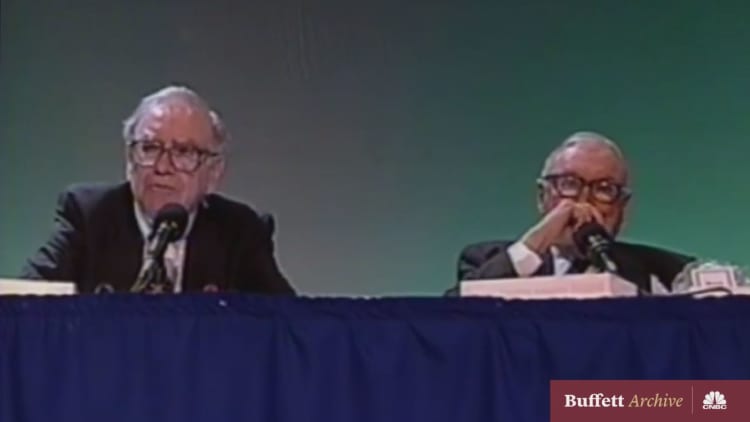
‘What bothers me is when companies pay a lot of money for mediocrity’ (1998)

AUDIENCE QUESTION: explain the justification and rationalization for the exorbitant salaries, bonuses, perks, directors’ fees, and other benefits that most public corporations are paying. (Applause)
WARREN BUFFETT: I would say this. In my own view, the most exorbitant are not necessarily the biggest numbers. What really bothers me is when companies pay a lot of money for mediocrity, and that happens all too often.
But we have no quarrel in our subsidiaries, for example, for paying a lot of money for outstanding performance. I mean, we get it back 10 or 20 or 50-for-1.
And similarly in public companies, we think that there have been managers — in our managers — who have taken companies to many, many, many billions of market value more than would’ve happened with virtually anyone else…
I am bothered by irrational pay systems. And I’m particularly bothered when average managers take really large sums.
I’m bothered when they design, or have designed for them, systems that are very costly to the company — maybe partly to make themselves look good because they want huge options themselves, so they feel if they give options widely throughout the company — so they design a system that is illogical company-wide because they want one that’s illogical for them personally.
But large sums, per se, don’t bother me. I’m not saying, you know, whether any individual should — might want to take them or not. But I do not mind paying a lot of money for performance.
It’s done in athletics; it’s done in entertainment. But in business the people who are the .200 hitters and the people who would not attract a crowd as an entertainer have worked it out so that — I mean, the system has evolved in such a way that — many of them take huge sums. And I think that’s obscene. But I can tell you, there isn’t much you can do about.
The system feeds on itself. And companies do look at other companies’ proxy statements, every CEO does. And they say, “Well, if Joe Smith is worth X, I have to be worth more.” And they tell the directors that, “Certainly you wouldn’t be hiring anybody that was below average, so how can you pay me below average?” And the consultants come in and ratchet up the rewards.
And it’s not anything that’s going to go away. It’s like we were talking about campaign finance reform earlier. The people who have their hands on the switch are the beneficiaries of the system. And it’s very hard to change the system when the guy whose hand is on the switch is benefitting enormously, and perhaps disproportionately, from that system.
BERKSHIRE STOCK WATCH
BRK.A stock price: $734,838.94
BRK.B stock price: $490.03
BRK.B P/E (TTM): 15.79
Berkshire market capitalization: $1,056,826,445,660
Berkshire Cash as of December 31: $373.3 billion (Down 2.2% from Sept. 30)
Excluding Rail Cash and Subtracting T-Bills Payable: $369.0 billion (Up 4.1% from September 30)
Berkshire resumed stock repurchases on March 4, 2026.
(All figures are as of the date of publication, unless otherwise indicated)
BERKSHIRE’S TOP EQUITY HOLDINGS – Mar. 13, 2026
Berkshire’s top holdings of disclosed publicly traded stocks in the U.S. and Japan, by market value, based on the latest closing prices.
Holdings are as of December 31, 2025, as reported in Berkshire Hathaway’s 13F filing on February 17, 2026, except for:
The full list of holdings and current market values is available from CNBC.com’s Berkshire Hathaway Portfolio Tracker.
QUESTIONS OR COMMENTS
Please send any questions or comments about the newsletter to me at alex.crippen@nbcuni.com. (Sorry, but we don’t forward questions or comments to Buffett himself.)
If you aren’t already subscribed to this newsletter, you can sign up here.
Also, Buffett’s annual letters to shareholders are highly recommended reading. There are collected here on Berkshire’s website.
— Alex Crippen, Editor, Warren Buffett Watch
<