

Franklin Templeton CEO Jenny Johnson on making family business last
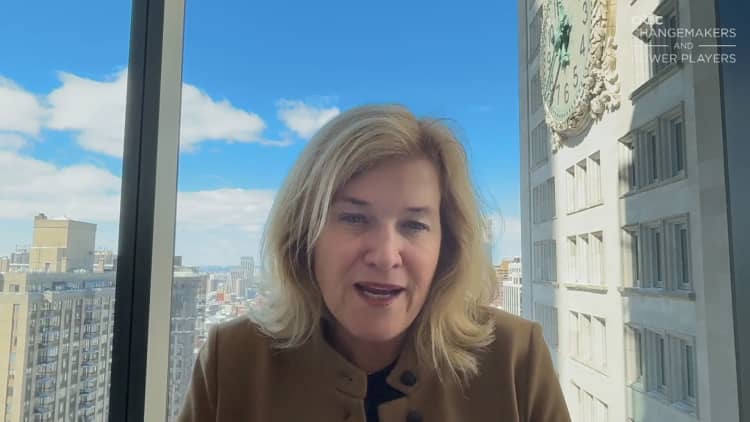

Franklin Templeton CEO Jenny Johnson has two equally challenging jobs. She oversees a fund company with nearly $2 trillion in assets under management within an industry experienced accelerated change, from active ETFs to tokenization. And, as a third-generation leader from the Johnson family, she’s in charge of the legacy of a business started by her grandfather 79 years ago that is now valued by the stock market at roughly $13 billion.
For a family business like Franklin Templeton’s to last into a third generation is notable. Johnson often refers to a saying that appears in different forms around the world to make this point. In the U.S., people say, “shirtsleeves to shirtsleeves in three generations.” In Europe, it’s “clogs to clogs.” And in Asia, it’s “rice paddies to rice paddies.” There is also, “Rich father; noble son; poor grandson.”
Or in other words: the first generation builds the business, the second grows it, and the third may be the one to bring about its failure. The actual data to support this global narrative is debatable. A 2021 Harvard Business Review analysis during the peak of the HBO “Succession” family business drama found that statistics commonly cited on the “third-generation failure” thesis were predicated on a single study from the 1980s, and its data was prone to misinterpretation. Nevertheless, a family business has a unique set of risks that need to be handled in a unique way, and many families do not prepare properly. According to PwC’s 2023 U.S. Family Business Success survey, only 34% of family businesses have a documented succession plan.
Johnson says one challenge she sees is that each generation experiences the company differently. Founders start with little and strive to create something valuable. Their children see their hard work and want to help expand the company. And by the third generation, the environment is different because the business is already well-established and younger generations may also have developed distinct interests. And those interests are not always aligned with hard work.
“The third generation has a really comfortable life and it’s hard to get motivated to work as hard because you have all these other things that you could do and they’re not going to necessarily change your standard of living. That’s my speculation,” she told CNBC’s Julia Boorstin in the latest episode of the “CNBC Changemakers and Power Players” podcast.
Johnson was named to the 2026 CNBC Changemakers List.
Jenny Johnson, CEO, Franklin Templeton at the NYSE in 2022.
Source: NYSE
Her perspective was shaped by her father, second generation Franklin Templeton CEO Charles Johnson, who transformed the mutual fund manager into a global investment firm and became a billionaire. But the leadership and legacy roadmap crystallized for Jenny over a number of years, and the unique risks in the family business were always on her mind. In fact, she noted that the family hired an estate planning expert as part of celebrating her dad’s 80th birthday, and among the things the expert told the family was, “I got tired of building all these estate plans and then having complete destruction in the heirs.”
From Johnson’s research and lived experience, she isolated a few factors critical for generation after generation to maintain success. First, the family has to have a set of values that are continually instilled. Second, the business always needs to take care of the clients. Third, the family has to decide on the best talent in the family to be a steward of any particular asset with no leadership post a given for any member.
Johnson says her father had instilled the values and the client-first mantra, and she agrees that successful family companies thrive on a shared, reinforced culture early on. “If you’re part of this family, you live by these values, hard work [and] work with integrity,” Johnson said.
But growing up as the sixth of seven children, she never assumed she would run the family business. “I actually never saw myself … as being the CEO. … I didn’t really think about it that much,” she said.
Ultimately, that’s where choosing the right family member for the right job came into play.
“We all went and worked for the business at some point because you needed a job. That was convenient. The business was growing so fast when we were all graduating from college. This was in the 80s. It was the heyday. People woke up to mutual funds at that point and you just had massive growth. … the ones that were passionate really stayed involved in the business for a long time,” Johnson said.
She worked in multiple roles throughout the company before being named CEO in 2020, mostly focused on technology and operations, “and I loved it,” she said. And she says having that tech background is very important for a market CEO to have now in a world of AI and tokenization. It was also an approach to learning the business that came straight from her dad:
“When he took over the company, he had only a part-time employee and then him. He’s done every job. He’s been the fund accountant, the technology, the client service, the investment person, the sales guy. At 93 years-old, he will circle a footnote on something and send me a note and ask me a question about it. He understands at that level.”
Her brother Greg, who focused on the investment and distribution side of the business, was CEO before her. Greg now runs the MLB’s San Francisco Giants — their father Charles was the team’s largest shareholder before turning over control to his son. “I do think that there’s a lot of people who think running a sports team is more fun. I personally prefer what I do,” she said.
She was once herself on the board of the Giants, but she says now, “He is a much better steward of that asset than I ever was. He’s the right family member for it.”
“It’s being willing as a family to put your own ego aside and say, ‘Who’s better on behalf of the family?'” Johnson said. “You actually have to decide who’s the best talent in the family to be a steward of that asset.”
“At that point, it made sense for me to come in and be CEO, although it was not a fait accompli,” she said.
The board put her through an external review to compare with other potential CEO candidates.
Ultimately, “it was more about what can I do to help build this business, this family legacy. You certainly feel that as being part of it,” she said.
Johnson took the helm during the pandemic and did not wait long to make her mark, with Franklin Templeton making a major acquisition, Legg Mason, that doubled the company’s size. Despite the timing, Johnson describes the pandemic period as a reminder how important consistent leadership is. “You just manage it,” she said. “Something else will happen. We’ll just manage it.”
Follow and listen to this and every episode of the “CNBC Changemakers and Power Players” podcast on Apple and Spotify.
<