
Gold loans are thriving in India
Hello, I am Priyanka Salve, writing to you from Singapore.
Welcome to the latest edition of Inside India — your one-stop destination for stories and developments from the world’s fastest growing large economy.
This week, I unpack what’s driving the rapid surge in gold‑loan growth in the world’s second‑largest bullion market. Loans against gold are a multibillion‑dollar industry in India, powered by households holding $5 trillion in bullion.
Enjoy!
Any thoughts on today’s newsletter? Share them with the team.
The big story
Indian households are sitting on a mountain of gold.
They own more than 34,000 tons of the yellow metal, as per a Morgan Stanley report from October last year, with Kotak Mahindra Bank pegging its value at about $5 trillion.
That vast reserve is now powering one of the fastest-growing lending segments in India. As other forms of consumer credit slow, gold loans have surged, driven by tighter banking rules for unsecured loans, a sharp rally in global gold prices, improved access, and perhaps a rising financial stress among households.
While about 90% of Indian households’ hoardings are still lying idle, according to Shripad Jadhav, business head of gold loans at Kotak Mahindra Bank, gold-backed lending is beginning to reshape India’s retail credit landscape, even drawing some global investors.
Global private equity firm Bain Capital has made a bold bet on loans against gold, with plans to acquire up to 41.7% stake in Manappuram Finance, India’s second‑largest gold loan provider.
The deal, approved by the Reserve Bank of India last month, signals how international investors see opportunity in the country’s most traditional but underutilized asset.
In December last year, Japanese financial behemoth MUFG said it was acquiring a 20% stake in Indian shadow banking firm Shriram Finance, which plans to double down on loans against gold.
RBI data shows gold loans more than doubled in one year, rising to 4 trillion rupees ($43.3 billion) in January from 1.75 trillion rupees a year earlier. Gold-backed lending is now the largest retail loan segment in the country after home and vehicle loans, as well as the fastest-growing retail credit category.
The actual size of gold loans in India is estimated to be 14 trillion rupees, said Yan Wang, chief emerging market strategist at Canadian firm Alpine Macro, adding that the RBI data only captures personal gold loans from certain commercial banks.
Non-banking financial companies, or NBFCs, account for 45%–50% of gold loan volume, according to a Macquarie report from last month — which is not captured by the RBI.
Gold rush
As India’s central bank tightened the rules around unsecured lending in late 2023, it cut off access to this line of credit for many small and private business borrowers, Hanna Luchnikava-Schorsch, head of Asia-Pacific economics at S&P Global Market Intelligence, told me.
“Personal loans growth has slowed from an average of 30% in six months to December 2023 to 12.2% in 2025,” she said. During the same time, global gold prices have soared.
From 2024 to date, gold has gained more than 140% to cross $5000 per ounce, hitting several records this year.
Higher gold prices increase the value borrowers can unlock with the same amount of metal — making gold loans more appealing, Luchnikava-Schorsch said.
Historically, demand for loans against gold was driven by South Indian states and the semi-urban market, especially among agricultural communities, experts said.
Now, that growth is broad‑based across India, says Kotak Mahindra Bank’s Jadhav, as middle‑class as well as high-net-worth individuals in big cities are using gold loans to fund time‑sensitive financial needs.
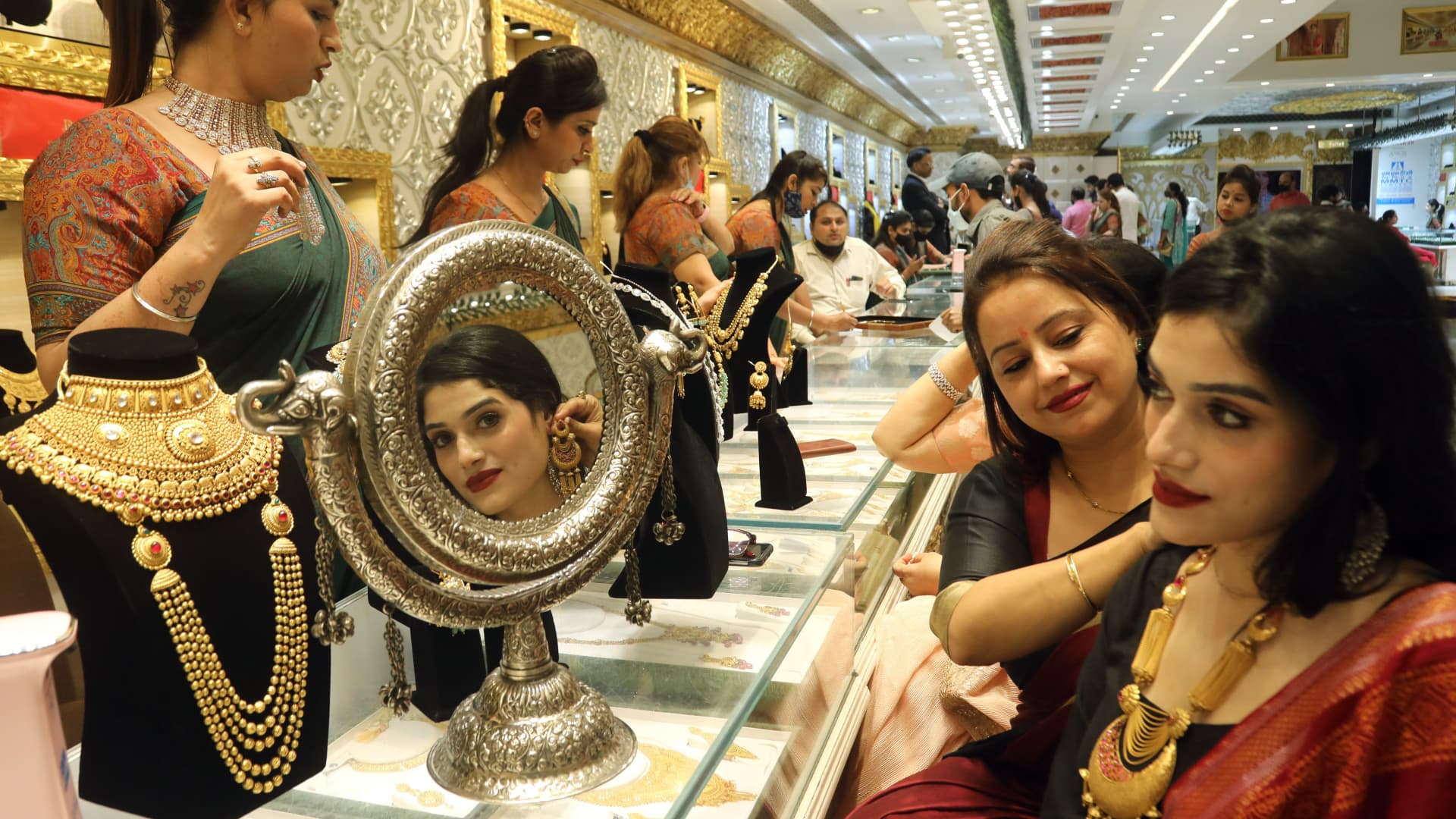
NEW DELHI, INDIA – OCTOBER 18: People buying the gold and silver jewelry on the occasion of Dhanteras at PP Jewellers, Karol Bagh on October 18, 2025 in New Delhi, India.
Hindustan Times | Hindustan Times | Getty Images
The biggest beneficiaries of this demand for gold loans have been NBFCs such as Manappuram Finance and industry leader Muthoot Finance. Their shares have risen 24% and 47%, respectively, over the last year, outpacing the benchmark Nifty 50 index by a wide margin.
“Most NBFCs can disburse a loan within an hour of a customer walking into a branch,” said Shreya Shivani, an NBFC analyst at Nomura.
Even a person with a “poor” credit score who owns good quality gold can get a loan at a much better lending rate compared to unsecured personal loans, she said. While that widens access to credit, it also raises questions.
A rapidly growing loan segment that bypasses traditional credit assessments could indicate stress in the economy, with Macquarie’s report also attributing people feeling financially squeezed, and incomes not keeping pace with costs, among the reasons driving the boom in gold loans.
Shripad says that the rise in gold loans is “a marker of financial maturity” as people are monetizing the precious metal and using it as a hassle-free, quick, and low‑cost credit line.
Need to know
India’s Modi reaches out to Iran. Indian Prime Minister Narendra Modi called Iranian President Masoud Pezeshkian within hours of Tehran’s new supreme leader vowing to keep the Strait of Hormuz closed, as New Delhi scrambles to mitigate energy supply risks.
India’s U.S.-Israel tilt is testing ties with Iran. While millions of barrels of oil flow to China via the Strait of Hormuz, India — Tehran’s old ally — is yet to secure a safe passage for its ships stuck in the critical waterway as New Delhi’s deepening ties with the U.S. and Israel strain relations with Iran.
India’s consumer inflation rises for a fourth straight month. India’s consumer inflation rose to 3.21% in February, up from 2.75% in the previous month, but in line with expectations of economists polled by Reuters.
Coming up
March 20: Weekly RBI updated on India FX reserve.
March 20: Central Mine Planning & Design Institute IPO opens.
March 24: India HSBC manufacturing and services flash PMI.
<