
Here are 3 ways to ignite a 2026 rally in beaten-down bank stocks
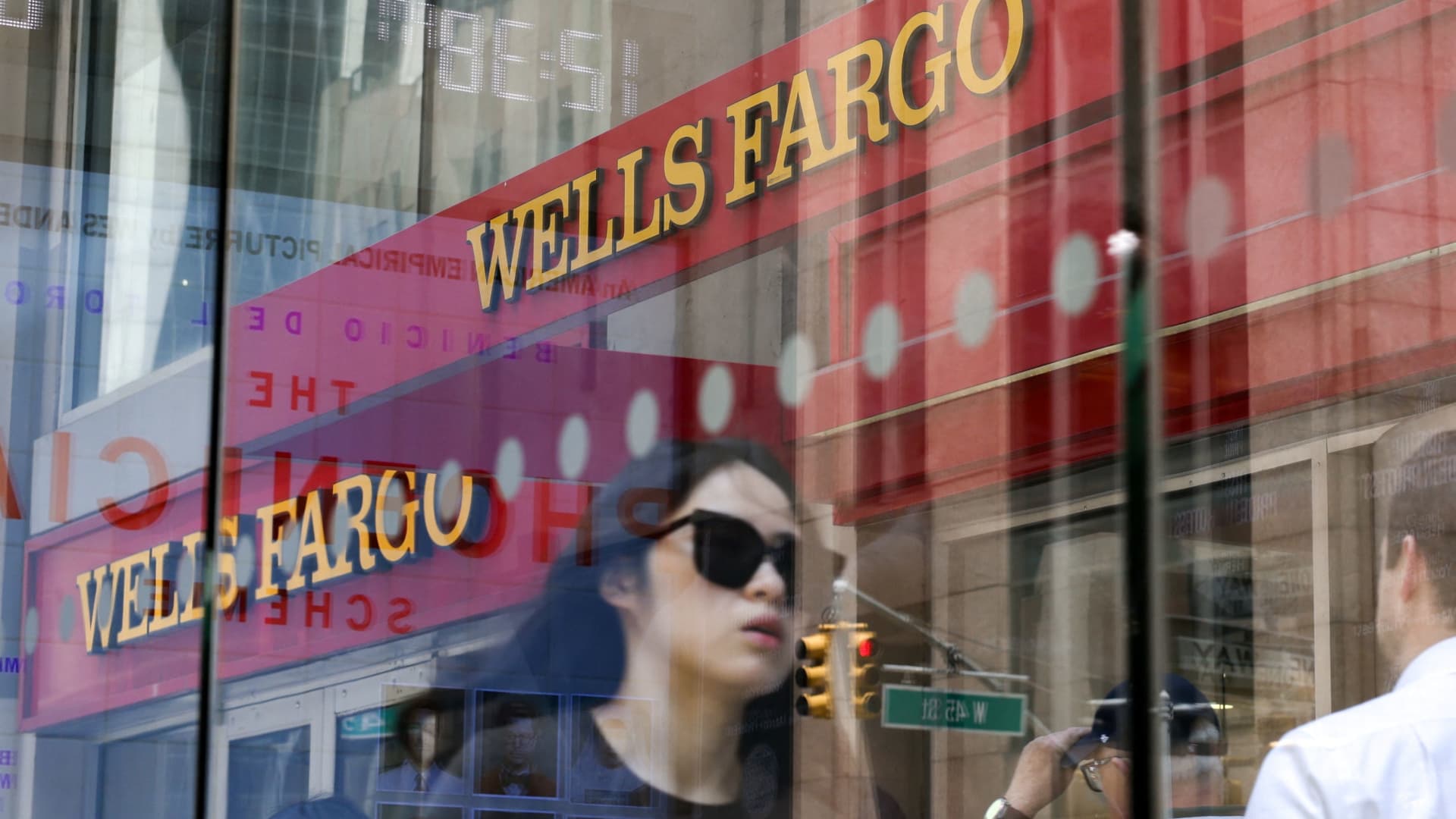
Bank stocks have been battered in 2026, but the tide may be about to turn. “The banks are so low that it makes me say, ‘You know what? Maybe this is a good group for the next quarter,” Jim Cramer said Wednesday on CNBC, the first day of the second quarter. Cracks in the private credit market , growing artificial intelligence adoption and the U.S.-Iran war all weighed on the financials over the first three months of the year. As asset managers limited redemptions on some of their private-credit funds, investors grew concerned about what that means for the big banks that lent to them. Bank shares also got hit on fears that AI could disrupt the labor market as more jobs become automated. As if that wasn’t enough, a spike in energy prices tied to the Middle East conflict has further muddied the economic outlook and put strain on consumers at the pump. As a result, Club name Goldman Sachs ended the first quarter down 13% from its all-time closing high on Jan. 15. Wells Fargo fared worse, ending Tuesday down 17% from its record close on Jan. 6. For the first quarter, the S & P 500 financials sector slid 9.8% underperforming the broad-market index’s 3.45% decline. It’s also a stark contrast to a banner 2025 for banks. But the Club sees three ways for the group to get back on track during 2026’s second quarter. GS YTD mountain Goldman Sachs (GS) year-to-date performance Iran-U.S. war The two-day rally on Wall Street on hopes of a resolution to the Middle East conflict could be a sign of things to come if an actual ceasefire agreement between the U.S. and Iran is reached. It has rattled markets for more than a month, and investors are grabbing onto any reason for optimism. Banks are some of the most economically sensitive stocks in the market, so if traders are able to take a war-driven recession off the table, there’s less downside risk to owning those stocks. Bank stocks will also rally when the conflict is over because macro uncertainty can stall Wall Street dealmaking. Companies tend to be more conservative with capital when markets are volatile and the economic outlook is cloudy. The shift in sentiment would be a positive for Goldman’s crucial investment banking division, which is the crux of our thesis in the stock. Wells Fargo would also benefit as the firm looks to play in more deals with its budding capital markets business. It’s a simple equation: A more stable backdrop should lead to more deals, which means more revenue from initial public offerings, mergers and acquisitions. Plus, Jim has said there’s a slate of potential monster public debuts for 2026, pointing to reports of plans from the likes of OpenAI and Anthropic. As anticipation for OpenAI’s IPO builds, the startup closed a $122 billion funding round at an eye-watering post-money valuation of $852 billion . The other big one: Elon Musk’s SpaceX. On Wednesday, CNBC’s David Faber reported the rocket maker has confidentially filed for an IPO . SpaceX is working with at least 21 banks for its IPO, Reuters reported , and the potentially record-breaking deal is estimated to value the company at $1.75 trillion. Goldman and Wells Fargo are among the banks working on the IPO, which is expected in June, according to Reuters. “We’ve never had deals like this,” Jim said Wednesday. “We don’t even know how to analyze them [because] they’re so big.” The Fed The Federal Reserve’s interest rate policy has a huge impact on banks, and a new leader who is eager to lower the cost of borrowing could be in charge soon. There could be more accommodative policy if President Donald Trump’s Fed chair nominee Kevin Warsh steps into the role when Jerome Powell’s term expires in May. To be sure, Warsh hasn’t officially been confirmed as Powell’s successor because the Senate approval process remains on hold. It’s hard to say whether rate cuts inherently will be a positive for our banks. The key is that they’re done correctly and support economic growth. In the past, we’ve said lower rates can be a double-edged sword . On the one hand, banks may not be able to charge as much for loans, which could compress their net interest income (the difference between what they earn in interest payments and pay customers for their deposits). On the other hand, lower rates tend to support economic activity, so there could be higher demand for loans overall, allowing the elevated volume to compensate for lower interest income. With lower rates, companies may look to borrow more money to invest into their businesses. Consumer spending also picks up when people feel more confident about the economy. Individuals tend to take out new mortgages, loans for cars or use credit cards for more discretionary spending. All of that activity should be supportive for Goldman Sachs and Wells Fargo. WFC YTD mountain Wells Fargo (WFC) year-to-date performance Earnings in focus Finally, stellar earnings reports would improve investor sentiment. Goldman is expected to release its first-quarter results on April 13, and Wells Fargo is set to report results the following day. For Goldman Sachs, the focus will be on the performance of its investment banking division in the first quarter. In the final three months of 2025, revenues from investment banking — the largest part of its global banking and markets division — jumped 25% year over year. Commentary from management about the broader dealmaking environment and pipeline will also be closely watched. While market volatility can tamp down on IPO and M & A activity, it is what Goldman’s trading desks thrive on, so their performance in the quarter will be notable. In the case of Wells Fargo, we want to see the bank beat expectations for net interest income, which is a huge driver of revenue growth. Wells expects 2026 net interest income to jump to around $50 billion , compared to the $47.5 billion garnered last year. Investors also want to see how Wells’ investments into higher-growth businesses like investment banking are paying off. The bank has been on the offense since its $1.95 trillion asset cap was removed in June. In recent years, Wells has made significant investments into its dealmaking division in order to diversify its revenues further and not rely so heavily on interest-based incomes, which are at the mercy of the Fed’s monetary policy changes. Analysts at HSBC showed some love for Wells ahead of earnings. The firm upgraded the stock to a buy from hold late Tuesday, citing an attractive valuation following the recent sell-off. Analysts also like the stock because they believe its net interest income outlook could be conservative, it has plenty of excess capital to drive growth or repurchase stock, and it has room to lift retail banking profits. Bottom line There’s plenty of reason to believe bank stocks can continue this week’s newfound momentum if these three things break their way. Moving forward, if Goldman does stage a comeback, we’ll likely take some off. The stock is currently the largest weighting in our portfolio, at just north of 5%, and we bought some below $800 apiece in mid-March. The stock ended Wednesday at $860.21 a share, up 1.7% on the session. Wells Fargo has a much smaller 3.9% weighting, so it’s less clear what our next move would be during a rally. Jim, however, has said that if shares tumble significantly below the $80 level, it would be a good opportunity to buy. The stock rose 1.25% Wednesday to close at $80.59 a share. (Jim Cramer’s Charitable Trust is long WFC and GS. See here for a full list of the stocks.) As a subscriber to the CNBC Investing Club with Jim Cramer, you will receive a trade alert before Jim makes a trade. Jim waits 45 minutes after sending a trade alert before buying or selling a stock in his charitable trust’s portfolio. If Jim has talked about a stock on CNBC TV, he waits 72 hours after issuing the trade alert before executing the trade. THE ABOVE INVESTING CLUB INFORMATION IS SUBJECT TO OUR TERMS AND CONDITIONS AND PRIVACY POLICY , TOGETHER WITH OUR DISCLAIMER . NO FIDUCIARY OBLIGATION OR DUTY EXISTS, OR IS CREATED, BY VIRTUE OF YOUR RECEIPT OF ANY INFORMATION PROVIDED IN CONNECTION WITH THE INVESTING CLUB. NO SPECIFIC OUTCOME OR PROFIT IS GUARANTEED.
<