Judge dismisses Boeing criminal case for 737 Max crashes
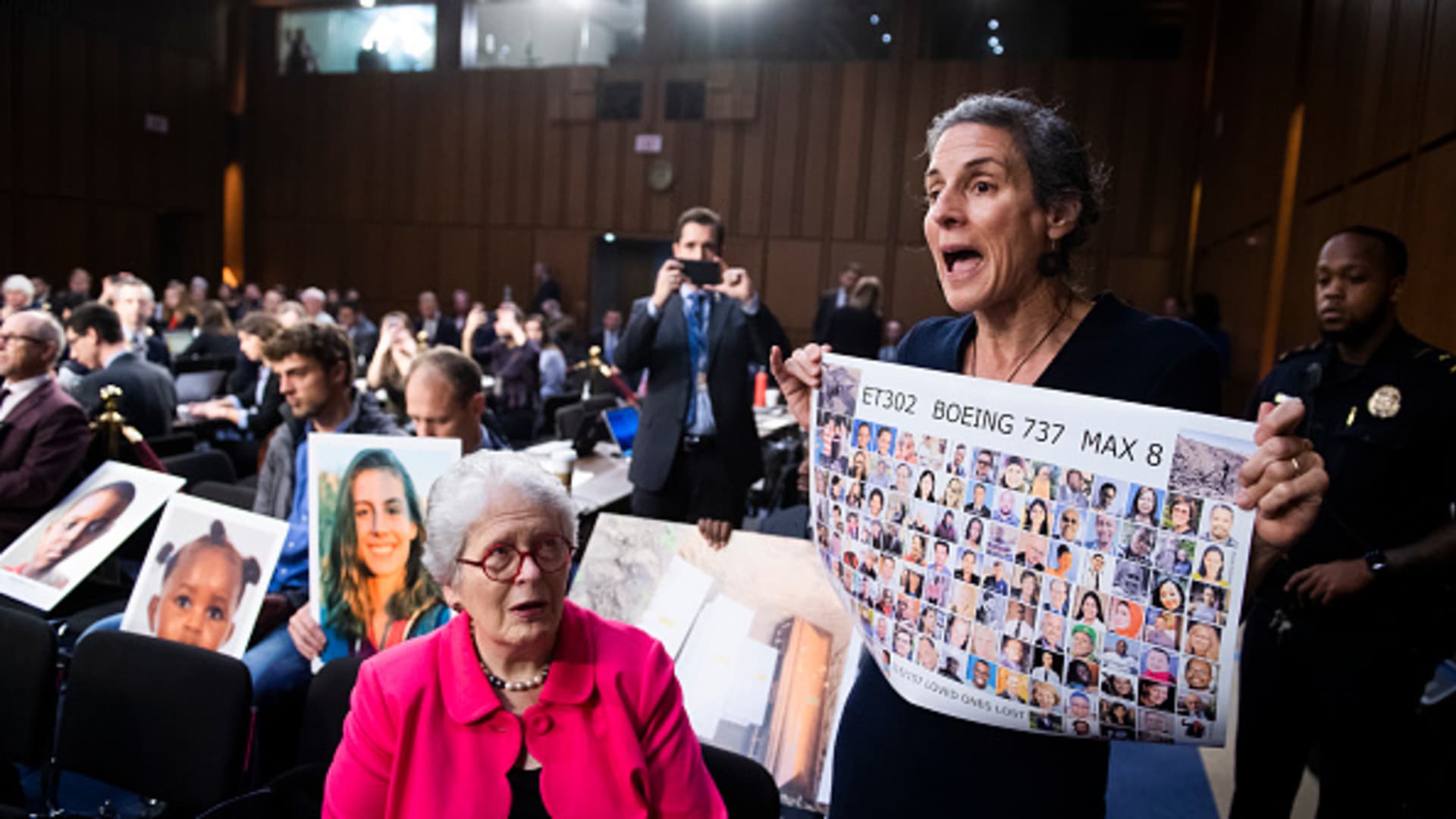
Nadia Milleron, whose daughter Samya Stumo was killed in the crash of Ethiopian Airlines Flight 302, holds a sign with photos of the crash victims during a Senate Commerce, Science and Transportation Committee hearing on aviation safety and the future of the Boeing 737 Max aircraft, in the Hart Building in Washington, D.C., Oct. 29, 2019.
Tom Williams | CQ-Roll Call, Inc. | Getty Images
A federal judge in Texas on Thursday dismissed a criminal conspiracy case against Boeing over two crashes of its 737 Max jetliner that killed 346 people, despite expressing sharp skepticism about the wisdom of the Department of Justice’s request that he toss the case.
Some families of victims of the crashes had strongly opposed the DOJ’s move in May asking Judge Reed O’Connor to dismiss the case in U.S. District Court in Fort Worth.
The dismissal comes more than a year after Boeing and the DOJ said they had reached an agreement that required the company to plead guilty and serve a term of probation.
The first crash, of Lion Air Flight 610 in Indonesia occurred in late October 2018, and the second crash, of Ethiopian Airlines Flight 302, occurred nearly five months later, in March 2019.
O’Connor, in his dismissal order, said that victim families who opposed the dismissal “are correct” that a non-prosecution agreement that the DOJ reached with Boeing “fails to secure the necessary accountability to ensure the safety of the flying public.”
O’Connor agreed with them that the agreement “disregards the need for Boeing to be subject to independent monitoring.”
Boeing on Wednesday reached settlements in three lawsuits filed by families of victims of the second crash, after a jury had been selected for the trial of one of those cases in Chicago federal court.
The DOJ criminally charged Boeing in January 2021 with conspiracy to defraud the United States for the company’s alleged obstruction of the Federal Aviation Administration’s evaluation of the Max’s maneuvering characteristics augmentation system.
At the same time that case was filed, the DOJ said it had entered into a deferred prosecution agreement with Boeing, which effectively suspended the case’s prosecution.
But in May 2024, the DOJ told O’Connor that Boeing had breached the deferred prosecution deal by “failing to design, implement, and enforce a compliance and ethics program to prevent and detect violations of U.S. fraud laws throughout its operations.”
This is breaking news. Please refresh for updates.
<