
Meta’s double whammy in court adds to Zuckerberg’s recent woes
Meta CEO and Chairman Mark Zuckerberg arrives at Los Angeles Superior Court ahead of the social media trial tasked to determine whether social media giants deliberately designed their platforms to be addictive to children, in Los Angeles, on Feb. 18, 2026.
Frederic J. Brown | AFP | Getty Images
Meta suffered stinging rebukes in two high-profile court cases this week, adding to the company’s challenges as it tries to navigate an increasingly complex social media environment while also chasing rivals in artificial intelligence.
Both trials — one in Santa Fe, New Mexico, and the other in Los Angeles — pointed to the struggles Meta has faced to adequately police Facebook and Instagram, which remain the company’s primary cash engines due to their dominant position in digital advertising.
Jurors in Santa Fe determined on Tuesday that Meta misled users about the safety of its social apps when it comes to children being targeted by online predators. A day later, a jury in LA ruled against Meta and Google’s YouTube in a personal injury trial, determining that their negligence was a “substantial factor” in causing mental health-related harms to a plaintiff identified as K.G.M., or Kaley.
Timothy Edgar, a lecturer at Harvard Law School, characterized the outcomes as “a major watershed event” that “represent a big shift in how Americans are viewing Big Tech.”
“It’s kind of the culmination of many years of growing skepticism,” Edgar said.

Wall Street has been showing signs of skepticism for very different reasons, pushing Meta’s stock down over 2% over the past year largely due to the company’s scattershot AI strategy and its ongoing high costs. Meta plans to pour up to $135 billion into capital expenditures this year, even as its AI models are far behind rivals Google, OpenAI and Anthropic, and the company hasn’t shown a significant new revenue opportunity in the market.
Among tech’s megacaps, Microsoft is the only company underperforming Meta, as the software maker’s stock is down 5% in the past year. Alphabet, meanwhile, has soared 76%.
On Wednesday, Meta announced hundreds of layoffs across multiple units, including Reality Labs, which oversees virtual reality, augmented reality and AI-powered wearable devices. Those cuts follow a January round of layoffs at Reality Labs that impacted 10% of the division, equaling over 1,000 employees.
While the verdicts this week represent a sharp and public criticism of Meta’s operations, the financial penalties are merely a slap on the wrist for a company with a $1.5 trillion market cap and over $60 billion in annual net income.
In the New Mexico case, the jury ruled that Meta must pay $375 million in damages, while jurors in L.A. determined that Meta and YouTube will be required to pay a total of $6 million in combined compensatory and punitive damages, with Meta covering 70% of the amount.
Both Meta and YouTube expressed disappointment with the verdicts and said they would appeal.
A Meta spokesperson pointed out that the jury in the L.A. case awarded the plaintiff less than 0.5% of what the lawyers were requesting. In New Mexico, Linda Singer, an attorney representing the state, urged jury members to impose a civil penalty against Meta that could top $2 billion.
Bellwether case
The precedent may be more concerning than the money, as there are a a host of forthcoming social media safety and addiction trials involving Meta and its peers.
Lexi Hazam, an attorney representing plaintiffs like school districts in a federal social media trial expected to commence in Northern California this summer, said she expects additional financial penalties. Hazam noted that the case is one of several in the state involving personal injury from social media.
“This was a person who had mental health harms, and these numbers we think are certainly appropriate and have the desired effect of compensating for her harms and punishing the two defendants in an appropriate manner in an individual case,” Hazam said after the verdict.
The rulings also point to a potential reckoning with the Section 230 provision of the Communications Decency Act that governs free speech. New Mexico attorney general Raúl Torrez, who spearheaded the state’s case against Meta and a similar ongoing lawsuit involving Snap, told CNBC on Tuesday that “there’s a distinct possibility that these cases motivate Congress to re-examine Section 230 and, if not eliminate it, dramatically revise it.”
“I think juries awarding penalties and holding companies accountable are an important signal to policy makers in D.C. that there is an urgency in the community that needs to be addressed around these issues,” Torrez said.

U.S. Sen. Dick Durbin, D-Ill., ranking member of the Senate Judiciary Committee, is a supporter of overhauling Section 230, and said the latest verdicts bolster his case.
“These back-to-back decisions in New Mexico and California show that Big Tech has become Big Tobacco,” Durbin said in a statement, referring to the 1990s, when tobacco companies were forced to pay billions of dollars for lying to the public about their products’ harms. “Now, it’s time for Congress to sunset Section 230 once and for all.”
Harvard Law’s Edgar said there’s a good chance these cases find their way to the Supreme Court on free speech grounds. While Edgar said the verdicts are “consistent with the overall backlash against Big Tech,” he added that there could be “unintended consequences.”
Edgar said people may look back in a decade or two and say, “The internet used to be a free, robust and wide-open place, and now it’s been tamed and regulated by the fact that people are afraid of what they say online, and I’m worried about that.”
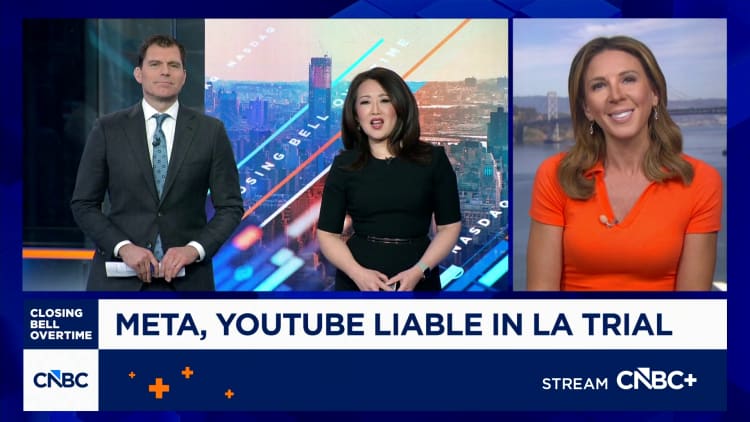
WATCH: Meta, YouTube found liable in social media addiction case.

<