

Micron rides memory price spike into earnings with stock up 62%
Sanjay Mehrotra, president and chief executive officer of Micron Technology Inc., during a groundbreaking ceremony for the new Micron Technology Inc. semiconductor manufacturing facility in Clay, New York, US, on Friday, Jan. 16, 2026.
Heather Ainsworth | Bloomberg | Getty Images
Micron saw its stock triple in 2025, and it’s up nearly 62% so far in 2026, as heavy demand for memory-rich Nvidia artificial intelligence chips leads to shortages.
The memory crunch that’s boosted Micron has been bad news for many of its tech peers, which are dealing with higher prices as they try to secure critical components. Among the 10 most valuable U.S. tech companies, Micron is the only one up this year. The rally has elevated Micron’s market cap to $520 billion, passing Oracle, which is now worth $445 billion.
Micron will issue fiscal second-quarter results after the close on Wednesday, with analysts expecting 148% year-over-year revenue growth, according to LSEG. Executives will discuss the results with analysts on a conference call starting at 4:30 p.m. ET.
The memory chip shortage is showing no sign of letting up, as the tech industry’s biggest names spend record amounts to keep up in the AI race.
“Memory is a key enabler of AI,” Micron CEO Sanjay Mehrotra told CNBC’s Sara Eisen in January. “It is a strategic asset today, not like just a component in the system. And so we need it. Just like your brain, you need more memory. You need faster memory.”
Amazon and Google, which buy large quantities of Nvidia chips and rent them out through cloud services, have been ratcheting up their forecasts for capital expenditures.
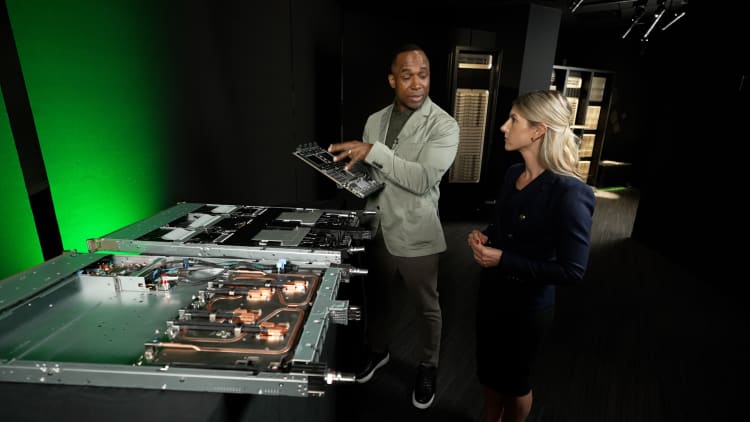
Cloud providers need racks full of Nvidia’s Vera Rubin graphics processing units in their data centers, and each system requires large amounts of memory.

An Nvidia Vera Rubin NVL72 system uses roughly three times the dynamic random access memory, or DRAM, as the Grace Blackwell GB300 NVL72 rack, RBC analysts wrote in a note Sunday. A single Rubin Ultra graphics processing unit will have a terabyte of high-performance HBM4e memory, more than three times that of one Rubin GPU.
Nvidia CEO Jensen Huang said Monday at his company’s GTC conference that he sees $1 trillion in purchase orders through 2027 for Blackwell and Vera Rubin GPUs.
All that GPU buying is boosting Micron, which indicated in December that it’s sold out of high-bandwidth memory for 2026.
At Nvidia’s GTC, Tae-won Chey, chairman of the parent of Micron rival SK Hynix, said the memory shortage will continue for another four or five years, Bloomberg reported.
Analysts polled by StreetAccount are projecting that Micron’s average DRAM selling prices climbed almost 32% from the previous quarter during the fiscal second quarter.
For the fiscal third quarter, analysts surveyed by StreetAccount are anticipating an adjusted gross margin of more than 71%, with $23.80 billion in revenue, which would be up nearly 156%.
Memory for PCs
The stockpiling of GPUs has sent memory prices for other products ripping higher. Tech industry analysis firm TrendForce said in a February report that PC DRAM contract prices “surged significantly this quarter.”
Analysts at RBC wrote that blended DRAM pricing is set to jump 80% to 85% in the first quarter of 2026, according to TrendForce data.
PC sales could fall as a result.
Last week, industry researcher IDC lowered its forecast for PC sales, expecting a decline of 11.3% this year, compared to the firm’s November estimate of a 2.4% decline in 2026.
IDC also sees smartphone shipments falling 12.9% this year.
“Memory shortages will persist well into 2027,” IDC research manager Jitesh Ubrani said in a statement.
Dell has also warned of the spike in memory costs, with operating chief Jeff Clarke telling analysts on the company’s February earnings call that the cost of DRAM has climbed five and a half times in the past six months, while NAND flash memory for long-term storage is four times higher.
“We’re working with our memory partners to be as flexible and as agile as possible,” Clarke said. “We are working through things of: How do we minimize our complexity? How do we improve our mix? How do we sell what’s coming? How do we improve our designs to take whatever parts that are available?”
Micron is taking steps to increase supply, but some of that build is a ways off.
In January, the company held a groundbreaking ceremony in upstate New York at the future site of up to four fabrication plants. The next month, it opened an assembly and test facility in India to turn memory wafers into finished products.
WATCH: RBC’s Pajjuri on Micron: Pricing will remain through the year and into next

<