
One year after DOGE cuts, former federal workers find new roles
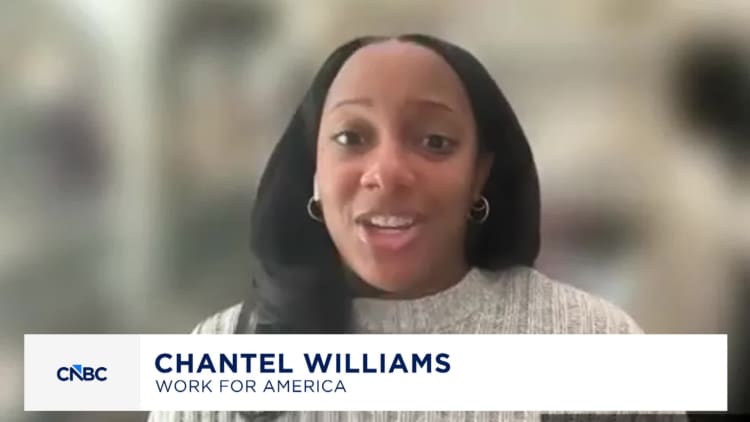

Last spring, Chantel Williams’ position in the federal government was in limbo.
Williams, once a General Services Administration employee on its hiring and recruitment team, found herself in a state of confusion and anxiety. The agency she worked for was in a holding pattern as Elon Musk’s so-called Department of Government Efficiency began its work to aggressively shrink the size and scope of government agencies at President Donald Trump’s direction.
The DOGE cuts, a pillar of Trump’s second term, were swift and wide-reaching across the federal workforce. Some of the most affected agencies included the U.S. Agency for International Development, the Consumer Financial Protection Bureau, the Department of Health and Human Services, and the Department of Education.
“As a federal employee, the oath is to the work and to the role, and not the administration,” Williams said. “It started off as feeling very startling that the transition wasn’t occurring as seamlessly as it had in prior years, because I had been working at GSA through a transition before.”
Williams said she felt, for the first time, real turmoil about working for the federal government.
“It was hard to wake up every day wanting to continue to serve but feel as though your leadership may have a different priority or maybe an opposition of you continuing to move forward in that mission,” said Williams.
In the end, she opted to take deferred resignation, receiving pay to leave her government post. She joined thousands of others in what was the largest reduction of the federal workforce in history, according to the U.S. Office of Personnel Management.
At the end of 2025, OPM reported that approximately 352,000 employees exited roles last year, with more than 123,000 taking the deferred resignation offer. In a release late last year, OPM said it was “in line with President Trump’s goal of a smaller, more efficient government.”
Caitlin Lewis, founder and director of Work for America, started her career in local government in New York City. Lewis launched the nonprofit in November of 2024 and has helped placed former federal workers in new roles around the country in the wake of federal workforce reductions over the last year.
Megan Leigh Barnard | Work for America
As mass layoffs and resignations hit federal workers like Williams, Caitlin Lewis stepped in to help.
Her nonprofit, Work for America, launched in November 2024 to help local governments recruit talent to fill gaps in staffing. Through its Civic Match platform, it helps former federal workers find new roles at the state and local level. The Work for America team has grown from two people to 15 in the last year, and the vast majority have come from prior careers in state, local and federal government. Four employees came directly from federal government roles.
“We never imagined the volume of need that was going to occur,” Lewis said. “What is so unique about this job seeker population is how unexpected the layoffs were for so many of them. Government has long been a place of stability and meaning making, and so much of what we understand the government job to be was really upended in that moment.”
Lewis, the daughter of a forest firefighter and a youth prison counselor who grew up in California, said she became civically engaged at a young age. That engagement led her to local government in New York City in the Bill de Blasio administration, first in the mayor’s office and then in housing and economic development. Work for America was informed by that experience.
“In a place like New York, it really showed me how when you have the right people in the right roles in government, that the public sector really can move mountains, and when you don’t, the basics start to fall apart,” she said. “And unfortunately we’ve seen that occurring in communities across the country where there hasn’t been the ability to get the right talent to lean into critical roles.”
Williams quickly landed a job at Work for America after taking deferred resignation. She is now a product and data manager with the nonprofit.
In the last year, Work for America has placed nearly 200 job seekers, 150 of which are former federal workers, in roles across the country. More than 12,800 job seekers have signed up for Civic Match since Trump’s election, representing more than 30 federal agencies.
“For many, it’s been a year of chaos and confusion. But we saw for our customers — cities and state governments across the country — that there was a true opportunity to capture the incredible talent that was going to be exiting Washington,” Lewis said.
Nate Haight turned to Civic Match as sweeping cuts took place at USAID, where he spent a decade of his career. Haight started out as an intern, then became a contractor, and by last year had been working as an education advisor and contract and grants specialist in its Latin America and Caribbean Bureau. Last February, he was told his job was under review and would most likely be cut.
“I particularly loved my work in the education sector. It was really meaningful being able to go out and see the impact that the programs were having around the world,” Haight said. “I was invested in the work and I saw the difference that it was making.”
He opted to take the deferred resignation offer from the government and found a new role through Work for America’s platform, knowing competition would be steep locally given how many other former federal workers were looking for jobs. Today, he’s in Indiana with his wife and four children, working as a grants administrator for the city of Indianapolis and Marion County.
“I think the satisfaction and fulfillment that I’ve been able to find already working in local government, I just want to encourage others to give it a shot as well … and to encourage everyone to keep their head up and know that all of the skills and experiences that they’ve gained, they’re going to be able to make a tremendous impact wherever they end up landing,” Haight said of his fellow former federal workers.
In the months to come, Civic Match is rolling out new features including candidate match scores powered by artificial intelligence, improved location targeting for jobs, city-specific pages and more.
Hope Rahill, a former political appointee in the Biden administration who left her role as the Trump administration moved in, is now director of people and culture at Work for America. Rahill said while the group has had success in placing candidates, many former workers are still looking for work and coming up on a year of “unemployment or underemployment.”
“There are still so many people looking for work,” Rahill said.
<