Prediction market gambling needs state regulation, Mulvaney says
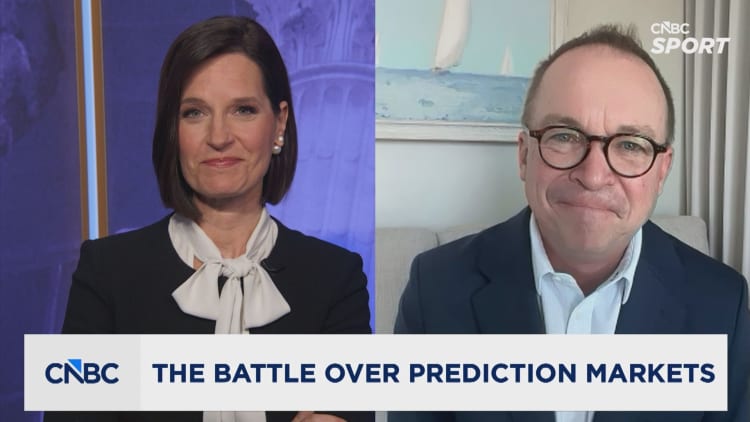

Buying contracts on prediction markets is just another word for “gambling,” says former Trump White House Chief of Staff Mick Mulvaney, who is leading a coalition that wants state authorities, not a federal commodities agency, to regulate that growing industry.
“The simple answer is that it’s gambling. It just is,” Mulvaney told CNBC’s Contessa Brewer, saying the burgeoning industry needs extra scrutiny following betting activity ahead of the Iran war.
“I buy a prediction contract, whatever that is, on the Lakers winning the basketball game. If you ask any ordinary human being if that’s sports gambling, it absolutely is, they would think that it is,” said the former South Carolina Republican congressman.
Mulvaney, whose new coalition is called Gambling Is Not Investing, argued that the Commodities Futures Trading Commission is “set up to regulate markets,” but it “is not set up to protect consumers,” such as the ones buying contracts on prediction markets, which include Polymarket and Kalshi.
The CTFC has argued that it should be the regulator of prediction markets, not state agencies.
“Look, I used to be a federal regulator,” Mulvaney said. “I ran the Consumer Financial Protection Bureau. Have nothing but the highest respect for the CFTC, but they’re not in the same business as regulating, say, sports gambling.”
Mulvaney also said recent contracts on prediction markets that paid off big for purchasers who predicted the U.S. would invade Iran should be investigated.
He also suggested, as members of Congress have, that such activity represents a security risk for the U.S.
“If someone’s trading in prediction markets on classified information, and our adversaries and our enemies are able to draw information about that … regarding our plans as a nation, how do you address that?” Mulvaney asked. “If the Russians or the Chinese or the Iranians glean information from prediction markets that help them against us, how do you fix that?”
Asked by Brewer who belongs to or funds his group, Mulvaney said, “We don’t reveal who we are, who funds us. We’re not required by law to do that.”
<