
Prices, pipelines and patent cliffs: Inside pharma’s big reset
This earnings season, Europe’s biggest pharma companies posted results ranging from 7% beats to 3% misses — but no one really cared.
Instead, drugmakers looked ahead, with 2026 shaping up to be a defining year following a dramatic 2025, and one where the impact from last year’s developments is set to crystallize.
“2025 was about understanding kind of the rules of the future of the game… what’s still to be seen in [2026] is how those companies actually implement what they agreed to, particularly in the deals that you saw with the Trump administration,” McKinsey Senior Partner Greg Graves told CNBC.
In addition to political dealings, companies are facing a so-called “patent cliff” in the upcoming years, where some of the world’s best-selling drugs lose exclusivity in key markets, exposing them to competition from much cheaper generics.
Pipelines are key – and companies know it
While drugmakers are always to some extent touting their pipelines, they’re now putting them even more on display as they seek to reassure investors that their pipeline holds enough promise to offset upcoming patent expiries.
“With the scale of the patent losses that are coming up over the next few years, you probably are hearing a bigger focus on the optimism for the future, as opposed to near-term delivery,” Graves said.
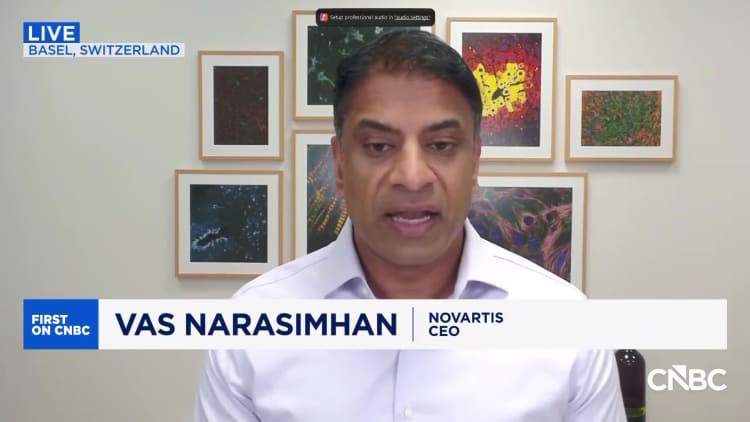
Novartis CEO Vas Narasimhan, for example, told CNBC’s “Squawk Box Europe” last week that his company is about to lose $4 billion in sales and nearly as much in profits only in the first half of this year, marking “the largest set of loss of exclusivities in Novartis’ history.”
In the same breath, he highlighted that due to “great growth drivers” and a “strong pipeline,” they are still able to grow.

AstraZeneca appears to be equally confident in its pipeline, boasting potentially 25 new blockbuster medicines by 2030, when it also hopes to reach $80 billion in revenue, up from the $59 billion seen in 2025.
Many companies are also emphasizing the importance of their business development strategies as they are increasingly looking to M&A to help them find the next blockbuster drug.
The phrases “strategic fit” and “bolt-on deals” have become go-to lines for the CEOs.
While some companies are targeting smaller acquisitions and early-stage assets, others are open to bigger, late-stage deals to bridge the gap, Camilla Oxhamre, portfolio manager at Rhenman & Partners, told CNBC.
While companies can fill that revenue gap by developing drugs internally, going on a shopping spree often yields faster results.
Sanofi’s CEO Paul Hudson learned that the hard way as his tenure as CEO came to an abrupt end on Thursday, closing out a six-year reign at the French company, during which his emphasis on R&D had failed to deliver speedy results. Sanofi has yet to respond to CNBC’s request for comment on Hudson’s departure.
Belén Garijo, currently CEO at Merck KGaA, will replace Hudson with the mandate to “strengthen the productivity, governance, and innovation capacity of Research & Development,” Sanofi said in a statement.
Sanofi has been clear-eyed about the need to offset the patent expiry of its blockbuster asthma drug Dupixent, which currently accounts for more than a third of sales and will lose key patents by early 2030s.
China is hotter than hot
With M&A becoming more of a focus for companies looking to replenish their pipelines, China has emerged as arguably the most interesting place to be right now. It has become a significant source of innovation, with several companies recently announcing deals with Chinese firms to secure access to assets being developed in the world’s second-largest economy.
Ten years ago, deals with Chinese companies were extremely rare, but today, it happens all the time, noted Oxhamre.
“It has a lot to do with the end market – the end market today is primarily the U.S., and Europe is second,” she said. “Many see that the end market 10 years from now will probably be the U.S. and China.”

The stock performance of Europe’s biggest pharmaceutical companies has varied greatly over the past 12 months.
Over the past year, the discussion has moved on from talking about China as a market, to a source of innovation, Graves said.
“What you’ve heard, particularly since the beginning of this year [and] end of last year, is real concerted effort being put into China to source innovation from there and also get the right presence in the market.”
Companies are starting to look at it as a way to potentially de-risk assets, using China as “a platform to understand how the drug works in a very rapid way, knowing that they’re doing their clinical development or their discovery development life cycles much faster than we are in Europe or the U.S.,” he said.
The pricing debate evolves
While the immediate threat from President Donald Trump’s so-called Most Favored Nation drug pricing, or MFN, isn’t as hot as it was at one point last year, it is still a big topic.
Now the market wants to know how companies are actually going to play this.
Will companies delay launches in Europe to avoid being tied down by European prices in the bigger U.S. market? Or, will they adopt a single-price model, even if that means less access in some markets?
“Those are the questions that we don’t know how they are going to get answered, but I think I can tell you that every company that I’ve worked with, there’s a lot of thought being put into [those options],” said Graves.
“The real key, going forward, as we launch many of these new medicines, what is the right pricing strategy, and we’ll have to think about that,” AstraZeneca’s CFO Aradhana Sarin told CNBC last week.

Another big unknown, especially for obesity players, is how price-sensitive customers are in a direct-to-consumer market.
Nobody quite knows what happens to volumes if a drug price is cut, Rothschild & Co Redburn analyst Simon Baker told CNBC. “That never normally happens in pharma, [if] you cut the price of a lung cancer drug, you don’t sell higher volumes of it, you just cut the sales.”
The obesity trade isn’t going anywhere
Pricing for GLP-1 weight loss drugs continues to be a focal point for investors, however the obesity space is unique and doesn’t necessarily work well as a signal for broader industry trends.
It has become more of a consumer market than a medicine market, Oxhamre said, adding that so far, the direct-to-consumer exposure for other pharmaceutical companies is still very limited.
That might change as Novo Nordisk and Eli Lilly, the two dominating players, will likely face increasing competition as other companies develop rival drugs.
AstraZeneca is moving its GLP-1 pill elecoglipron into late-stage trials, while Roche is aiming to become a top three obesity player, with several treatments under development.
In the U.S., Pfizer entered the race with the acquisition of Metsera last year, and Amgen is developing a once-monthly injection MariTide, which it hopes can help it to tap into the market for weight maintenance.
With the space becoming more crowded, companies are trying hard to differentiate their drugs.

Weight maintenance is a big theme, as studies show most people stopping weight loss drugs eventually regain the weight.
Convenience is another differentiating factor that is driving the sector to target pills such as Novo’s newly launched Wegovy pill, as opposed to injections. An oral option is said to be favored by consumers and could also help companies with distribution, as they don’t need to be cold-stored. More long-acting molecules could also play a part.
GLP-1s often come with side effects, most commonly gastrointestinal, an improved tolerability profile is another key differentiator that companies are looking at with amylin treatments that target another gut hormone, alongside treating related conditions.
<