
Private credit stocks plummet on concern about exposure to software industry disrupted by AI

Blue Owl signage outside the Seagram Building at 375 Park Avenue in the Midtown East neighborhood of New York, US, on Tuesday, Jan. 20, 2026.
Bing Guan | Bloomberg | Getty Images
Shares of stocks with significant private credit market holdings were diving on fears about exposure to the industries being disrupted by artificial intelligence, most notably, software.
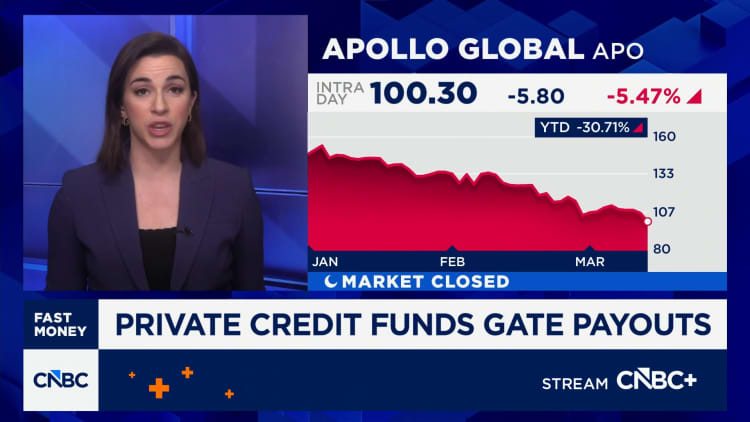
Shares of Blue Owl, TPG, Ares Management and KKR were all down by double digit percentages on Tuesday. Apollo Global was off by 7%. BlackRock shed 5%.
Publicly traded software stocks have been slammed this year as investors grew increasingly concerned about AI eating into their future growth and profit margins as companies use programs like Anthropic’s Claude Code to build their own software. The iShares Software ETF is down 20% this year, including another 5% decline on Tuesday.
UBS analysts estimate 25% to 35% of the private-credit market is exposed to the risk of AI disruption (other sources say that software, specifically, accounts for about 20 percent of outstanding loans for private-direct lenders). By comparison, the high yield corporate bond market (Using the iShares iBoxx High Yield Corporate bond ETF as a proxy) has only 8 percent exposure to technology, reflecting a broader diversification among the syndicated market than the private-credit market.

Blue Owl Capital, YTD
The publicly traded alternative asset managers are impacted in two ways – their private-equity side could be hit because software is rerated lower, which may mean less carry for tech-exposed or tech-adjacent investments. And then on the private credit side, there’s a risk of redemptions and, worst case, defaults. UBS estimates default rates could rise to 13% for private credit firms in the U.S. if AI triggers a big disruption. Comparatively, the default rate would be 4%for HY, UBS said.
“VC confidence in legacy enterprise SaaS business models has weakened materially over the last year with rapid change expected this year,” stated the UBS research. “Rather than an ‘AI Bust’ scenario, we think an ‘AI Disruption’ scenario is more likely with differentiated risks at an individual subsector and credit level.”
The “cockroaches” being talked about late last year (See JPMorgan CEO Jamie Dimon’s comment) were specific situations, mostly alleged fraud. This software rerating is a big test for private credit because of sector concentration and the ubiquity of exposure.
<