Samsung reveals first details of AI smart glasses to launch 2026
The Samsung exhibition stand features the prominent ”A new era of mobile agentic AI” slogan by the South Korean company Samsung Electronics.
Joan Cros | Nurphoto | Getty Images
Samsung’s upcoming smart glasses will have a camera and be connected to a smartphone, a top executive told CNBC, as the tech giant prepares to make its first foray into the product category.
Jay Kim, executive vice president at Samsung’s mobile business, teased some details about the smart glasses for the first time, on the sidelines of the Mobile World Congress trade show in Barcelona.
Kim told CNBC that the smart glasses will have a built-in camera at “your eye level.” The eyewear will be connected to your smartphone so that the handset can process information that is received from the camera.
Meta’s Ray-Ban glasses dominate the smart glasses market with 82% global share, according to Counterpoint Research. But other players, from Alibaba to Xreal and now Samsung, are trying to challenge the U.S. social media giant.
Samsung has been working with chip designer Qualcomm and Google since 2023 to design the operating system, semiconductors and hardware around so-called mixed-reality technology. The term refers to the combination of augmented and virtual reality, often involving digital images that are imposed over the real world.
The first product from this partnership was the Galaxy XR headset which went on sale last year and was based on Google’s Android “XR” — an umbrella term for VR and mixed and augmented reality — operating system. Qualcomm CEO Cristiano Amon told CNBC in 2024 that smart glasses were the ultimate goal.
Companies see smart glasses as potentially having a larger appeal than other XR products because they are smaller and glasses are already so widely worn.
“I think the XR on headset will sort of be around. But not as a sort of mass scale business,” Kim said.
“Everybody talks about what’s the next AI device is, and I know I’ve been looking at many different types of devices. Glasses, obviously is one of them and everybody’s looking at it.”
The development of more advanced AI applications like Google Gemini or ChatGPT has fueled the push towards smart glasses.
Device makers are figuring out how users might interact with these services beyond typing in an app on a separate device, such as by speaking to an AI assistant in the glasses and the glasses’ camera being a mode of input for AI.
Kim added that the “important thing” was for AI to understand “where you’re looking at” so it can “feed the information to the mobile phone and then it processes and actually gives you a lot of information.”
Kim declined to say whether the glasses will have a built-in display when asked but said that Samsung has other products like the smartwatch or phone if a user needs a display.
Kim said Samsung’s target is “to have something for industry this year.”
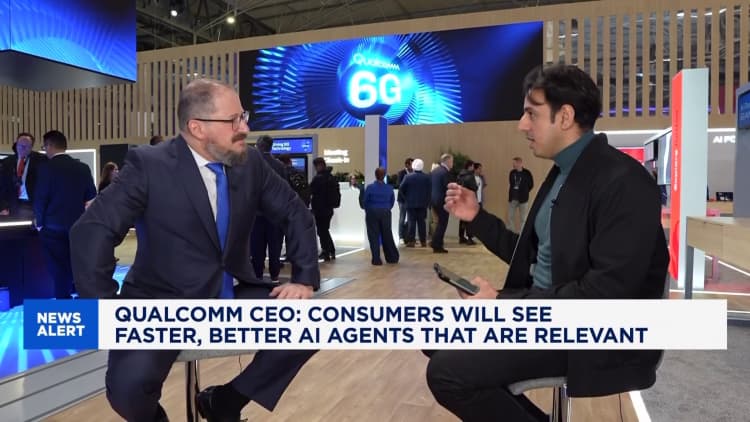
Qualcomm’s Amon told CNBC earlier this week that the smart glasses will be released this year.

Amon also laid out why he was “bullish” on smart glasses, saying they were “close to our eyes, close to our ears, close to our mouth, we’re going to have those agentic experiences and workloads.”
“Agentic” refers to AI applications that can carry out tasks on users’ behalf autonomously. Device makers have talked up a world where users may be able to ask their AI agents to call a cab or book a hotel.
The things users once did on their phones and laptops will shift to other devices like smart glasses, Amon said.
He likened the current state of smart glasses to the early days of smartphones when there were far fewer apps available.
“But then you go to 200 apps, 1,000 apps, and that’s how we’re going to see those glasses getting better over time as new agents get developed,” Amon said.
<