
What’s at stake in the countdown to the Trump-Xi meeting
This report is from this week’s CNBC’s The China Connection newsletter, which brings you insights and analysis on what’s driving the world’s second-largest economy. You can subscribe here.
The big story
As street traffic returns in Beijing after a nine-day holiday, there’s little time for businesses to breathe, ahead of a critical few weeks for U.S.-China relations.
First up is an annual meeting of China’s parliament that kicks off next Thursday. That’s when Chinese Premier Li Qiang will announce the year’s growth targets and stimulus plans — against renewed tariff uncertainty.
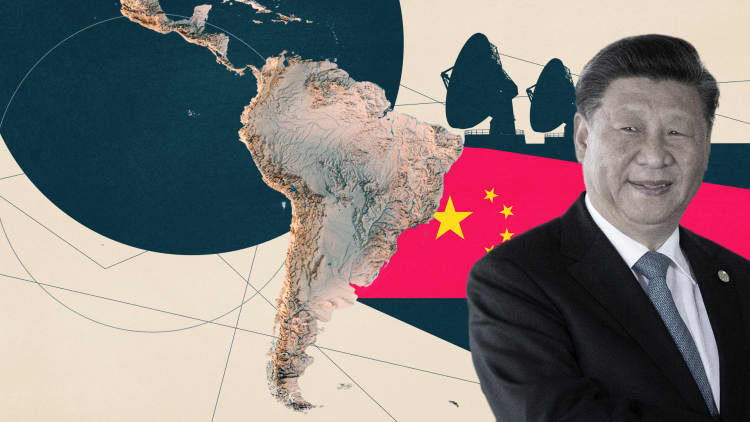
All eyes, however, will be on U.S. President Donald Trump’s meeting with Chinese President Xi Jinping. The White House said the visit will happen from March 31 to April 2, although China has yet to confirm the dates.
Tariff cuts will be in focus. The two leaders could send a positive signal by publishing whitelists that support cross-border investment, said Hai Zhao, a director of international political studies at the Chinese Academy of Social Sciences, a state-affiliated think tank.
Zhao also hopes the U.S. and China can agree on guidelines that can prevent the relationship from being rocked by short-term developments.
Time, however, is tight for both sides to refine negotiating points. China’s parliamentary meeting is likely to end only in the second week of March, followed by a state-organized “China Development Forum” which typically draws executives from U.S. and other foreign companies.
If Trump’s trip proceeds, it will be the first visit to China by a sitting U.S. president since 2017.
The U.S. tariff leverage calculus on Beijing has shifted in the years following that trip. The U.S. share of China’s overall exports has fallen sharply from 18% at the end of 2017 to 9.6% at the end of last year.
After a weekend of back-and-forth from Washington on global tariff rates, China’s Commerce Ministry broke its holiday silence with a statement Monday that urged the U.S. to cancel its tariffs.
“For companies, the [U.S. Supreme Court tariff] ruling renews trade uncertainty as the stop-and-go policy will prevail and complicate inventory management,” Ludovic Subran, chief investment officer and chief economist at Allianz Research, said in a co-authored report Monday.
For now, “the Global South and China now emerge as the biggest winners,” Allianz Research said.
China won’t change its demand for lower U.S. tariffs and hopes for a more stable and predictable tariff regime, Zhao said. He added that China isn’t seeking to maximize its trade surplus with the world and may need to adjust its relations with other countries to address the economic impact.
This aerial photo shows containers at the Longtan port in Nanjing, eastern China’s Jiangsu province on January 14, 2026.
Str | Afp | Getty Images
Interconnected economies
China’s top diplomat Wang Yi typically fields questions during the roughly week-long parliamentary session and could shed light on Beijing’s stance on global trade.
But the ultimate answer lies at home. What’s the actual economic pressure that China’s policymakers are up against?
The U.S. economy and China’s exports remain closely linked, Macquarie’s Chief China Economist Larry Hu noted.
That’s because U.S. economic growth has been largely propelled by investment in artificial intelligence, while China’s export strength has been supported by overseas sales of chips and power equipment, according to Hu’s analysis.
“If an AI bust causes China’s exports to plunge … Beijing would need to step up domestic stimulus,” Hu said. In that scenario, Beijing would likely step up support for the property sector, which would then revive a long-awaited recovery in consumption.
As investors brace for more AI-driven volatility, what’s the takeaway? If AI-related spending and stocks plunge, the ultimate winners are companies exposed to consumer spending in China, according to Hu.
The market turbulence comes even as Beijing accelerates its AI push. In recent weeks, homegrown startups and established tech giants have rolled out a wave of new models, moving swiftly ahead of a widely anticipated update from domestic AI company DeepSeek.
As its parliamentary meeting kicks off next week, policymakers are expected to release more details on its five-year plan to boost domestic tech capabilities.
Deepseek, which became a talking point for policymakers at last year’s meeting, signaled a renewed emphasis on tech.
The question hanging over next week’s gathering is less about whether China will double down on tech than about how confident Beijing is in a fragile U.S. trade truce that keeps exports afloat.
Top TV picks on CNBC

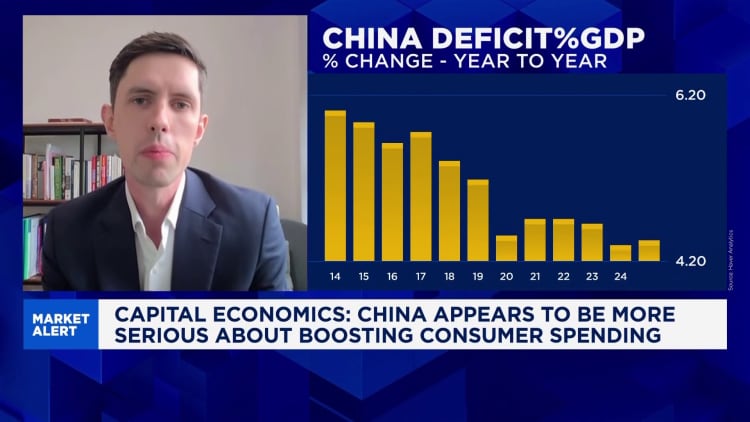
Julian Evans-Pritchard, head of China economics at Capital Economics, said Chinese authorities are starting to realize that investments into infrastructure and real estate are no longer able to deliver long-term economic growth.

Latest data from the Port of Los Angeles and the Port of Long Beach suggest China has yet to follow through on commitments to increase purchases of U.S. agricultural goods under a trade agreement between President Xi Jinping and President Donald Trump.

Max Kahn, president of Coresight Research, said the aspirational segment of the luxury market in China is improving as with consumer sentiment, and that there’s still demand for Western goods.
Need to know
Port controversy. China-linked CK Hutchinson has officially lost control over Panama Canal assets — which local authorities handed to Danish shipping giant A.P. Moller-Maersk and Swiss-based Mediterranean Shipping Co.
‘Remarkable.’ That’s how OpenAI CEO Sam Altman described Chinese tech companies’ progress in a CNBC interview. It’s not just AI. Their pace of development in “many fields” is “amazingly fast,” he said.
Humanoids advance. From stumbles to kung fu flips, Chinese human-shaped robots have shown rapid improvement in just one year.
In the markets
Chinese and Hong Kong stocks rose in afternoon trading Wednesday, after easing concerns around the impact of artificial intelligence on select industries led to a tech-driven rally on Wall Street
Hong Kong’s Hang Seng index rose 0.39%, while mainland’s CSI 300 added 0.49%. Year-to-date, the CSI 300 is up 2.26%, while the Hang Seng Index rose 4.12%.
China’s benchmark 10-year government bond yield rose to 1.807%, while the offshore yuan was little changed at 6.9088 against the greenback.
— Lee Ying Shan

The performance of the Shanghai Composite over the past year.
Coming up
Feb. 25-26: German Chancellor Friedrich Merz on state visit to China
Feb. 26: Baidu to release quarterly earnings after the Hong Kong market close
March 1: China to lower tariffs on Canadian canola seed and resume imports of Canadian beef
March 4: RatingDog China Services and Manufacturing PMI, Official NBS Manufacturing PMI
<