

4 lessons for the UK from bond markets
Alexander Spatari | Moment | Getty Images
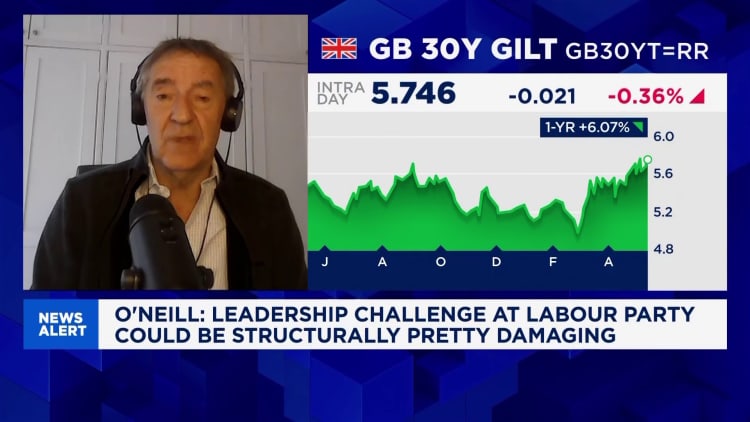
Britain faces among the highest borrowing costs of any developed nation — but bond markets offer 4 key lessons the government can embrace to remedy the issue, according to former U.K. Treasury minister Jim O’Neill.
Speaking on CNBC’s Squawk Box Europe, the former economist and Goldman Sachs asset management chief said that the U.K. government needs to stop obsessing with social media and the “next 24 hours”, and instead focus on the big issues facing the country.
It comes after U.K. government bonds — known as gilts — came under heavy selling pressure on Tuesday amid calls for Prime Minister Keir Starmer to resign. While Starmer insists he is going nowhere, Britain could soon see its fourth leader in as many years.

“We have got to get rid of the triple lock,” O’Neil told CNBC, referencing Britain’s state pension which is guaranteed to increase annually by the highest of three metrics; consumer price inflation, average earnings growth, or a minimum of 2.5%.
“We have got to do something about very misallocated welfare payments,” he added. “We have got to do something substantial about how we tax the housing market. And we’ve got to do something to stop this… persistent belief that. whatever happens, we’re going to spend more and more of our government money on rising NHS costs.
“It’s just not sustainable.”
U.K. bonds initially rallied on Wednesday morning, reversing course after the previous trading session saw borrowing costs surge to generational highs. But yields later shifted into positive territory and then fluctuated around the flatline.
The renewed volatility came amid reports that Health Secretary Wes Streeting is preparing to resign. A subsequent story from the BBC claimed his political allies had told the broadcaster he was planning to launch a leadership coup as soon as Thursday.
Streeting has long been reported to covet the top job in government, and is widely seen as a frontrunner to replace Starmer.
By 12:47 p.m. in London, the yield on the benchmark 10-year gilt traded less than 1 basis point lower at 5.095%.

UK 10-year gilt
The previous day saw the 10-year gilt add 9 basis points to hit its highest level since 2008.
Bond yields and prices move in opposite directions, with traders often commanding higher yields on debt investments when confidence in the government issuing the bonds is shaken.
Starmer’s leadership hangs in the balance after his party’s poor performance in the U.K.’s local elections last week led to widespread demands from lawmakers for his resignation.
His position appeared more stable by Wednesday morning. While 90 members of parliament from the governing Labour Party have called on the prime minister to step down, more than 100 signed a statement backing Starmer to stay put.
The prime minister has repeatedly refused to step aside, saying he plans to see his mandate through and pointing out that no contender has formally stepped forward to challenge his leadership.
On the rumors surrounding a potential leadership challenge, O’Neill added that the country has got to be “a bit more adult” about how it approaches internal contests.
“The leadership of the country is being treated like a game show,” he said. “The Tories went down this disastrous path, now Labour want to try it too.”
The bond market has largely been supportive of Starmer and his finance minister Rachel Reeves retaining their positions, relative to potential alternatives, with gilts selling off in previous bouts of uncertainty over their political futures.
On Wednesday, yields fell across the curve in early trading as Starmer’s premiership began to appear more tenable — but by the afternoon in London, volatility resurfaced in the U.K. bond market as the BBC reported that Streeting could launch a leadership challenge as soon as Thursday.
Yields on 20- and 30-year gilts, which are hovering around their highest levels since 1998, oscillated around the flatline on Wednesday afternoon. They were last seen trading marginally higher.
UK 20-year and 30-year gilts
Many traders have voiced concern about a potential move toward a more left-leaning policy mix should Starmer be replaced. Former Deputy Prime Minister Angela Rayner and Greater Manchester Mayor Andy Burnham are widely seen as potential candidates to replace Starmer. Rayner and Burnham — who is currently ineligible to stand as prime minister because he lacks a seat in parliament — are broadly considered more left-leaning than Starmer.
Without Starmer’s resignation, a Labour leadership challenge — which would determine Starmer’s fate as leader of the governing party — can only be triggered if 20% of Labour MPs back a challenger. Currently, that means 81 Labour MPs would need to back a potential replacement.
The U.K. already has the highest government borrowing costs in the G7, with yields on its 10-, 20- and 30-year government bonds trading well above the critical 5% threshold.
<