
5 things to know before the market opens Tuesday
This is CNBC’s Morning Squawk newsletter. Subscribe here to receive future editions in your inbox.
Happy Tuesday. Shares of key players in the artificial intelligence trade — like Oracle, Nvidia and SoftBank Group — are all falling this morning following a report that OpenAI missed internal targets for revenue and user growth.
Stock futures are mixed in pre-market trading. The S&P 500 and Nasdaq Composite both recorded new record highs yesterday.
Here are five key things investors need to know to start the trading day:
1. The stage is set
Sam Altman, CEO of OpenAI (L) and Elon Musk, CEO of Tesla.
Reuters
The nine-person jury was seated yesterday in the high-profile trial between OpenAI CEO Sam Altman and Tesla CEO Elon Musk. Opening arguments in the $134 billion suit are set to begin this morning in California federal court.
Here’s what to know before trial kicks off:
- Musk is suing OpenAI, Altman and the AI lab’s president Greg Brockman, alleging that they went back on their promise to keep the company a nonprofit.
- Judge Yvonne Gonzalez Rogers has divided the trial into two parts: a liability phase to determine if any wrongdoing has taken place, followed by a remedies phase focused on next steps.
- The jury will only weigh in during the first phase, and only in an advisory capacity, meaning Gonzalez Rogers will ultimately make the final decision in both parts of the trial.
- On Monday, lawyers for the two sides gauged potential jurors’ views of Musk, Altman and artificial intelligence, leading some to admit to having a negative perception of Musk due to his political views. “The reality is people don’t like him,” Gonzales Rogers said.
- Altman and Greg Brockman — both of whom Musk has pushed to oust as part of his suit — were in the courtroom yesterday.
- CNBC will cover the trial from the courtroom, live on TV and online. Tune in here.
2. Under consideration
White House Press Secretary Karoline Leavitt speaks during the daily press briefing in the Brady Press Briefing Room at the White House on April 27, 2026 in Washington, DC.
Andrew Harnik | Getty Images
President Donald Trump on Monday discussed Iran’s proposal to reopen the Strait of Hormuz with his national security team, White House press secretary Karoline Leavitt said yesterday. Under the framework, Tehran would the open the key passage if the U.S. ends its blockade of the strait and the war concludes, while negotiations over Iran’s nuclear ambitions would be reportedly be postponed.
As CNBC’s Kevin Breuninger reports, Leavitt said discussion of the proposal did not mean Trump was “considering” the offer and that Trump would likely speak directly on the subject “very soon.” Trump has pledged to keep the strait closed until a deal with Iran is “100% complete.”
Brent oil futures surged above the $111 per barrel mark this morning. Still, investors have largely looked past the latest tension: The S&P 500 and Nasdaq Composite both hit new record highs yesterday. Follow live market updates here.
3. A tariff tailwind
The General Motors global headquarters at Hudson’s Detroit in Detroit, Michigan, US, on Monday, Jan. 12, 2026.
Jeff Kowalsky | Bloomberg | Getty Images
Trump’s tariffs hit automakers especially hard. Now, the Supreme Court’s decision to overturn the president’s steep duties is giving a boost to at least one car manufacturer.
General Motors hiked its 2026 guidance this morning, citing an expected $500 million tariff refund. The company also beat earnings expectations for its first quarter, though revenue for the period came in slightly under expectations.
Investors liked the announcement. Shares of General Motors are roughly 5% higher in premarket trading.
4. Up for grabs
In this photo illustration, Apps for online prediction market sites are shown on an electronic device on Feb. 25, 2026 in Chicago, Illinois.
Scott Olson | Getty Images
Perpetual futures are one of the biggest —and riskiest — corners of crypto trading. As CNBC’s Tanaya Macheel reports, prediction market platforms want a piece of it.
Kalshi and Polymarket last week were reported to be planning a buildout of so-called perps, which have been largely restricted in the U.S. until recently. Now, perps account for more than 70% of total volume on centralized crypto exchanges, according to CoinGecko.
Perps can offer as much as 100-times leverage on an investment. The addition of this type of leveraged trading could redefine how Americans trade the real-world event contracts that have made prediction markets so popular.
5. Spotting partner
Spotify and Peloton are teaming up. The streaming platform is launching a fitness category with more than 1,400 Peloton classes available for premium subscribers, the companies announced yesterday.
The deal builds on Spotify’s efforts to monetize content beyond music and podcasts, while aiding Peloton’s transition away from a hardware-focused business model. Neither company disclosed financial terms for the partnership.
Shares of Spotify are down more than 10% this morning after reporting earnings for the first quarter. The company’s revenue for the period was in-line with expectations, but weaker-than-expected operating income guidance for the current quarter sent shares tumbling.
The Daily Dividend
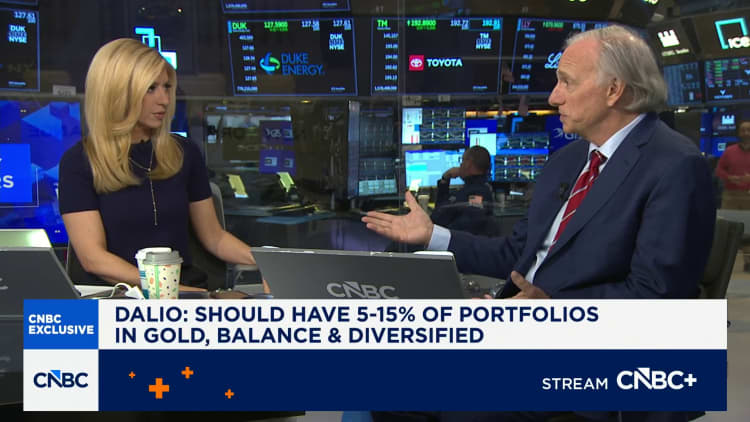
Bridgewater Associates founder Ray Dalio told CNBC yesterday that the U.S. economy is in a “stagflationary” environment. As a result, the billionaire investor recommended against interest rate cuts for the Federal Reserve.

— CNBC’s Ashley Capoot, Lora Kolodny, Spencer Kimball, Sam Meredith, Sean Conlon, Kevin Breuninger, Tanaya Macheel, Brandon Gomez, Michael Wayland and Yun Li contributed to this report.
Davis Giangiulio assisted in the production of this newsletter. Josephine Rozzelle edited this edition.
Disclosure: CNBC and Kalshi have a commercial relationship that includes a CNBC minority investment.
<