European Central Bank keeps rates on hold as inflation jumps
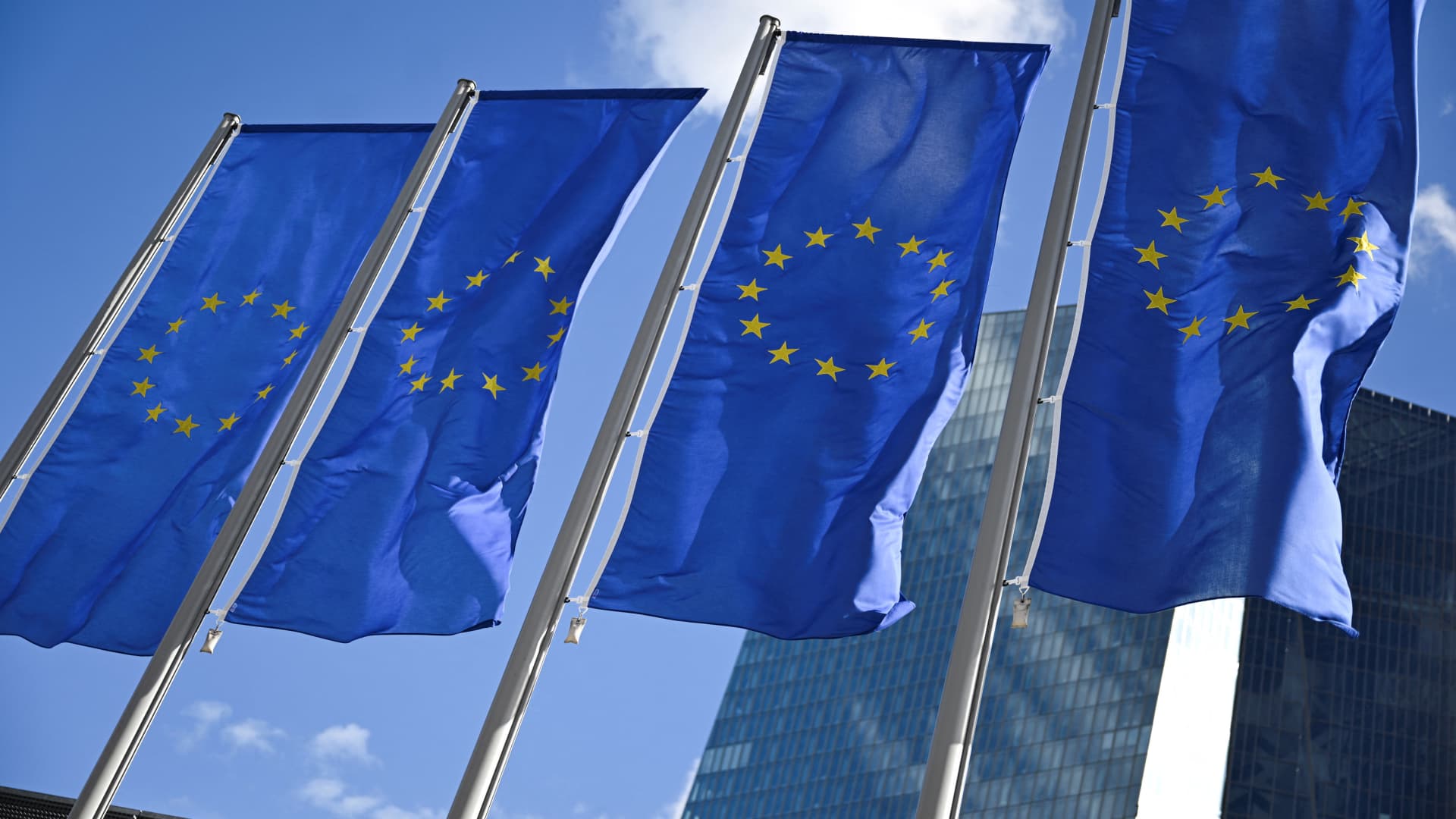
European Union flags flutter on the day European Central Bank (ECB) President Christine Lagarde speaks to reporters following the Governing Council’s monetary policy meeting in Frankfurt, Germany September 12, 2024.
Jana Rodenbusch | Reuters
The European Central Bank kept interest rates on hold at its April meeting, despite a surge in inflation in the euro zone since the war in Iran began.
The ECB’s governing council opted to hold its benchmark deposit facility rate at 2% on Thursday.
In a statement, the bank said that while its previous assessment of the inflation outlook was largely unchanged, “the upside risks to inflation and the downside risks to growth have intensified.”
It said its governing council remained committed to setting monetary policy to ensure that inflation stabilizes at the 2% target in the medium term.
Acknowledging that the war in the Middle East had led to a sharp increase in energy prices, pushing up inflation and weighing on economic sentiment, the ECB noted that “the implications of the war for medium-term inflation and economic activity will depend on the intensity and duration of the energy price shock and the scale of its indirect and second-round effects.”
“The longer the war continues and the longer energy prices remain high, the stronger is the likely impact on broader inflation and the economy,” the bank stressed.
It said it would closely monitor the situation and take a data-dependent and meeting-by-meeting approach to determining its monetary policy stance. Policymakers would not pre-commit to a particular rate path, it emphasized.
The euro was trading almost 0.2% higher against the dollar after the move, at $1.17. Euro zone bond yields fell slightly, with the interest rate on the 10-year German bund down 3 basis points to 3.0580%, and its French equivalent 4 basis points lower, at 3.7135%.
The ECB’s decision came after flash data out Thursday showed inflation in the euro zone jumped to 3% in April, driven largely by a rise in energy costs in the region. Growth slowed in the first quarter, expanding by a meager 0.1%.
ECB President Christine Lagarde told a press conference Thursday that “domestic demand remains the main driver of growth, supported by a resilient labor market.”
“However, the economic outlook is highly uncertain and will depend on how long the war in the Middle East lasts and how strongly it affects energy and other commodity markets as well as global supply chains,” she said
“The war in the Middle East remains a downside risk to the euro area economy, adding to the volatile global policy environment.”
Today, she added, the governing council had made “an informed decision on the basis of yet-insufficient information,” having debated the bank’s various options at length.
What happens next?
Lagarde said at the bank’s last gathering in March that policymakers were ready to hike interest rates even if an expected jump in euro zone inflation proved temporary.
Some economists say the bank’s June meeting will be the one to watch, with a potential 25-basis-point increase to take its key interest rate to 2.25%. Others insist that the central bank must tread very carefully before hiking rates at a time when the economy appears to be stalling and consumer confidence is waning.
Mark Wall, chief European economist at Deutsche Bank, said the bank is exuding a sense of calm confidence for now, “with references to the resilience of the economy in recent quarters and longer-term inflation expectations remaining well-anchored.”
“But there is also a sense of rising concern the longer the conflict in the Middle East continues. Overall, this is a statement that does not pre-commit the ECB to hiking in June. But it does not stop the ECB from hiking in June either,” he added.
Crowds of pedestrians and shoppers walk along Weinstrasse toward Marienplatz in Munich, Germany, on March 14, 2026.
Michael Nguyen | Nurphoto | Getty Images
Yael Selfin, chief economist at KPMG, sees the potential for a rate increase in the near term.
“In contrast to several other major central banks, including the Bank of England, policy rates in the Eurozone are in neutral territory, contributing to a potential greater need for the ECB to act more swiftly to prevent inflationary pressures from becoming more embedded.”
“Unlike during the energy shock in 2022, fiscal policy across the euro zone is more restrictive and the labor market has softened, reducing the risk of second‑round effects taking hold. However, with inflation rising and energy supply disruptions showing few signs of easing, the ECB is likely to begin its rate hiking cycle in June with any further moves remaining highly dependent on incoming inflation and wage data.”
<