How Apple’s new chief could shake things up

This report is from this week’s The Tech Download newsletter. Like what you see? You can subscribe here.
The week kicked off with major news that Apple’s chief Tim Cook will step down this year, with Senior Vice President of Hardware Engineering John Ternus taking over as CEO in September.
Cue tech and political leaders praising the outgoing Cook, who’d presided over a more than 20-fold increase in market cap at the tech giant since taking over from the late Steve Jobs in 2011.
But what does the change in leadership say about where Apple’s going in the coming years?
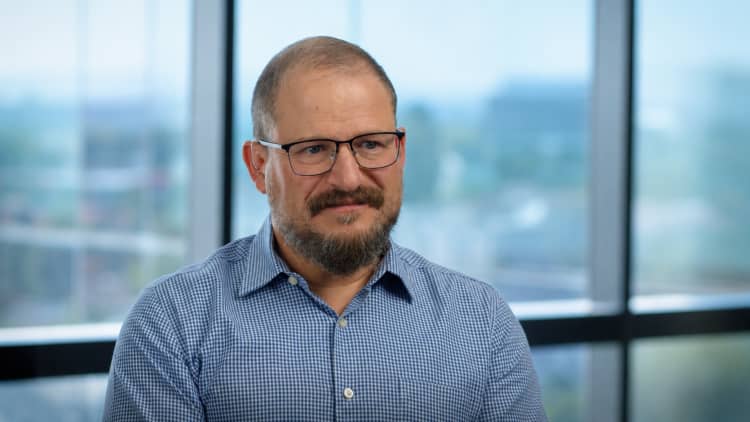
I caught up with CNBC’s Fortt to get his sense of what it could mean for the future of the company.
John Ternus, senior vice president of hardware engineering at Apple Inc., during an Apple event in New York, US, on Wednesday, March 4, 2026.
Adam Gray | Bloomberg | Getty Images
How significant is it that Apple’s release mentioned Cook’s new role as involving “engaging with policymakers around the world?”
That’s very significant.
In a way, Tim Cook’s superpower was always taking the innovation in Cupertino and orchestrating the external forces to bring it to life, through perfecting the supply chain and designing supplier relationships as chief operating officer, and eventually practicing international diplomacy as CEO.
It seems he’ll be retaining some of this role as executive chairman. That could prove to be enormously valuable, giving John Ternus time to focus on Apple’s innovation processes without all of the political distractions.
Will Ternus’ appointment change Apple’s international strategy?
I would be surprised if Ternus comes in and changes international strategy, because the supply chain is both one of Apple’s core strengths and one of the most difficult things for the company to change its mind about.
Think about how long it takes to negotiate terms with governments and partners, coordinate with supply chain partners, build factories, train workers — it’s a commitment measured in decades.
That said, with the way geopolitical norms are shifting, Apple is likely to adjust things — I’m just not sure it would be attributable to Ternus taking the CEO seat.
How will Ternus impact Apple’s thesis around AI?
The Ternus appointment suggests Apple is not having an AI-induced identity crisis.
While the company obviously hasn’t executed perfectly on AI, announcing features like Siri with Apple Intelligence it hadn’t been able to ship, the company hasn’t reached outside of its homegrown ranks for a CEO. Apple hasn’t shifted software to some new position in its structure.
Instead the company has picked an insider and doubled down on its functional management structure and integrated product strategy.
What else does this mean for Apple’s trajectory?
There’s an interesting shift here in how Apple appears to be approaching hardware.
The company has gone from an emphasis on external changes to shape and color, to one on internal ramps of capability and efficiency.
During the Steve Jobs era, the partnership between Jobs and industrial design lead Jony Ive was an important driver of hardware innovation and “taste.” A lot of that expression was in how the machines looked on the outside, which of course was heavily influenced by how they were engineered inside and out.
Over the last 20 years, the way Apple has expressed hardware innovation has shifted.
The iMac G5 and Mac Mini in 2004 and the MacBook Air in 2008 became the blueprints for future hardware expressions. The exterior of these designs has barely changed, while the insides have changed profoundly.
With Johny Srouji now in charge of all hardware, that direction looks to me to be reinforced. Srouji made an enormous contribution by growing Apple’s silicon capabilities over the past 18 years. Now he’s leading development of hardware overall.
Latest updates
Chinese artificial intelligence startup DeepSeek on Friday released a preview version of its long-awaited V4 large language model, allowing users to test its new capabilities and features.
Microsoft looked at a potential deal for Cursor prior to SpaceX’s announcement this week that it’s obtained the right to acquire the AI coding startup for $60 billion, two people familiar with the matter told CNBC.
Anthropic is ramping up a push to secure European data center deals to power its AI models, as it looks to hire a role for negotiating compute capacity in the region.
Google, LinkedIn and Wikipedia are among hundreds of websites and apps where Meta plans to capture employee keystrokes and mouse clicks as part of a project to train its artificial intelligence models, according to internal messages viewed by CNBC.
Microsoft on Thursday announced an $18 billion investment into Australia’s digital infrastructure which will see the technology giant partnering with Canberra on initiatives spanning cybersecurity, workforce upskilling, and artificial intelligence development.
Stock of the week

Tesla stock has dropped since it reported earnings on Wednesday.
Tesla shares dropped after reporting first-quarter earnings on Wednesday that saw revenue come in weaker than expected despite beating analysts’ estimates.
It follows a few months that’s seen Tesla’s stock underperform compared to its megacap peers, with its core automotive business struggling against competitors across the globe like China’s BYD and Xiaomi.
<