Jeff Bezos says bottom half of earners should pay zero in income taxes
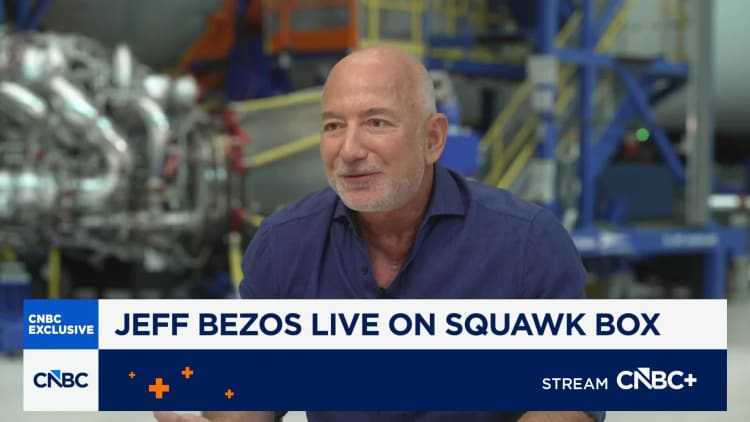

Amazon Executive Chairman Jeff Bezos on Wednesday called for zero federal income taxes on the bottom half of earners.
The top 1% of taxpayers pay about 40% of all the tax revenue, and the bottom half pay 3%, Bezos told CNBC’s Andrew Ross Sorkin on “Squawk Box.”
“I don’t think it should be 3%,” Bezos said. “I think it should be zero.”
The bottom half of taxpayers had an adjusted gross income of nearly $54,000 in 2023, according to the Tax Foundation, citing the most recent IRS statistics. By contrast, households in the top 1% earned at least $676,000 of income that year.
Bezos said the income tax paid by lower earners is “a small amount of money for the government,” and offered the hypothetical example of a healthcare worker who makes $75,000 a year.
“We shouldn’t be asking this nurse in Queens to send money to Washington,” he said. “They should be sending her an apology. It really makes no sense.”
He said he would “advocate” for such a change, but did not offer details on how lawmakers might enact it.
Bezos is the world’s fourth-richest person, with a net worth around $269 billion, according to Forbes.
Tax burden on low earners
Bezos’ comments come as a number of Democratic states explore higher taxes on the wealthy.
Several federal lawmakers have also recently introduced proposals to cut taxes for lower earners. Sen. Corey Booker, D-N.J., proposed the Keep Your Pay Act, which calls for the first $75,000 of income to be tax-free for households filing joint tax returns, with proportional tax relief for single filers and heads of households.
“No income tax on the first $75,000 families earn would be a game changer for working people,” said Booker in a statement announcing the proposed legislation on March 9. “This tax cut would immediately put more money in your pocket every month to deal with the high price of everyday expenses, an unexpected emergency, or to plan for the future.”
The average income tax rate in 2023 was 14.1%, according to a Tax Foundation analysis of IRS data. The top 1% of taxpayers paid an average rate of 26.3%, seven times higher than the 3.7% average rate paid by the bottom half of taxpayers.
There were more than 76 million households in the bottom half in 2023, according to the Tax Foundation. They paid $913 of federal income taxes, on average, that year.
However, when counting refundable tax credits, the bottom 40% of taxpayers already pay no income tax, on average, said Erica York, vice president of federal tax policy for the Tax Foundation.
‘A tale of two economies’
While the bottom half of earners have a lower tax burden, their struggles have been more pronounced amid higher inflation and broader concerns about affordability.
The so-called K-shaped economy illustrates Americans’ diverging experiences: Higher-income households continue to benefit from rising markets and wages, while many lower- and middle-income consumers struggle with higher costs and financial strain.
Federal Reserve Bank of New York research shows that the expiration of pandemic-era subsidies for low- and middle-income households created a noticeable divergence in 2023. More recently, sharply higher gasoline prices amid the Iran war are exacerbating the K-shape, researchers found. Lower earners spend a greater share of their incomes on gasoline relative to higher earners.
“I think what’s going on is that it’s kind of a tale of two economies, so you have a bunch of people in this country who are doing really well, but you also have a bunch of people in this country who are struggling,” Bezos said.
Do the rich pay their fair share?
Jeff Bezos speaks with CNBC’s Squawk Box from Merrit Island, Florida on May 20th, 2026.
CNBC
The notion of whether the wealthy pay their fair share of taxes relative to lower earners has long been a subject of fierce debate.
Critics of raising taxes on higher earners often point to the progressive nature of the federal tax code.
For example, the top 1% of taxpayers accounted for nearly 21% of total adjusted gross income in 2023 — but paid a much larger share, about 38%, of all federal income taxes that year, according to the Tax Foundation, citing IRS data.
Meanwhile, the bottom half of taxpayers accounted for 12% of total income, but just 3% of total income taxes paid.
Placing a higher tax burden on the rich may reduce the amount of money that they save and invest, according to Thomas Savidge, a research fellow at the American Institute for Economic Research, a free market think tank that promotes limited government.
That saving and investment activity generally “creates access to capital for all, allowing people to create and innovate, making everyone wealthier,” he wrote in 2025.
However, high earners often use the “intricacies of the tax code” to cut their IRS bills, and they pay an effective rate that is “far less” than the rate they must pay on paper, according to a 2024 report by the Yale University Budget Lab.
That said, tax burdens can range widely even among the richest households, it found.
For example, some taxpayers in the top 1% pay an effective tax rate of 3% while others pay as high as 45%, according to the Budget Lab’s analysis.
Some groups in favor of raising taxes on the wealthy say that the U.S. tax system isn’t as progressive as it may seem, when taking a more holistic view of household taxes beyond the personal income tax.
Payroll taxes are the biggest levy that many people pay, and those for Social Security aren’t owed on income above $184,500, according to a recent blog post by Jessica Vela, a federal policy analyst at the Institute on Taxation and Economic Policy, a progressive think tank. Million-dollar earners stopped paying into Social Security for 2026 in early March, the Center for Economic and Policy Research estimated.
Low earners also spend a greater share of their income on sales taxes at the state and local level relative to higher earners, contributing to a more regressive tax system, Vela wrote.
When accounting for all federal, state and local taxes paid by U.S. households, the top 1% account for 24% of total tax revenue — only slightly higher than their share of reported income, 20%, according to an ITEP analysis in 2024.
This doesn’t account for so-called unrealized capital gains, or the untaxed profits from stocks and other assets that are disproportionately owned by the wealthy, according to the analysis.
— CNBC’s Jessica Dickler and Kate Dore contributed reporting.
<