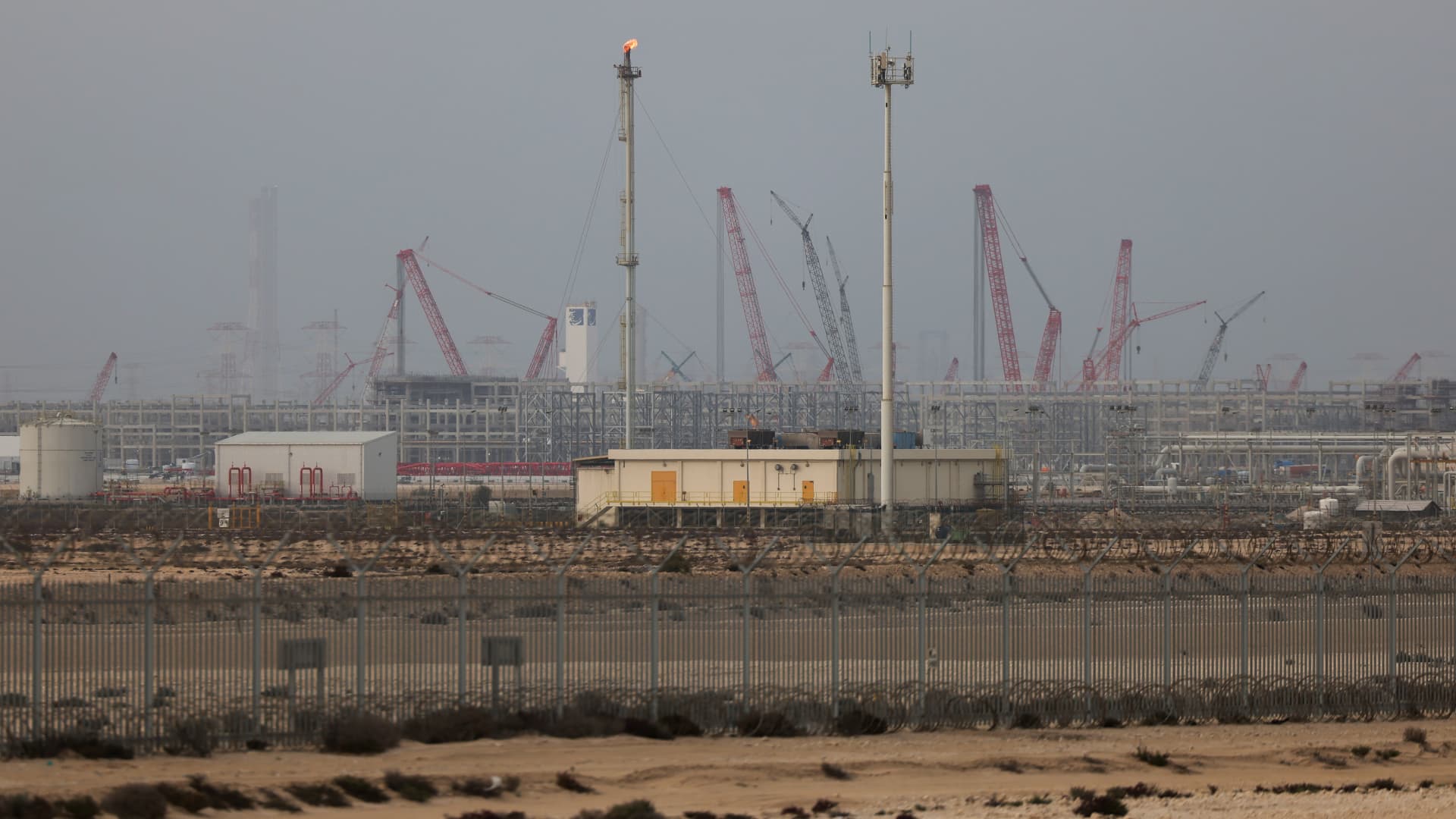

Jet fuel bidding war breaks out as airlines face global stress test

Europe is urgently turning to alternative suppliers of jet fuel as imports from the Middle East remain knocked out — but the continent must “fight for every cargo” in what analysts have dubbed a “global stress test” for the airline industry.
The loss of Middle Eastern jet fuel because of the Iran war is quickly becoming an acute logistics problem for Europe, according to analysts at Societe Generale.
The continent’s average daily demand of about 1.6 million barrels of jet fuel a day is typically met primarily through domestic production, at 1.1 million barrels per day.
But the additional 500,000 barrels is met via imports — three-quarters of which traditionally arrived from the Middle East, SocGen analysts said in a note Monday.
That supply has largely dried up since the Strait of Hormuz shipping channel effectively closed after the U.S.-Iran conflict started on Feb. 28.

While jet fuel remains available, it is “nowhere near” what is needed to replace supplies normally imported by Europe from the Gulf, said Benedict George, head of European product pricing at Argus.
“While we can import more, and we are, from the U.S. and Nigeria, we have to fight for every cargo that’s going to come,” George told CNBC’s “Squawk Box Europe” on Monday. “We have to fight against Singapore, against Australia — and the price…just goes higher and higher.”
Alternative sources
Before the start of the conflict, about 360,000 barrels of jet fuel were typically moved through the Strait of Hormuz every day — representing about 20% of shipped global flows.
The U.S. is emerging as a key source for Europe. U.S. global exports of jet fuel have gone stratospheric, soaring to a record 442,000 barrels a day in early April, or about 372,000 barrels over a four-week average, according to SocGen.
That’s about 200,000 barrels a day more than the five-year norm of 172,000 barrels a day. The U.S. has historically exported to about half of this to its neighbors Mexico, Canada and Panama — but now Europe is battling for this jet fuel too.
Before the war, Europe typically received between 30,000 and 60,000 barrels a day from the U.S. That’s since surged to about 200,000 barrels a day. But a Middle East deficit of about 53% of normal flows, or 175,000 barrels a day, remains.

International Consolidated Airlines Group.
“Europe would therefore need to bid harder for additional cargoes to maintain summer inventories,” SocGen analysts led by Mike Haigh, head of FIC and commodity research, said in the note published this week.
Across Europe’s six biggest jet fuel consumers — the U.K., Germany, France, Spain, Turkey and Italy — domestic output meets about 63% of their combined demand, which totals roughly 1.1 million barrels per day, SocGen said.
But reliance on domestic refining versus imported jet fuel differs sharply. Spain, for example, is typically a net exporter of jet fuel, while the U.K. — Europe’s largest consumer — depends heavily on imports, sourcing roughly 65% of its needs from abroad.
Even net exporters of jet fuel, such as the Netherlands, aren’t protected from the impact of rising prices, George said.
While certain Asian countries are already protecting consumers by restricting the export of jet fuel, the U.S. has not followed suit.
“U.S. consumers and U.S. airlines are competing against Europeans and against Singapore and so on for that American jet fuel,” George said.
‘Existential’ challenge
The International Energy Agency earlier this month warned that Europe could run out of jet fuel in weeks.
SocGen analysts warned that price hedging among airlines may not be enough if physical fuel actually becomes scarce.
“The distinction is critical,” they noted. “Paying more for energy is manageable; not having it is existential.”
George said that shortages are not yet imminent, as there are still fuel inventories, but airlines will have to balance maintaining their market share with trying to recoup the cost of fuel.
“Airlines, at some point, will anticipate they won’t be able to fill the plane if they pass this fuel cost on to consumers,” he said. “For each individual airline, it could be quite different.”
Elevated jet fuel costs stemming from higher oil futures can be passed onto consumers through higher fares and other surcharges. But cancelled flights due to unavailable fuel would be a “very different and far more disruptive outcome,” SocGen analysts added.
Lufthansa.
The prospect of sweeping cancellations, coupled with stiff price hikes on remaining routes, looms large across the continent. Lufthansa last week nixed about 20,000 flights, which it said would result in jet fuel savings of more than 40,000 metric tons.
A Lufthansa spokesperson told CNBC that it expects a “largely stable fuel supply” for its summer timetable.
“Lufthansa is working on various measures to achieve this, such as ensuring the physical supply of kerosene and safeguarding prices. As a general principle, our hedging strategy is designed to provide planning stability — not to eliminate market exposure entirely,” they said.
The German airline has hedged approximately 80% of its requirements for 2026 and approximately 40% for 2027 at pre-crisis price levels. “With this level of hedging, we are in a better position than most competitors,” the spokesperson added.
A spokesperson for IAG — owner of British Airways, Aer Lingus and Iberia — said: “We are not seeing jet fuel supply interruptions, but fuel prices have risen sharply and, despite our hedging strategy which gives some shorter-term mitigation, we are not immune to the impact.
“Our airlines will continue to monitor and respond to the situation and as long as these pressures continue, flexibility from government, including on slot alleviation, would ensure airlines can continue to operate as efficiently as possible and manage sustained cost challenges while keeping people and trade moving.”
EasyJet said it currently sees “no disruption to fuel supply” and its flights continue to operate normally.
“We are always focused on keeping fares low and have already confirmed we will not add surcharges to any pre-booked flights and package holidays, or to any future bookings for this summer,” an EasyJet spokesperson told CNBC.
The “sharp and sudden” increase in fuel prices has prompted Air France-KLM to hike ticket fares and make a number of adjustments to flight schedules in the coming months, a spokesperson said.
Economy fares on long-haul return flights have increased by 100 euros, and 70 euros for flights to the U.S., Canada and Mexico. For short- and medium-haul flights in Economy class, fares have been increased by 10 euros per return.
“For the upcoming months we are continuously analyzing and monitoring the situation, as well as various scenarios that could potentially impact our operations, including as a result of the blockade in the Strait of Hormuz as well as the reopening of the Strait.”
Wizz Air CEO József Váradi said Monday that the London-listed low-cost Hungarian carrier intends to grow its schedule by 17% this summer compared to last year. Váradi added that its fuel is 70% hedged for the summer period and said he did not expect the airline to run out of jet fuel.
But analysts at Morningstar warned that Wizz Air had the lowest fuel margin buffer out of all the main European publicly-listed carriers. Ryanair, by contrast, has a “high” full-year hedge, at about 80%.
<