Movie Review: Paul Rudd and Nick Jonas hit the right notes in ‘Power Ballad’
Let’s just say that the wedding band has never occupied the most exalted rung of the ladder in music.
Playing “September” and “Celebration” is often what’s most required. As one member of the Bride and the Groove, the band at the center of John Carney’s new film, puts it: They’re not rock stars. They’re human jukeboxes.
But in “Power Ballad,” a wedding band singer and pop star cross paths. For one night, all of the stratification of the music world falls away. “Power Ballad” starts like a fairy tale.
Since 2007’s “Once,” the Irish writer-director has focused his films on the redemptive capacity of music. Carney, who was once a bassist for the Frames, knows from experience. From “Sing Street” to “Flora and Son,” he has made unabashedly earnest tales where a song, or just picking up an instrument, changes lives.
This can, undoubtedly, lead Carney into sentimental territory. Lucky for him, his chosen subject — music — is more worthy of sentiment than almost anything else. Yet the song doesn’t quite remain the same in “Power Ballad,” a movie that begins with the gentle sweetness Carney is known for, but detours into something more discordant.
Rick (Paul Rudd) is an American musician who gave up on his once-promising rock band’s future to instead live with his wife (Marcella Plunkett) and teenage daughter (a spunky, underused Beth Fallon) in Dublin. His former group was called Octagon, a perfect former band name if there ever were one.
But for years, Rick has fronted the Bride and the Groove. It’s an unromantic day job (or rather a night one) that hasn’t entirely sapped his belief in his own songwriting. During an encore at one wedding, he plays an original tune and is mentally transported to an arena full of swaying fans. When he snaps out of it, he’s staring at an empty dance floor and faces that say: That wasn’t Kool & the Gang.
At another wedding at at a castle, the band is asked to let a friend of the newlyweds sit in. They reluctantly agree, and are surprised to see the very popular boy band veteran, Danny (Nick Jonas), step on stage. He sings Stevie Wonder’s “I Wish,” and it’s great. Though Rick had just dismissed Danny’s music as “manufactured content for young, excitable teens,” he discovers Danny is a genuine musician.
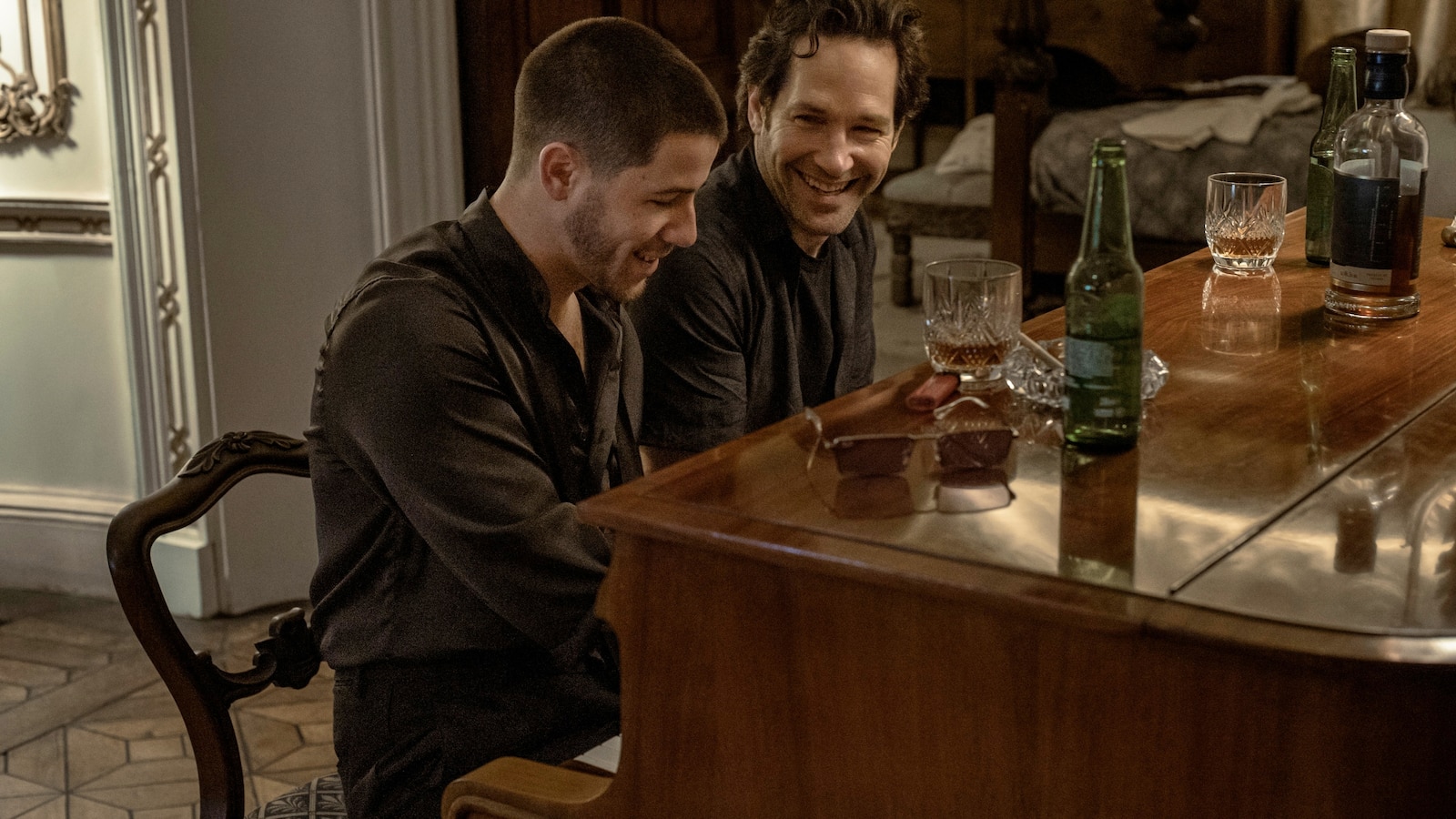
But, later that night, something even more remarkable transpires. Rick bumps into Danny, and the two quickly hit it off. They begin jamming together and sharing songs that need work. They are both so jazzed by their unlikely collaboration that they play into the next morning.
The actual moment of artistic creation, and the craft it requires, is something the movies almost always skip over. But capturing collaborative juices flowing is exactly what Carney excels at. You can feel his joy in it. So it’s fitting that one of the unfinished songs Rick plays for Danny, “How to Write a Song (Without You),” is about creative invention.
It’s here when you wonder where “Power Ballad” is headed. Is this, for Rick, the beginning of a beautiful friendship? Will they turn into the next great songwriting duo, lifting Rick out of weddings and proving to the world that Danny is more than a boy-band pretty face?
That is very possibly the movie Carney might have made a decade ago. But “Power Ballad,” which he co-wrote with Peter McDonald (who also co-stars as a band member), shifts six months ahead in time. Rick is standing in a shopping mall when the familiar lyrics of “How to Write a Song” softly float through the stores. He stands dumbfounded in the gleaming halls of commerce, a befuddlement that slowly turns into outrage the bigger and bigger Danny’s smash hit grows.
“Power Ballad” loses some of its steam in its second half, which follows Rick’s struggle for justice. Making things considerably harder is that he can find no recorded demo of the song. His family and his band don’t even really believe him.
But even as the movie struggles to sustain its opening refrain, Carney’s film is always riffing on ideas of authenticity and aspiration in music. That Jonas is, himself, a former boy band star who has at times gone it alone, lends the movie a direct connection to contemporary music, where tussles over authorship are increasingly common.
Jonas has been good in other films (notably the “Jumanji” movies), but this is his most ambitious and convincing performance to date. It’s a testament to the movie that Danny’s theft isn’t a purely villainous act. He gives the song a bridge and the vocal power to take it to another level. He’s under mounting pressure from his label to deliver a hit. An executive (Jack Reynor) wants “Danny 2.0” but has little faith he can supply it.
But it’s an even more well-tailored role for Rudd. He memorably and very goofily played a bassist in the 2009 comedy “I Love You, Man.” But while he sings well, it’s not his musical chops that lift the performance. It’s more that Rick, a contented family man with unrealized rock-star dreams, gives the exceptionally genial Rudd more notes to play as an actor. Rudd makes for a very likeable everyman out to convince the world he is capable of a beautiful song.
And that’s the abiding belief of Carney’s. No matter all the struggles, the artistic injustices, the corporate hegemony, he still believes that if you make something truly soulful, it will break through. It will claw its way to the surface, and move people. It’s undoubtedly gotten harder since “Once,” this movie seems to admit. The world is against you. But what one person can offer, a ballad or otherwise, still has power. Fairy tale or not, that’s worth believing in.
“Power Ballad,” a Lionsgate release in theaters Friday, is rated R by the Motion Picture Association for “language throughout and some drug use.” Running time: 108 minutes. Three stars out of four.
<