

Nvidia rivals eye huge funding rounds as AI chip market booms
European chip startups developing alternative technology to Nvidia’s graphics processing units (GPUs) are eyeing big funding rounds as they look to scale amid the AI boom.
Dutch company Euclyd, backed by the former CEO of chipmaking equipment giant ASML, is currently in discussions with investors for a round of at least 100 million euros ($118 million), its founder Bernardo Kastrup, told CNBC in an exclusive interview.
Elsewhere, U.K. startup Optalysys is planning a $100 million plus fundraise later this year and British company Fractile and France’s Arago are reportedly fundraising for nine-figure rounds. Fractile declined to comment and Arago did not respond to a request for comment. So far in 2026, investors have already funnelled more than $200 million into the Netherlands’ Axelera and the U.K.’s Olix.
Nvidia has rapidly become the world’s most valuable company as its GPUs, originally designed for gaming, have been repurposed for training AI models, but eyes are now turning to the most efficient ways to use those models, known as AI inference.
While the U.S. chip giant is developing semiconductor systems for that purpose too, a crop of new European startups are emerging that claim the tech they’re building can do it more efficiently.
“Inference is dominant now, and the existing GPU architecture wasn’t built for it in ways that matter most at scale,” Patrick Schneider-Sikorsky, director at the Nato Innovation Fund (NIF), which has invested in Fractile, told CNBC.
“The geopolitical tailwinds are obvious with U.S. export controls, concentration risk around [chipmaker] TSMC and a genuine European sovereign compute imperative are all pushing capital toward homegrown silicon.”
ASML alumni
Euclyd is developing AI chips that operate in a system which it says can deliver 100x higher power efficiency for inference compared to Nvidia’s latest generation Vera Rubin chips. Nvidia did not respond to a request for comment from CNBC.
The Dutch startup, founded in 2024 by former ASML director Kastrup and counting ex-ASML CEO Peter Wennink as advisor and investor, has already raised a seed round of under 10 million euros and is now looking for fresh funds to scale its tech and begin supplying its first customers.
Euclyd is building chip systems to replace GPUs, but with a different architecture, Kastrup said. While GPUs spend time and energy moving data through the memory stack, Euclyd’s chips will process data in multiple places, which Kastrup says will increase efficiency for AI inference.
The company’s silicon systems for foundational models will reduce the energy, cost and footprint of AI data center infrastructure, he added. But, unlike Nvidia’s chips, Euclyd’s systems have not yet been proven in deployment at scale with commercial partners.
Euclyd’s prototype system. Credit: Euclyd.
Euclyd is working on that. It has already developed a chip for AI inference, and is currently developing a multi-chiplet system — which will process faster than the current iteration of its product — which it aims to produce by 2028. It is in negotiations with four potential customers, said Kastrup, two of which the company hopes to begin supplying next year and two the year after.
Olix, which is developing photonics-based processors for AI, is also targeting initial customers next year, though it is currently in a research and development phase, Taavet Hinrikus, partner at Plural, an investor in the company, told CNBC.
Photonic processors are chip systems that use light to move data and, in some cases, to perform computation.
The startup will target any customers in need of inference services, Hinrikus said, including hyperscalers and governments. Olix did not respond to a request for comment.
The electronic architecture of chips, which include GPUs, is really “hitting the limits” in terms of how small they can be made, said Hinrikus. Chipmakers are trying to make processors smaller so they can fit more components on wafers and improve the economics of running systems on them.
“The heat [current chips] generate is becoming a major issue. We strongly believe that the photonics platforms will be the next paradigm,” he added.
Nvidia is also working hard to stay at the front of the pack. The chip giant spent more than $18 billion on research and development in its most recent full financial year, ending January 2026. In December, it acquired assets from AI inference startup Groq for $20 billion and announced in March it had invested $4 billion in two companies developing photonics technology.
Challenges to European startups remain
European startups face hurdles.
“Chip development timescales are long, the distance from tape-out to volume deployment is tough, and Europe’s foundry ecosystem still needs to mature,” the NIF’s Schneider-Sikorsky said.
Axelera CEO Fabrizio Del Maffeo told CNBC that governments in Europe are still “conservative” in investing in products from new companies and they don’t have an equivalent of DARPA, a U.S. Department of Defense agency research organization that funds startups and other tech projects.
Europe also lacks mechanisms to encourage consumption of locally built products and fragmented labor laws across borders make it harder to recruit European talent, he added.
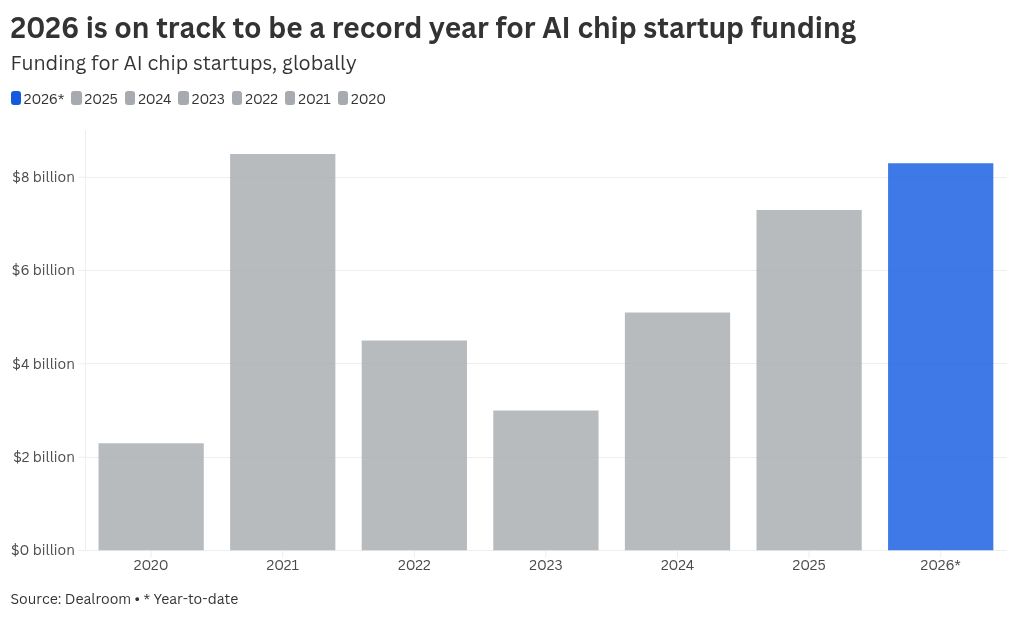
European AI chip startups are behind in funding, raising $800 million so far in 2026, compared with $4.7 billion for their U.S. counterparts, according to Dealroom.
In the U.S., Cerebras Systems picked up $1 billion in February, and there have been $500 million rounds for MatX, Ayar Labs and Etched this year.
Nonetheless, European startups developing chips for AI inference to rival Nvidia are increasingly garnering interest from investors.
“We’re seeing it in deal flow and in the conversations we’re having with founders in the space,” Carlos Espinal, managing partner at Seedcamp, which backed chip startup Vaire Computing, told CNBC. “It’s no longer a niche bet. It’s becoming a core part of how people think about AI infrastructure.”
<