SK Hynix posts record first-quarter profit, in line with estimates as memory prices climb
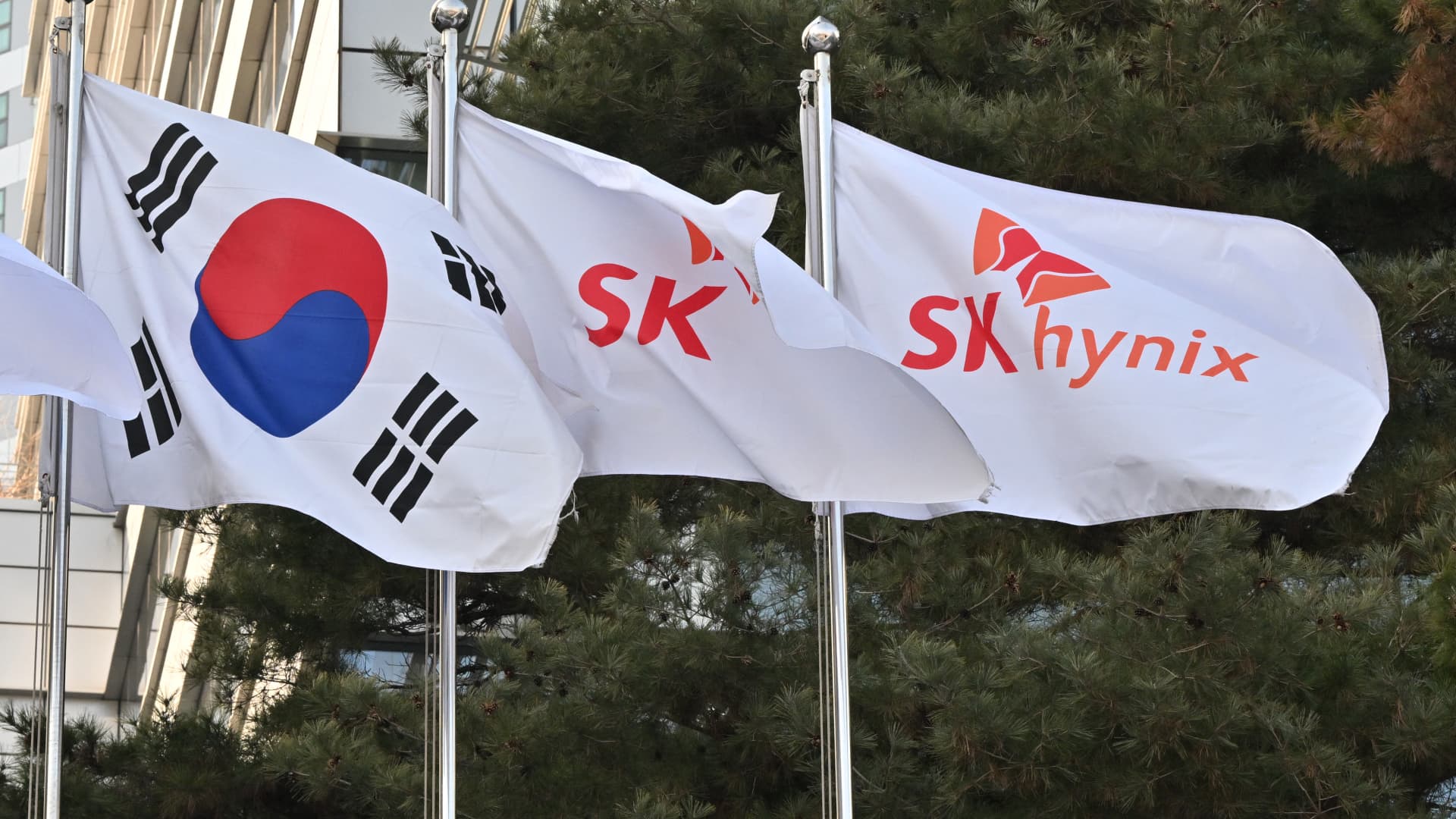
A SK Hynix flag (R) and a South Korean national flag (L) flutter outside the company’s Bundang office in Seongnam on Jan. 26, 2024.
Jung Yeon-je | Afp | Getty Images
South Korean memory chip giant SK Hynix posted yet another quarter of record profit and revenue on Thursday, as prices for its products continue to surge amid strong AI demand. While its earnings were broadly in line with estimates, revenue missed forecasts.
Here are SK Hynix’s first-quarter results versus LSEG smart estimates, which are weighted toward forecasts from analysts who are more consistently accurate:
- Revenue: 52.58 trillion won ($35.55 billion) vs. 53.55 trillion won
- Operating profit: 37.61 trillion won vs. 37.92 trillion won
Revenue in the March quarter nearly tripled from the same period last year, surpassing 50 trillion won for the first time.
Operating profit grew by a factor of five year-over-year and nearly doubled from the previous quarter, while operating margin also reached an all-time high of 72%.
SK Hynix makes memory chips used to store data, which are found in everything from servers to smartphones and laptops.
The company has benefited from a boom in artificial intelligence demand as the world’s leading supplier of high-bandwidth memory, or HBM, used in AI datacenters.
“SK Hynix noted that despite the fact that first quarter is typically a seasonal downturn, strong demand persisted due to expanded investments in AI infrastructure,” the company said in its earnings release.
HBM falls into the broader category of dynamic random access memory, or DRAM — a type of semiconductor memory used to store data and program code that can be found in PCs, workstations and servers.
SK Hynix had gained an edge over rivals like Micron and Samsung in the DRAM market, thanks to its early lead in HBM and its role as a key supplier to the world’s leading AI processor maker Nvidia.
However, Samsung reclaimed the top spot in DRAM revenue in the last three months of the year, according to data from Counterpoint Research. Meanwhile, SK Hynix continued to dominate in HBM with a 57% market share.
Counterpoint added that the DRAM market has recorded 30% quarter-over-quarter growth for two consecutive quarters due to rising memory prices.
Rising memory prices have resulted from surging demand for HBM, which has occupied manufacturers’ capacity, triggering a broader memory shortage in recent quarters.
SK Group Chairman Chey Tae-won reportedly stated in March 2026 that the global chip wafer shortage is likely to persist until 2030, as demand for HBM continues to outpace supply and strain manufacturing capacity.
He added that building additional wafer supply could take at least four to five years, with a projected shortfall exceeding 20%.
<