Trudeau says US, Europe nearly drove Canada towards China
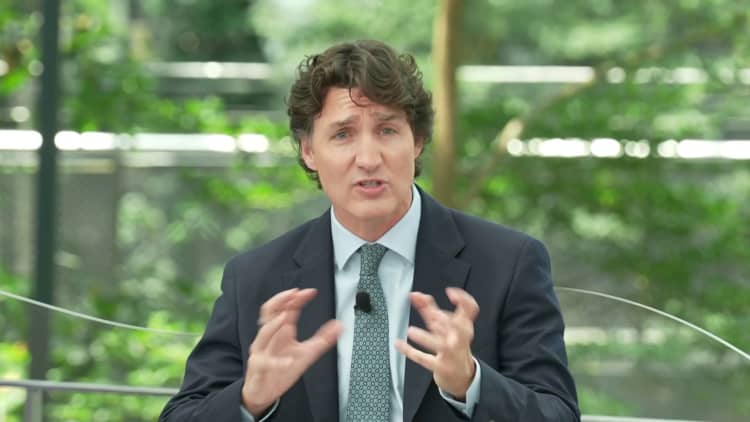
Former Canadian Prime Minister Justin Trudeau speaks at CNBC CONVERGE LIVE in Singapore on April 23, 2026.
CNBC
Canadian companies are turning towards making deals with China because of economic coercion from the U.S., according to former Canadian Prime Minister Justin Trudeau.
Speaking at CNBC’s CONVERGE LIVE in Singapore on Thursday, Trudeau described a time when he said the U.S. and Europe “almost drove” Canada “into China’s arms.”
Canadian company Bombardier, which makes private jets, began building a commercial jet known as the C Series in 2008. But it was unable to sell the model to airlines because of pressure from Airbus, a European company and Boeing, a U.S. firm, Trudeau said.
Bombardier was approached by Chinese investors, who offered a “dump truck full of money” to buy the business, according to Trudeau. “Boeing and Airbus — that were busy trying to put Bombardier out of business because they didn’t want Bombardier to be a contest — almost drove us into China’s arms,” Trudeau said.
Chinese investors offered a partnership with Bombardier in 2015 when talks about a potential Airbus merger fell apart. In 2017, Bombardier again turned to China for a deal after negotiations with Boeing over the C Series were unsuccessful.
At the G7 Summit in 2017, an annual meeting of the Group of Seven leading industrialized nations, Trudeau intervened, he said. “It took me around the G7 table in Sicily … in 2017 saying to Macron and Merkel and Trump, you are driving us into Chinese pockets, into Chinese hands to protect jobs. They’re willing to pay anything to get this,” Trudeau told CONVERGE LIVE.

In 2018, Airbus took on a “majority stake” in Bombardier’s commercial C Series and began manufacturing it as the A220. It bought the remaining stake in 2020, securing more than 3,300 Airbus jobs in Quebec, the companies said at the time.
“This was an example of internal economic pressures and coercion that when we’re busy competing with ourselves as like-minded nations, we almost ended up giving a significant competitor that doesn’t share the same approach and views as us, a significant let-up,” Trudeau said.
He described the Bombardier case as an example of economic coercion, adding that U.S. President Donald Trump’s tariff threats had a “similar” effect, as Canada’s automotive industry was “having to look at working with China, because the American industry doesn’t want to work with us any more.”
Trudeau added that Canada had signed deals with Europe to supply it with aluminium after the U.S. imposed 50% tariffs on imports of the metal. “That uncertainty of, are you going to throw tariffs on us again, means that we found better partners for that, and that’s a way of getting around some of that economic coercion,” he said.
Speaking at CONVERGE LIVE, Trudeau also called out “great powers,” naming the U.S., China, Russia, and India, saying they had decided they can “opt in or opt out of pieces of the rules-based order.”
— CNBC’s Anniek Bao contributed to this report.
<