
Trump ‘slush fund’ a flashpoint as Senate leaves without funding DHS
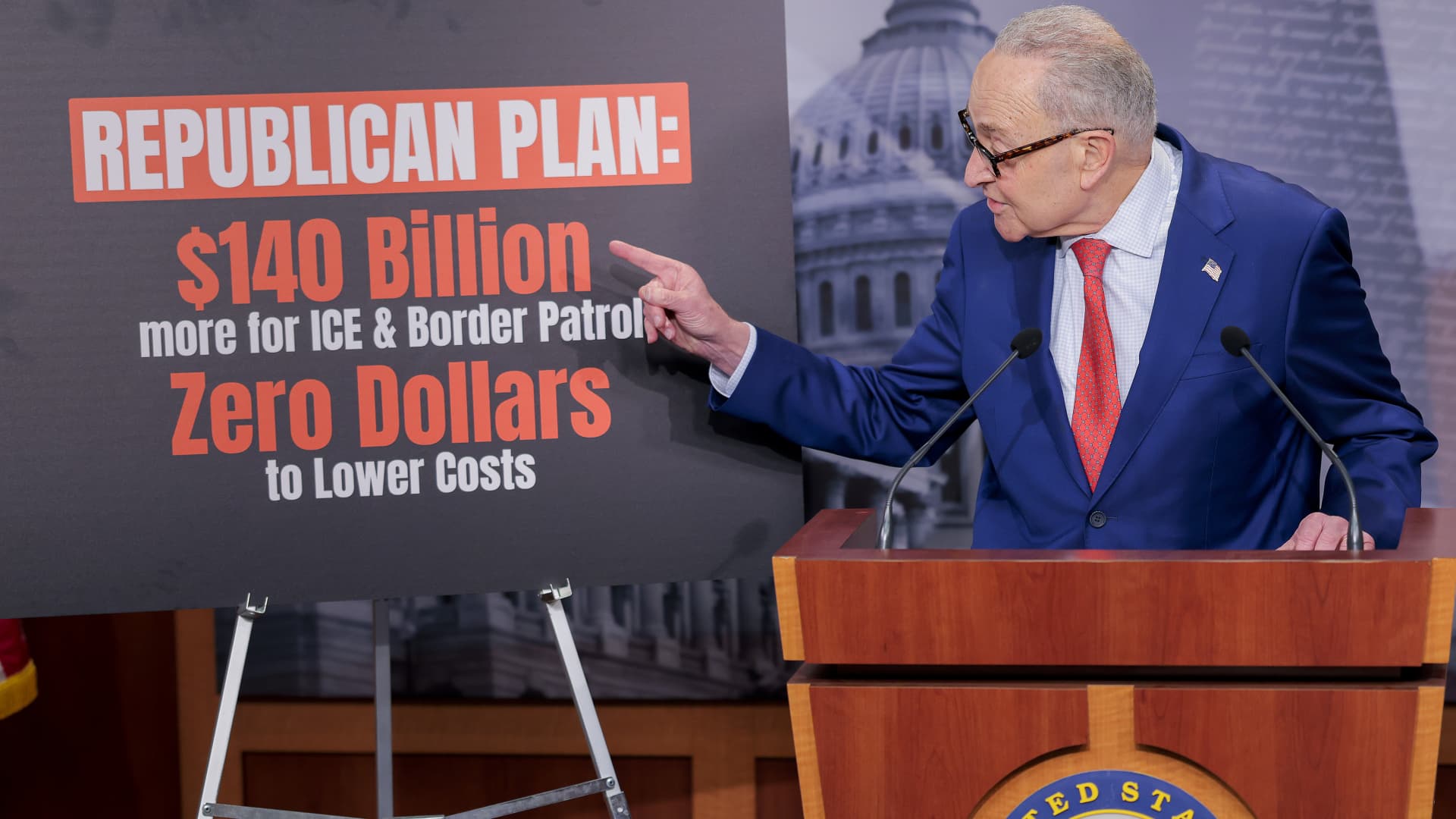
Senate Minority Leader Chuck Schumer (D-NY) speaks during a press conference at the U.S. Capitol on April 22, 2026 in Washington, DC.
Heather Diehl | Getty Images
The Senate will leave Washington this week without approving a package that would fund immigration enforcement agencies within the Department of Homeland Security, as tensions simmered over a recently announced $1.8 billion “anti-weaponization” fund that could provide payouts to allies of President Donald Trump.
Multiple Senate Republicans said Thursday they were going home, speaking after a meeting at the Capitol with Acting Attorney General Todd Blanche, who was dispatched on Thursday to meet with senators on the fund.
The Senate was originally planning to start considering the package on Thursday, potentially sending it to the House to take up before both chambers were slated to take a one-week recess.
The punt means Congress will miss the arbitrary June 1 deadline Trump had set for final passage of the package, which was intended to make up money for immigration enforcement that wasn’t included in an earlier Department of Homeland Security funding bill.
Democrats had been preparing to make the process of passing the funding package as painful as possible for their Republican colleagues.
Senate Minority Leader Chuck Schumer, D-N.Y., said Democrats would use a marathon voting procedure — known as a vote-a-rama — to force Republicans to weigh in on politically fraught topics, like Trump’s proposed White House ballroom and the anti-weaponization fund, which could be used to pay out people purportedly targeted by the Biden administration, potentially including Jan. 6 Capitol riot defendants.
“In the coming debate, the contrast between Democrats and Republicans will be on full display. All of America will see it,” Schumer said Thursday as a press conference on the Senate steps with Democrats from the House and Senate before negotiations broke down.
Republicans had hoped to kickstart the process on the Senate floor to pass the $72 billion budget package that would fund Immigration and Customs Enforcement and Customs and Border Security. Democrats have refused to fund both DHS subagencies in response to two civilian deaths at the hands of federal agents during an immigration crackdown in Minneapolis in January, setting off a monthslong partial government shutdown.
In April, Congress passed and Trump signed a law to fund the rest of the agency, effectively ending the partial shutdown, as Republicans sought to make up funding for ICE and CBP via the budget reconciliation process.
Under budget reconciliation, the Senate has only a 50-vote threshold for clearing legislation, but it’s only allowed to be used for spending-related measures.
But cracks emerged this week over a series of Trump priorities.
For one, intraparty divisions emerged this week among Republicans over whether to include taxpayer funds for security upgrades tied to his proposed White House ballroom. The Senate parliamentarian ruled last week that a $1 billion Secret Service provision for the project could not be included the the package, though Senate Republicans initially indicated they would restructure the language and try again.
Trump raged at the parliamentarian, a nonpartisan official who advises on Senate procedures, and demanded her firing in a post to TruthSocial. But by Wednesday, anger about the ballroom funding was growing amid the ranks, and Politico reported it would likely be cut from the reconciliation bill, in a blow to Trump.
According to a memo obtained by MS NOW, $220 million of the $1 billion Secret Service provision would have gone toward the East Wing ballroom project, while the rest would pay for other Secret Service security measures. Trump has said the ballroom will be paid for using private funds.
“The ballroom is paid for, it’s a gift,” he said during an announcement on Thursday from the Oval Office. “The money that they’re spending is for security, having to do maybe around the ballroom and other parts of the house, but this is not for the ballroom.”
The “anti-weaponization” fund, announced this week as part of Trump’s settlement with the Internal Revenue Service, also proved a flashpoint.
“People are concerned about paying their mortgage or rent, affording groceries and paying for gas, not about putting together a $1.8 billion fund for the President and his allies to pay whomever they wish with no legal precedent or accountability,” Sen. Bill Cassidy, R-La., who lost his bid for reelection in a Republican primary last weekend after Trump backed one of his opponents, posted to X on Wednesday.
“This is adding to our national debt. If there needs to be a settlement, the administration should bring it to Congress to decide,” Cassidy said.
While Democrats, who are in the minority in both chambers, will have little power to stop the package Republicans ultimately agree on, they said they would seize all opportunities to hammer their GOP colleagues on rising costs and the alleged corruption of the Trump administration whenever the package does come to the floor.
“Democrats are cracking down on corruption in government. Republicans are actively helping Trump steal from the American people to fund his ballroom and his multi-billion dollar MAGA slush fund,” Schumer said Thursday.
—Emily Wilkins contributed to this story.
<