UK PM Starmer fights for his political future in pivotal speech
Watch here
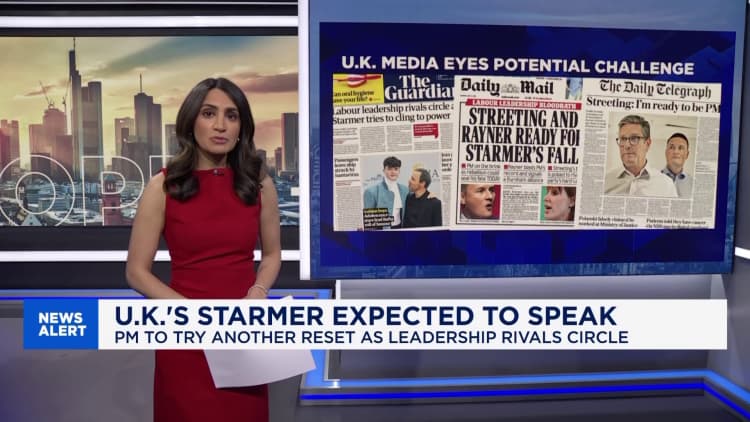
British Prime Minister Keir Starmer is expected to vow to “face up to the big challenges” facing the U.K. in a make-or-break speech on Monday, amid mounting pressure on his leadership.
Starmer is set to cite growth, national defense, the U.K.’s relationship with Europe and energy needs as key issues that must be tackled urgently, as he tries to convince Labour Party colleagues to keep him in the job.
“To meet the challenges that our country faces, incremental change won’t cut it,” he will say, according to excerpts of the speech pre-released by the government.
The speech comes after the ruling Labour Party suffered heavy local election losses last week. While the vote did not affect how the U.K. is governed nationally, it was seen as an important reflection of public sentiment towards the ruling party and its leader.
The results prompted immediate calls from lawmakers within the Labour Party for the prime minister to step down, with several believed to be weighing up potential leadership challenges.
Starmer insists he’ll lead the Labour Party into the next general election, due in 2029, but speculation over a change of prime minister has put increasing pressure on already-high government borrowing costs.
“You will see hope, urgency and exactly whose side we are on,” Starmer is expected to say Monday, adding that “people need hope. We will face up to the big challenges and we will make the big arguments.”
Starmer embraces Europe
Starmer is also expected to promote his government’s bid to deepen ties with the European Union.
He will say the right-wing Reform UK party, which saw sweeping gains in local council elections last Thursday, and the rival Conservative Party, are “defined by breaking our relationship with Europe.”
“This Labour Government will be defined by rebuilding our relationship and by putting Britain at the heart of Europe. So that we are stronger on the economy, on trade, on defense, you name it,” Starmer will say.

As of 8pm on Sunday, 42 Labour MPs were calling for Starmer’s resignation. Labour MP Catherine West, who has led calls for a leadership contest, told Sky News on Sunday that she will launch her own bid if Starmer’s pitch proves unconvincing.
Starmer’s former deputy, Angela Rayner, is another potential leadership candidate. She said on X on Sunday that “what we are doing isn’t working, and it needs to change. This may be the Labour Party’s last chance.”
Other potential challengers include Health Secretary Wes Streeting and Manchester Mayor Andy Burnham, though he would have to be elected as an MP in order to run for the leadership.
Former Deputy Prime Minister of the Labour party, Angela Rayner, delivers a speech during Labour’s North West Regional Conference at the Titanic Hotel on January 25, 2026 in Liverpool, England.
Ryan Jenkinson | Getty Images News | Getty Images
Gilts in focus
Financial markets will be watching leadership bids and U.K. borrowing costs closely in the wake of the speech.
As the scale of Labour’s local election defeats became apparent last Friday, yields on benchmark 10-year U.K. government bonds, known as gilts, stood lower at 4.904% after Starmer insisted that he would not step down from his post. On Monday morning, the yield stood at 4.954%, up 3 basis points, while the U.K.’s FTSE 100 index was trading 0.3% higher.
“Let’s see what happens today,” Kallum Pickering, chief economist at Peel Hunt, told CNBC Monday.
“Markets are very good at looking through noise but if you do get a leadership challenge, I wouldn’t be surprised if you see bond yields go up somewhat,” Pickering told CNBC’s “Europe Early Edition.”

The U.K. has the highest borrowing costs in the G7 group of industrialized nations, reflecting concerns over persistent inflationary pressures in the country and weak growth, Pickering noted. The economic fallout of the Iran war has exacerbated this issue.
“When it comes to the specific developments around near-term politics, the mere fact that bond yields declined in the U.K. on Friday but didn’t elsewhere, suggests that there is still a political component to it [too],” Pickering said.
“And so even if we were to get rid of the political noise. Yes, bond yields would be elevated versus the start of the year, but they would probably be lower than they, let’s say [by] 10-15 basis points.”
<