
Why Anthropic was No. 1 on this year’s list
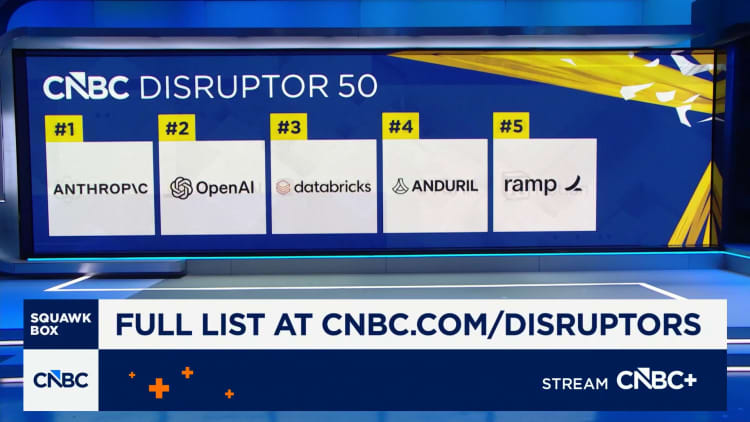

This year’s Disruptor 50 list, with Anthropic at No. 1, followed by OpenAI, features companies that are using technology — primarily AI — to challenge existing industries and build new ones.
With explosive growth — CEO Dario Amodei says revenue grew 80 times in the first quarter — Anthropic has had one of the fastest ramps in enterprise software history. In addition to its consumer-facing products, Claude Code has revolutionized software development and been embraced for its reliability and strong performance on complex tasks. The company is also in talks to raise even more capital at a sky-high valuation of as much as $900 billion.
What puts Anthropic at No. 1 is not just its growth, but its positioning: a focus on building powerful AI systems that enterprises trust. Its emphasis on safety and “constitutional AI,” combined with rapid gains in model capability, has helped it emerge as one of the clearest challengers to OpenAI, while attracting major partners and customers looking for reliable, enterprise-grade AI.
It was just about three years ago that Anthropic launched its first product, and “really out of the gate, we said, ‘We’re prioritizing building for businesses for a variety of reasons,'” co-founder Daniela Amodei recalled.
Within the past year, it’s the rate of acceleration that has changed, she says, not the focus. “Particularly over the past three to six months … I think what we’re seeing is the combination of the models getting smarter, the products getting better, and that really sort of generating a huge amount of value for businesses,” she said.
Mattias Balk | Picture Alliance | Getty Images
In a sign of how massive and powerful the tech ecosystem is, this year’s list has a total valuation of $2.4 trillion, nearly $2 trillion of that from the top five companies on the list — and most of that from the top two, Anthropic and OpenAI. The list’s implied valuation has grown by three times year over year. The amount of money that’s been invested has scaled dramatically, too, with total funding into this year’s 50 companies at $337 billion, two and a half times more than last year.
The fourteenth installment of the Disruptor 50 showcases the trends that are dominating the market and the increasing focus on AI across the economy. Forty-three of the 50 companies on this year’s list say AI is critical to their business model. Enterprise tech is the largest category, with 20 companies on the list. We’re also seeing AI applied to health, with five healthcare companies on the list and three biotechs. Fintech continues to be a key category, with six companies, including No. 5 Ramp, No. 16 Ripple, and No. 29 Revolut.
There are two new categories on this year’s list. Vibe coding is making its debut with three companies: No. 37 Cursor, No. 39 Lovable, and No. 42 Replit, startups that have helped to revolutionize the ease of programming both for consumers and the enterprise. And this year is the first time that prediction markets are being recognized — with Kalshi and Polymarket, ranked at No. 43 and No. 48 respectively — as they’ve created new trading markets and challenged traditional gaming platforms.
Defense tech boom continues
Last year, defense tech giant Anduril topped the list. This year, the value of technology to the defense industry continues to grow. At No. 4, Anduril is already a leading modern defense contractor, combining cutting-edge technology and hardware to create autonomous systems for the military. Meanwhile, No. 40 Saronic focuses on maritime defense and is partnering with the Navy to provide AI-powered naval ships and drone vessels. And No. 49 Shield AI is focused on the skies, building autonomous aircraft and drones.
But the ties to the defense industry extend more broadly across this year’s list. No. 9 Cyera and No. 46 Abnormal AI are focused on national security and cyber defense, and “physical AI” company Applied Intuition, at No. 21, is increasing its focus on the military sector. Record funding has poured into the space: VCs invested $51.2 billion in defense globally in 2025 vs. $39.9 billion in 2024 and $27.7 billion in 2023, according to PitchBook.
Military prowess is also top of mind for the well-known AI giants. Anthropic is in the midst of a battle with the government over whether the military should have unrestricted access to its tech, while rival OpenAI is moving aggressively into defense partnerships. Last year, the Department of Defense awarded OpenAI a contract worth up to $200 million to develop prototype frontier AI capabilities for both warfighting and enterprise domains. This is part of what the Defense Department describes as part of its strategy to build an “AI-first fighting force.”
For the companies, the Pentagon provides reliable revenue and validates the technology’s high-stakes utility. The fact that so many companies in Silicon Valley have embraced working with the military is a departure from the mood in the tech sector not long ago when Google employees protested the company’s work with the government on “Project Maven.” Anthropic is a rare and notable outlier. And the fact that its revenue is growing by 80 times, despite its battle with the government, speaks to the power of its technology.
Anthropic also expects the longer-term partnership to ultimately outweigh the current disagreement. “Our long-standing history of productive partnership with the government gives me a lot of hope that we have more in common than we don’t,” Daniela Amodei said. “My sense is there’s a lot of work that needs to be done between Anthropic and all of the labs and all of the major technology companies and the government. And I absolutely believe that there will be plenty of work to go around and a path forward there,” she added.
Bay Area riches rise
With the rise of AI comes a geographic shift on the Disruptor 50 list: a return to San Francisco and the Bay Area in numbers we haven’t seen since the pandemic dispersed entrepreneurs. This year there are a record 18 Bay Area companies, two more than last year, reflecting the flow of VC dollars. The Bay Area accounted for more than three-quarters of all U.S.-based AI funding last year and half of the ten largest venture deals were Bay Area companies, including OpenAI and Anthropic, and No. 3 Databricks and No. 31 Perplexity.
In the next year, the two private AI giants, as well as others, are on IPO watch. In the past year, two companies from our 2025 Disruptor 50 list went public — Navan and Figma — as did four companies from previous D50 lists. Now, Goldman Sachs says there’s a multi-year high IPO backlog. Investors are watching five D50 companies that could set IPO records: Anthropic, OpenAI, Databricks, Stripe and SpaceX. As investors focus on AI, profitability, and scale, one of these companies could mark the biggest public debut ever.
Disclosure: CNBC and Kalshi have a commercial relationship that includes customer acquisition and a CNBC minority investment.
Sign up for our weekly, original newsletter that goes beyond the annual Disruptor 50 list, offering a closer look at list-making companies and their innovative founders.
<