Will China help Trump bring the Iran war to an end?
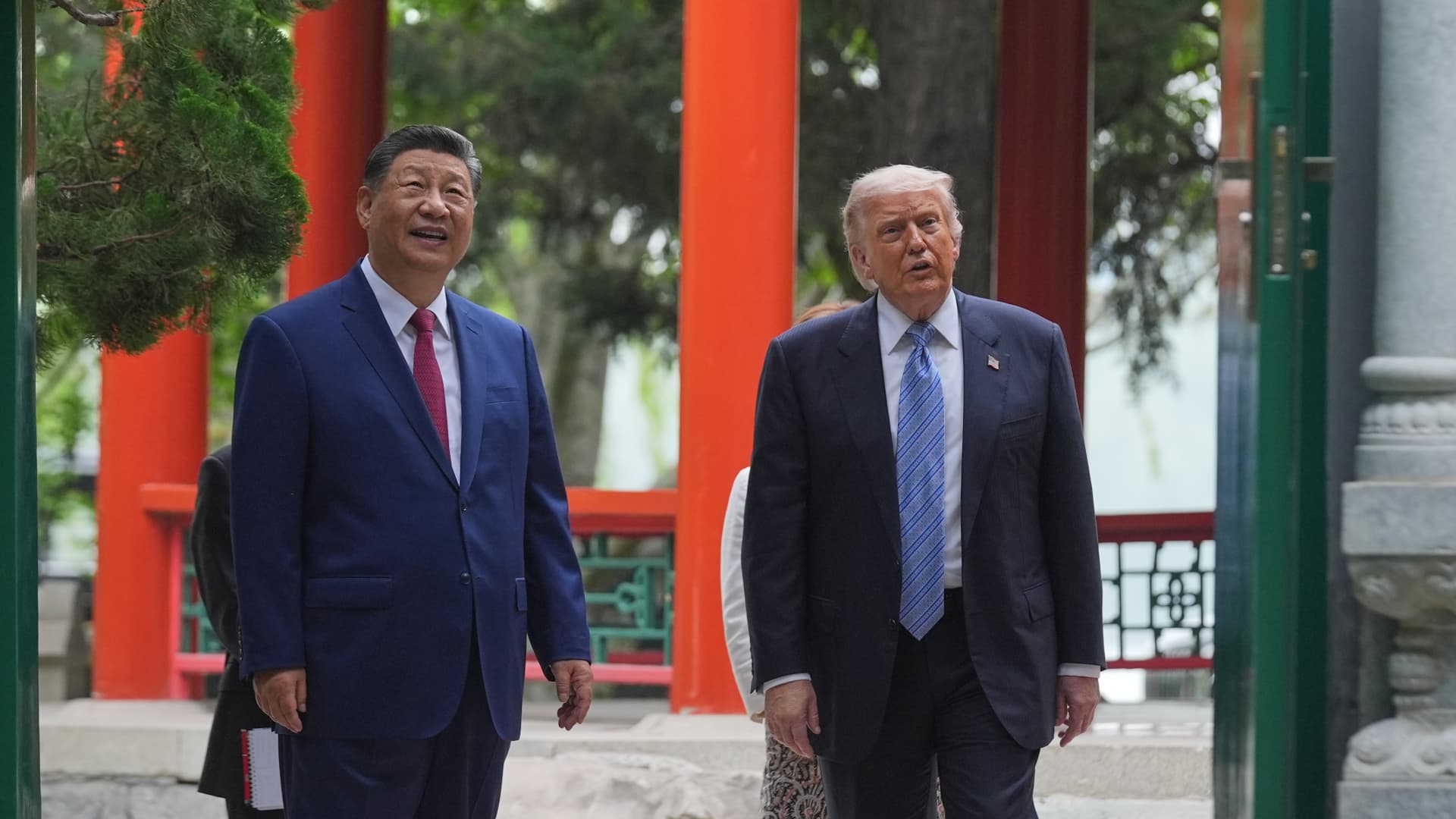
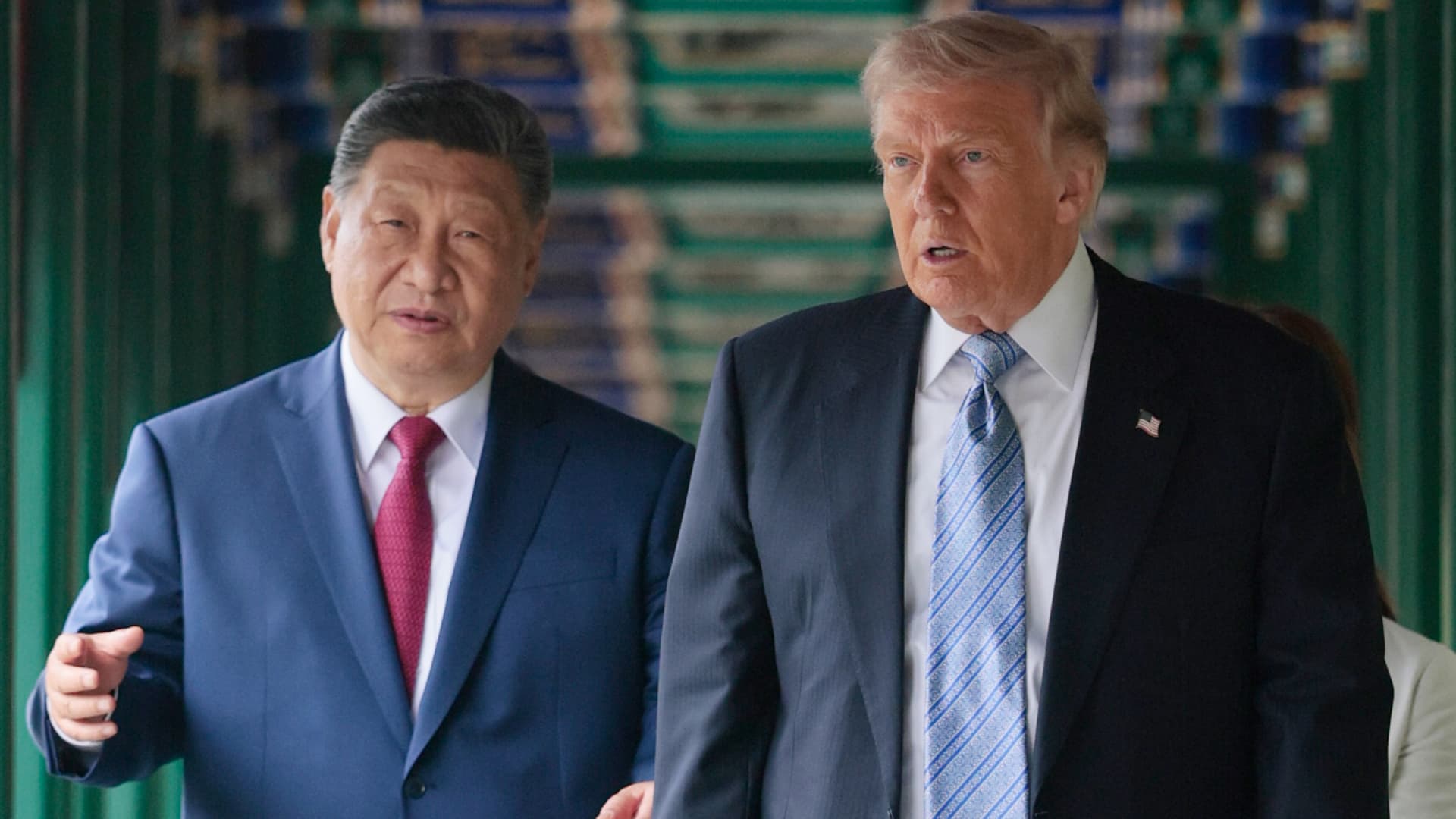
BEIJING, CHINA – MAY 15: U.S. President Donald Trump and Chinese President Xi Jinping tour the Zhongnanhai leadership compound on May 15, 2026 in Beijing, China.
Mark Schiefelbein-Pool | Getty Images News | Getty Images
China is eager to “help” peace negotiations between Washington and Tehran, U.S. President Donald Trump said Thursday, as he concluded a two-day presidential summit in Beijing.
In an interview with Fox News on Thursday, Trump said his Chinese counterpart Xi Jinping had ruled out sending military assistance to U.S. forces in Iran, but that he had offered diplomatic help.
“He’d like to see Hormuz Strait opened,” Trump said, adding that Xi said China was ready to assist efforts to bring the war to an end.
“He said, ‘if I can be of any help at all, I would like to be of help’,” Trump said.
Speaking to reporters on board Air Force One on Friday, Trump said he and Xi “agree almost entirely” on the situation in Iran.
Asked if he believed China would put pressure on Iran to reopen the Strait of Hormuz, Trump said he was “not asking for any favors.”
“When you ask for favors, you have to do favors in return. We don’t need favors,” he said.
But he added: “I think he will,” in a reference to Xi.
“I think he’d like to see it opened up,” Trump said. “He gets about 40% of his energy or his oil [from] the Strait. We get none. We don’t need it.”
On Thursday, U.S. Treasury Secretary Scott Bessent told CNBC that China will work behind the scenes to help reopen the Strait of Hormuz.
CNBC has reached out to the Chinese government for comment.
The Iran war, now well into its third month, has caused gas prices to spike in the U.S. and oil to soar globally as Iran continues to lock down the Strait of Hormuz, a critical shipping route for oil and other commodities.
Washington suspended attacks on Iran last month, but Trump has said the ceasefire is “on life support” as the two sides struggle to agree the terms of a peace deal.
Trump told Fox News on Thursday that China had agreed to purchase American oil, adding that Xi would like to see the Strait of Hormuz free of tolls.
China is Iran’s largest trading partner and the primary buyer of its oil, according to the U.S. government. Chinese purchases account for around 90% of Iranian oil exports and provide tens of billions of dollars in annual revenue to Tehran.
Beijing has largely stood on the sidelines of the U.S.-Iran war, but has criticized the conflict and called for it to come to an end.
A spokesperson for the Chinese foreign ministry reiterated that stance on Friday, saying that Beijing “believes that dialogue and negotiation is the right way forward, and the use of force is a dead end.”
“There is no point in continuing this conflict, which should not have happened in the first place,” they said. “To find an early way to resolve the situation is in the interest of not only the U.S. and Iran, but also regional countries and the rest of the world.”
In this picture obtained from Iran’s ISNA news agency and taken on May 2, 2026, the Gambia-flagged tanker vessel Bili is pictured anchored in the Strait of Hormuz off Bandar Abbas in southern Iran. (Photo by Amirhossein KHORGOOEI / ISNA / AFP via Getty Images) /
Amirhossein Khorgooei | Afp | Getty Images
Will China help Trump on Iran?
Analysts told CNBC that there are likely to be limitations on how much influence China will be willing or able to exert to help bring the U.S.-Iran war to an end.
Yue Su, principal economist for China at the Economist Intelligence Unit, said that while bilateral talks between Trump and Xi “highlighted that they do have common ground” when it comes to Iran, there are limits to what China can realistically do.
“The Iranian regime is operating in survival mode and will prioritize its own interests and agenda above all else,” she said.
Damien Ma, director of research center Carnegie China, told CNBC that Beijing doesn’t have a strong interest in supporting Iran.
“Over the last decade, it’s been clear that China has been diversifying its relationships in the Middle East — whether that’s Saudi Arabia or the UAE. It was really a relationship of convenience,” he said.
While there can be some consensus and agreement reached between the U.S and China on what to do about Iran, Ma said China will be less motivated than other economies by fears of an energy shock.
“China is one of the better-positioned countries in terms of withstanding the shock to oil markets — it’s got tons of renewables, it’s got tons of domestic coal,” he said. “Compared to many other countries, China is pretty well placed.”
Meanwhile, Eurasia Group China analysts questioned how far China would be willing to go when it comes to U.S.-Iran diplomacy.
“Limited coordination on Iran remains base case, with more likely to come on Taiwan,” they said. “The U.S. readout suggests that Beijing has taken a more explicit stance on Iran, making clear its opposition to Hormuz tolls, and may increase purchases of U.S. energy as a means of addressing Washington’s concerns. [But] this is likely the limit of U.S.-China coordination on Iran.”
Analysts at Raymond James said in a note earlier this week that China was unlikely to voluntarily insert itself into the situation.
“Trump may seek to use China’s leverage to move the needle in stalled talks with Iran, but we are skeptical that China will want to use its influence in a muscular fashion in this context,” they said.
“Beijing needs to balance its relationships with Iran, other Arab Gulf partners, and the U.S.; as such, we will likely continue to see China issue further calls for peace without taking a more proactive role.”
They added that one area where China could take a more prominent role is as a potential recipient of Iranian highly-enriched uranium, should proposals to transport remaining stockpiles out of Iran bear fruit.
Kirk Yang, a professor at National Taiwan University’s school of political science and economics, said that Trump needs Beijing’s help to secure an end to the war.
“Trump needs the help from China to end the war with Iran and increase global oil supply, to reduce oil price and inflation in the U.S., as he has a mid-term election in about 6 months,” he said. “Trump would also like more trades with China, and [will] perhaps lower tariffs for China. However, it is very clear Trump will continue to block China from access to high-end AI chips and technology, which has great implications to U.S. national security.”
<