Johnson & Johnson Q1 profit beats estimates
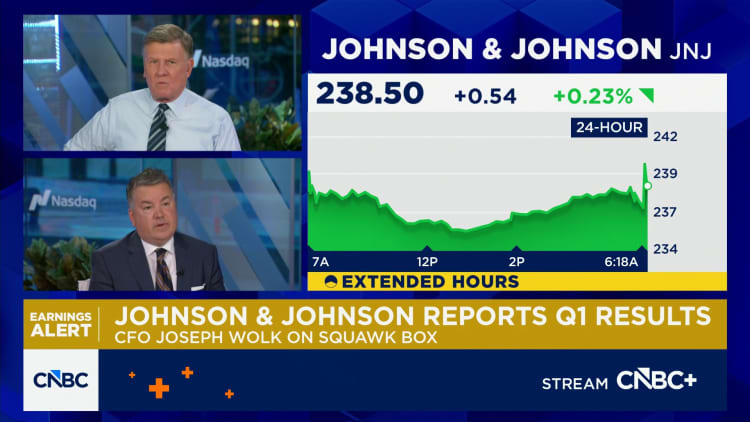

Johnson & Johnson reported first-quarter earnings that beat Wall Street expectations on Tuesday and raised its full-year forecast, as strong demand for cancer drug Darzalex and psoriasis treatment Tremfya more than offset a steep falloff in sales of its blockbuster autoimmune drug Stelara.
The drug and device maker reported first-quarter revenue of $24.1 billion, up nearly 10% from a year earlier. That exceeded analysts’ estimates of $23.6 billion, according to LSEG data. Adjusted earnings came in at $2.70 per share, above the consensus estimate of $2.66.
Stelara, which topped $10 billion in annual sales at its peak, is facing biosimilar competition after losing patent protection last year. Sales of the drug fell around 60% from a year ago to $656 million.
Shares of the company, which have risen 15% so far this year, were marginally up in volatile premarket trading.
Chief Financial Officer Joseph Wolk said in an interview that instead of switching to biosimilars, many patients have chosen other treatments such as Tremfya.
“We are seeing increased share in Tremfya and we anticipate we’ll see something similar in the new oral offering,” Wolk said, referring to its new drug Icotyde, which was approved in March.
The company said it expects the impact from newly launched products to become more pronounced as the year progresses.
Tremfya, which treats psoriasis as well as inflammatory bowel diseases, brought in $1.6 billion for the quarter. Analysts were expecting sales of $1.2 billion for the drug.
Sales of Darzalex, a blood cancer therapy launched in 2015, were $4 billion for the quarter, easily beating analysts’ expectations of $3.4 billion.
Quarterly sales for the medical technology business rose 7.7% to $8.6 billion, in line with analysts’ expectations.
J&J expects further rounds of China’s volume-based procurement (VBP) this year, with greater impact in the second half. China rolled out the bulk-buy program in 2018 to negotiate lower prices with drug manufacturers and has since expanded it across many parts of the country.
The company raised its full-year 2026 revenue forecast range with a new midpoint of about $100.8 billion, just above Wall Street’s estimate of $100.6 billion. It also lifted its adjusted earnings outlook to $11.55 per share at the midpoint, about in line with current expectations.
J&J is among the group of top global drugmakers that have agreed to so-called most-favored-nation drug pricing deals with the Trump administration. The companies have said they will lower their U.S. drug prices to match those charged in other developed countries in exchange for tariff relief.
The company expects the impact of the agreement with the U.S. government to be evenly distributed throughout the year.
President Donald Trump has asked Congress to codify the most-favored-nation deals through legislation, but Wolk said J&J believes that would be bad policy.
“We’re not a fan of codifying” MFN, he said. “It’s really kind of a back door to price controls and we’ve seen what happens in countries with price controls — patients have less access to the most important medicines and innovation goes down.”
<